Québec fall 2025 foliage tracker: when colours peaked, region by region
Tracking the colour turn across Québec’s regions
Québec’s fall foliage is one of the most spectacular natural events in North America, and unlike whale migrations or northern lights, it is entirely predictable within a window — the question is only which week in which region, not whether it will happen. This piece is a post-season recap of how the 2025 foliage unfolded across the province’s main viewing regions.
I tracked reports, drove two of the routes myself (Laurentides and Charlevoix), and compiled information from Sépaq (Société des établissements de plein air du Québec) condition reports and the provincial parks network’s foliage monitoring system.
| Region | 2025 peak dates |
|---|---|
| Laurentides | Sept 21–29 |
| Gaspésie | Sept 25 – Oct 5 |
| Charlevoix | Oct 3–12 |
| Eastern Townships | Oct 8–20 |
Why Québec foliage is worth the trip
The specific combination of sugar maple, red maple, yellow birch, trembling aspen, and beech across Québec’s deciduous forests creates a colour palette that is broader and more saturated than most European or even northeastern US forest equivalents. The red of the sugar maple against a blue October sky, reflected in a lake, on a hillside in Charlevoix or the Laurentides, is the kind of image that travel photographers return to repeatedly — not because it is rare but because it is genuinely extraordinary.
Peak colour in Québec moves from north to south and from elevation to valley floor over roughly four to five weeks in September and October. The Gaspésie and northern Laurentides go first; the Eastern Townships go last. Knowing this allows you to plan by region rather than hoping to catch everything at once.
The Laurentides: peak September 21-29, 2025
The Laurentides region, north of Montréal and centred around Mont-Tremblant and the national park, saw its 2025 peak between roughly September 21 and 29. This was approximately five days earlier than the historical average, consistent with a trend of slightly earlier peaks that researchers have been tracking over the past decade.
The drive north on Route 117 from Saint-Jérôme toward Mont-Tremblant reached peak colour in the last week of September. From Montréal, this is a 90-minute drive on a dry weekday morning, and the highway itself passes through sufficient forested hillside to give you the general colour experience without leaving the car. For deeper immersion, the roads around Lac Ouimet and into the national park at Lac Monroe are significantly more spectacular.
The Montmorency County roads between Boischatel and Château-Richer — a less-visited strip of the Côte-de-Beaupré — also peaked in the third week of September and produced some of the most photogenic conditions of the season in the Québec City region.
Laurentian Mountains fall leaves day trip from Montréal
Charlevoix: peak October 3-12, 2025
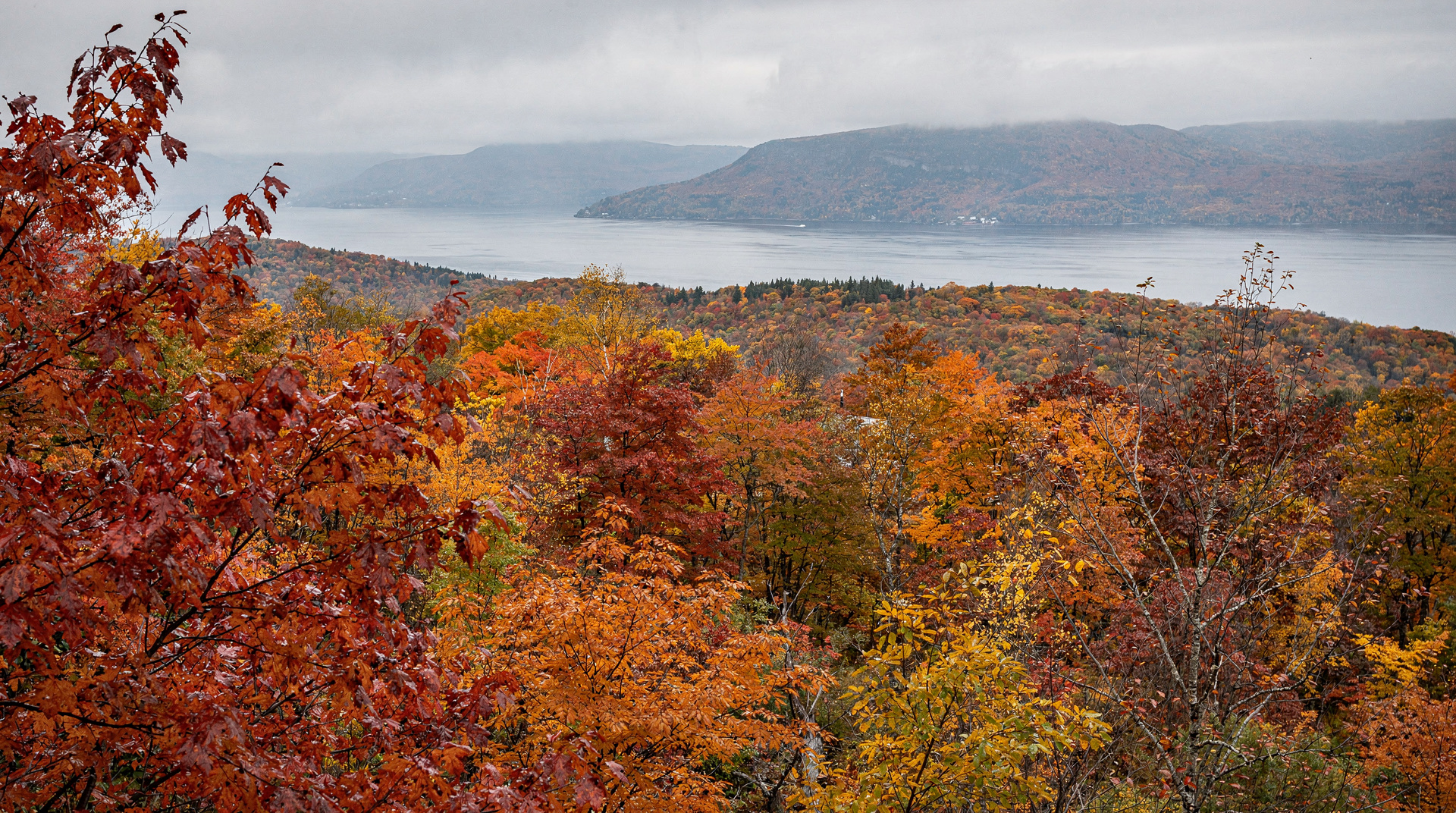
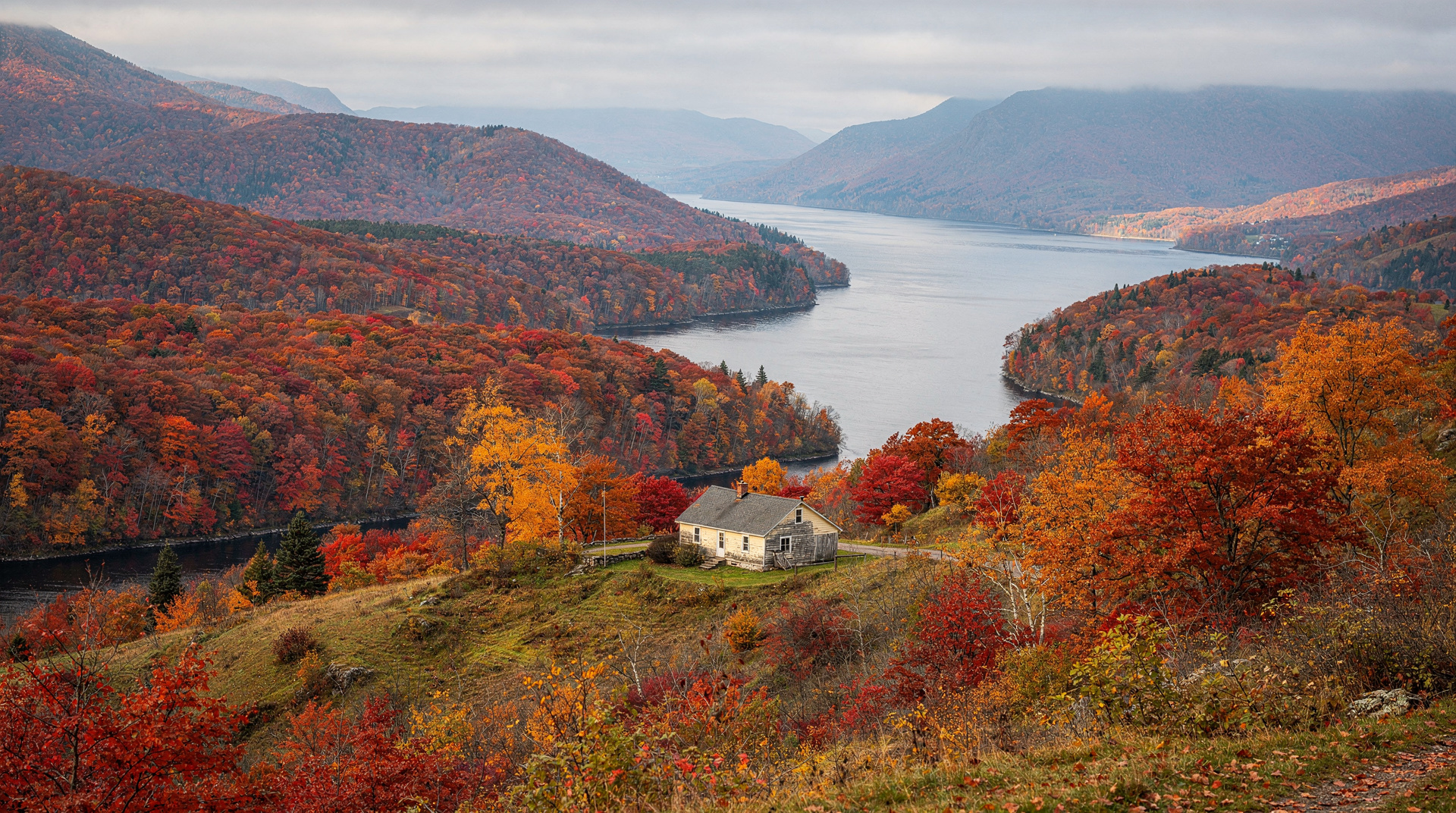
Charlevoix, the region northeast of Québec City along the Saint-Laurent, consistently produces what I consider the most beautiful fall foliage scenery in the province. The combination of steep hillsides dropping to the river, the particular mix of deciduous and conifer species, and the dramatic light from the Saint-Laurent creates conditions that are different from the plateau forests of the Laurentides.
The 2025 peak in Charlevoix fell between October 3 and 12, which is essentially textbook timing for this region. The drive on Route 138 from Baie-Saint-Paul northward toward La Malbaie was at its most spectacular in the second week of October. The Hautes-Gorges-de-la-Rivière-Malbaie, a provincial park in the interior of Charlevoix, reached peak colour around October 8 — the gorge walls in full autumn colour, reflected in the river below, constitute one of the best single landscapes in Québec at any time of year.
The practical consideration for Charlevoix: the road along the river (Route 138) is beautiful but slow, and accommodations in Baie-Saint-Paul and La Malbaie fill up weeks in advance for peak foliage weekends. Plan well ahead. A Thursday to Sunday visit at the predicted peak gives you the full experience with slightly less competition for restaurant tables than a full weekend visit.
Eastern Townships (Cantons-de-l’Est): peak October 8-20, 2025
The Eastern Townships, southeast of Montréal near the Vermont border, peaks last among the major foliage regions. The 2025 peak stretched over about 12 days, with the hills around Sutton and Orford most intense between October 10 and 18.
The Cantons-de-l’Est foliage is lower-elevation than the Laurentides or Charlevoix, which means the colours are distributed across a more agricultural landscape — vineyards, apple orchards, dairy farms, and forested hillsides interleaved. The visual effect is less dramatic on a single overlook but more sustained over a full day of driving the wine route and country roads.
Mont-Orford, the ski hill that anchors this region, has excellent high-elevation views during foliage peak. The gondola at Orford is open through mid-October, and from the summit the colour spread across the Eastern Townships to the Vermont Green Mountains in the distance is genuinely impressive.
Gaspésie: peak September 25 — October 5, 2025
The Gaspésie peninsula is where the most dramatic foliage meets the most dramatic geography — the Chic-Chocs mountains, the coastal cliffs of Forillon, the Bonaventure coastline. The region’s foliage peaked in 2025 between September 25 and October 5, which is slightly earlier than the Charlevoix peak but broadly consistent with its northern and high-elevation character.
Parc national de la Gaspésie, centred on the Chic-Chocs, reached peak around October 1. The high-elevation treeline creates a mix of colour and exposed rock and lichen that is unlike anything elsewhere in Québec. The drive on Route 299 from Sainte-Anne-des-Monts into the park during peak foliage is one of the most spectacular single drives in eastern Canada.
The logistical challenge: Gaspésie is far. From Montréal, the drive to Percé (the geographic and tourist centrepiece of the peninsula) takes 10 to 12 hours without stops. From Québec City, it is still 7 to 8 hours. Foliage tourism in Gaspésie is a serious commitment — a minimum of four to five days makes sense to justify the travel time.
What the 2025 season taught us
A few observations from the 2025 season:
The window is shrinking. Multiple photographers and park rangers I spoke with noted that peak colour in the Laurentides and Charlevoix seems to arrive slightly earlier each decade, and the window of peak intensity (the period where colour is maximally vivid before the leaves begin to fall) was about six days in the Laurentides in 2025, compared to estimates of eight to ten days in the 1990s. More reason to be specific about timing rather than general.
Weekend congestion is real. The most popular viewpoints in Charlevoix (the lookouts on Route 138 above Baie-Saint-Paul) and the Laurentides (the gondola at Mont-Tremblant, the overlooks in the national park) saw significant weekend congestion in 2025. Arriving at any viewpoint before 09:00 or after 16:00 dramatically reduces the experience of sharing the landscape with 500 other people.
Weather matters more than people think. The colour happens regardless of weather, but the photography and the visual experience are heavily dependent on light. A clear, cool morning with strong directional light turns a good foliage scene into an extraordinary one. An overcast drizzly day in peak colour is still worthwhile, but manage your expectations.
Applying this to a 2026 trip
The regional order rarely changes much year to year even when exact dates shift by a few days: Laurentides and Gaspésie go first, Charlevoix follows about ten days later, and the Eastern Townships close out the season. Use the 2025 dates above as a planning anchor and adjust by a few days depending on how warm the preceding September has been — a cold August accelerates the whole calendar, a mild one delays it. The best time to visit guide tracks the broader seasonal picture if foliage is one part of a longer trip rather than the whole focus.
For the complete planning guide to Québec fall — including the month-by-month overview, regional timing, trail recommendations, and where to stay — see the Québec in October guide.