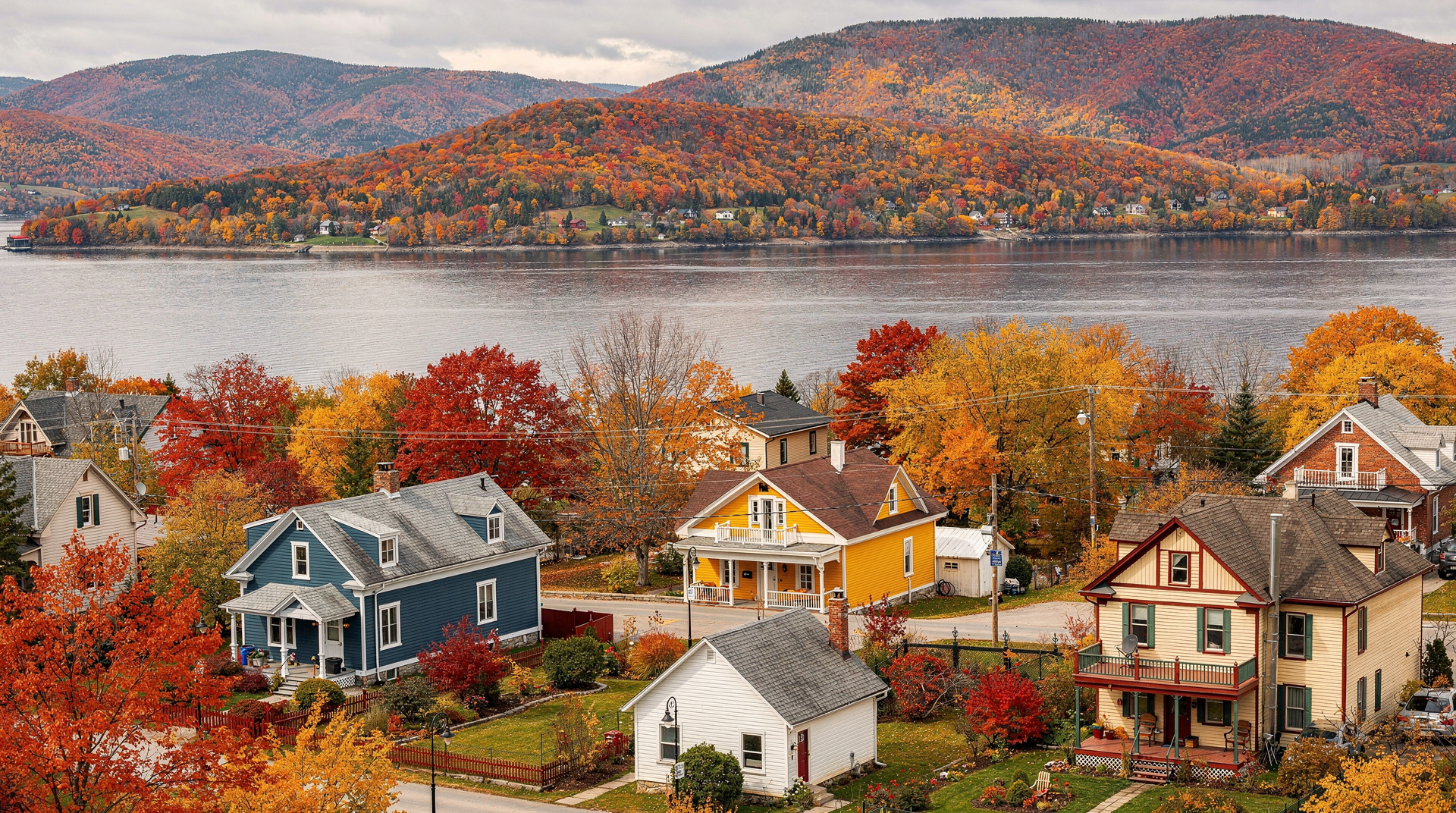
Tadoussac
Tadoussac: whale-watching capital of eastern Canada. Blue whales, humpbacks, and belugas where the Saguenay meets the Saint-Laurent — best July–August.
3-Hour Whale Watching Boat Tour
Duration: 3 hours
Quick facts
- Distance from Québec City
- ~200 km via Route 138 and ferry, ~2h30–3h
- Whale watching season
- Mid-May to mid-October (peak July–August)
- Species present
- Blue whale, fin whale, humpback, minke, beluga
- Ferry
- Baie-Sainte-Catherine ↔ Tadoussac, free, ~10 min, year-round
- Currency
- CAD (taxes ~15%)
Before the detail below, the logistics in brief:
| Where | Côte-Nord, at the mouth of the Saguenay Fjord |
| Distance | around 200 km / 2h30–3h from Québec City via Route 138 + ferry |
| Cost | around 75–120 CAD/person for a boat or zodiac tour |
| Time needed | half a day for one tour; 1–2 days to also see the village and fjord |
| Best time | July–August for peak diversity; late June and September for fewer crowds |
Where the Saguenay meets the Saint-Laurent
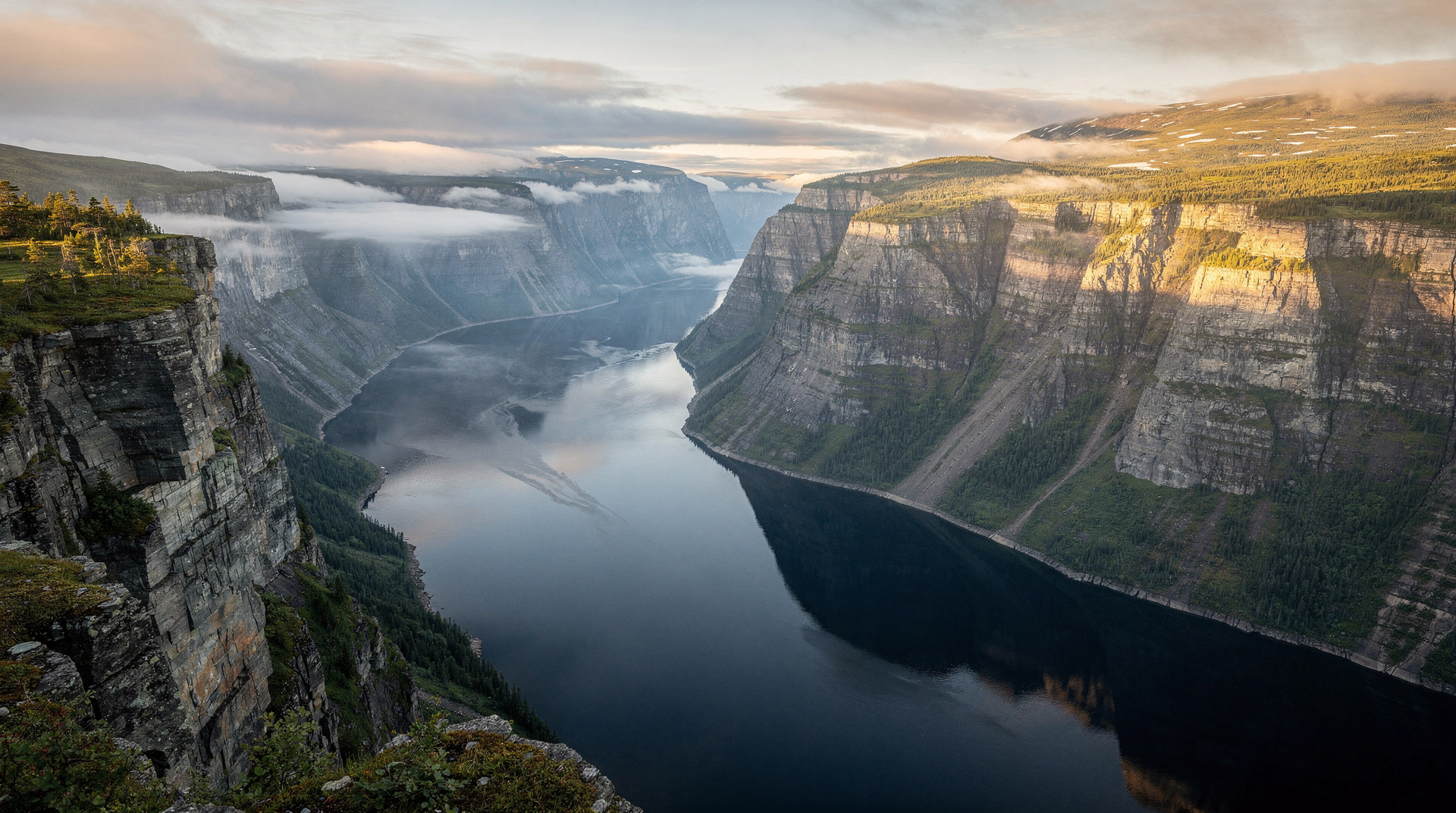
Tadoussac is a small village of 800 permanent residents at the confluence of the Saguenay Fjord and the Saint-Laurent. It is also one of the most significant marine mammal observation sites in the world. The specific oceanography of this location — deep cold water from the fjord meeting the tidal surge of the Saint-Laurent, creating upwellings that bring nutrients and small crustaceans to the surface — attracts some of the largest animal concentrations accessible from shore on the east coast of North America. Blue whales, the largest animals on earth, feed here in summer within view of the shore.
This is not hyperbole crafted for a travel guide. Tadoussac genuinely delivers an encounter with large cetaceans at a frequency and proximity that surprises even experienced wildlife watchers. On a typical summer boat tour, you will see at minimum fin whales and minke whales. In a good year — which July and August usually are — you have a strong probability of blue whales, humpback whales, and a view of the beluga pod that permanently inhabits the Saguenay estuary.
Getting here from Québec City takes 2h30 to 3h: Route 138 north along the north shore of the Saint-Laurent to Baie-Sainte-Catherine, then the free ferry across the mouth of the Saguenay to Tadoussac. The ferry runs year-round, takes about 10 minutes, and is managed by the Ministry of Transport — no booking required, you simply queue.
What to expect on a whale-watching tour
Tours run 3 hours on average and depart from the Tadoussac marina. The operators know where to find whales based on that day’s conditions — they are in contact with each other and with the marine mammal research station at Tadoussac — and the guides provide commentary on species identification and behaviour. What follows is an honest breakdown of what to prepare for.
Species you will likely see (July–August):
- Fin whale (second largest animal on earth, 18–24 m): common, often feeding in groups, recognizable by the asymmetric white coloration on the lower right jaw
- Minke whale (smallest baleen whale at 7–10 m): the most frequently sighted, fast-moving, often surfaces in multiple places
- Blue whale (up to 27 m): present June–September, not guaranteed on every trip but sighted regularly at peak season; the blow alone is visible from hundreds of metres
- Humpback whale (13–15 m): acrobatic, known for breaching and tail-slapping, present June–October; the most dramatic for photography
- Beluga (4–5 m, white): the Saint-Laurent beluga population (about 900 animals) uses the Saguenay as a calving area; year-round presence but sightings vary with tidal movement
Species you might see:
- Atlantic white-sided dolphin: more common in autumn
- Harbour seal and grey seal: present near the shore year-round
- Harbour porpoise: small, shy, often seen near the Saguenay mouth
What to prepare for: The Saint-Laurent is a cold, often choppy river-sea. Even in August, water temperature is 8–12°C and the air on the water can be 10°C cooler than on shore. Bring more layers than you think you need — the 3-hour tours catch a lot of people underdressed. Seasickness is a real factor for susceptible individuals; take medication before boarding rather than on the water. Binoculars are worthwhile for blue whale sightings (the animals surface 200–500 m from the boat more often than alongside it).
Boat tour vs zodiac: which to choose
The fundamental choice in Tadoussac whale watching is between a large boat and an inflatable zodiac. Both have real advantages and honest drawbacks.
Large boat (enclosed vessel, 100–200 passengers):
- More stable in choppy water: better for seasick-prone visitors and families with young children
- Upper deck viewing provides elevation and better overview perspective
- Heated interior and bathrooms available
- Slightly more distance from whales (larger boat = larger exclusion zone per regulation)
- Cost: around 75–80 CAD per adult 3-Hour whale watching boat tour (around 80 CAD) — the standard enclosed boat experience with the full 3-hour program.
VIP upper deck whale watching (around 120 CAD) — premium seating on the open upper deck with better sightlines and a smaller group section.
Zodiac (semi-rigid inflatable, 10–14 passengers):
- Faster, more nimble: can reposition quickly as whales surface
- Lower to the water: more intimate, occasionally closer encounters
- Much more physically demanding: significant wave impact in choppy conditions; not suitable for young children, seniors with mobility issues, or those prone to seasickness
- No weather shelter
- Cost: around 75 CAD per adult Zodiac whale watching tour (around 75 CAD) — for those who want the nimble, low-to-water experience.
Morning and twilight tours
The dawn and dusk tours are favoured by photographers and by those who want smaller crowds. The light in the early morning and at twilight is better for photography, and the marine mammals are often more active feeding at these times.
Whales and fjord morning or twilight tour (around 85 CAD) — departs at dawn or just before sunset, often combines whale watching with a section of the Saguenay Fjord mouth.
Whale watching plus bear observation
For those with a full day, the combined whale and bear observation tour extends the day into the forested areas above Tadoussac where black bears are fed by a registered operator.
Whale watching and bear observation (around 150 CAD, 5–6 hours) — combines the standard boat tour with an afternoon drive to a managed bear feeding site. The bear viewing is at short range and almost guaranteed; the wildlife-purist objection to managed feeding sites is noted but the sighting is reliable.
Best operators and booking
Croisières AML: The largest operator, running multiple boat sizes including large enclosed vessels. Consistent reviews for guide quality and reliability. Good for first-timers and families.
Otis Excursions: Mid-sized operator with both zodiacs and small enclosed boats. Smaller group sizes.
Groupe Dufour: Runs several vessel types including zodiac-only departures. Long-established Tadoussac operator.
Mer & Monde: Focused on zodiac and sea kayak experience; smaller group, more expedition-oriented.
Booking through GYG gives you the flexibility of late cancellation compared to direct booking on peak-season days. That said, for the absolute peak weeks of late July and early August, book at least a week ahead regardless of platform — Tadoussac is small and the boats fill.
When to visit: month-by-month
| Month | Species density | Comment |
|---|---|---|
| May–early June | Low–medium | Whales arriving, cold water, fewer boats |
| Late June–July | High | Peak whale diversity; blue whales common |
| August | High | Highest visitor numbers; book well ahead |
| September | Medium–high | Fewer crowds; humpbacks often most active |
| October | Medium | Season ending; cold but spectacular on clear days |
Understanding cetacean behaviour on tour
First-time whale watchers often arrive with expectations shaped by documentaries — extended above-water interactions, breaching, the whale swimming alongside the boat. The reality of a 3-hour tour is more episodic: you spend time scanning the horizon for blows (the visible exhalation of water vapour that fin and blue whales produce at 5–8 m height), position near feeding aggregations, and observe animals at ranges from 30 m to several hundred metres. Blue whales, when feeding, surface in a relatively predictable pattern — usually 5–8 blows in sequence, then a deep dive indicated by a fluking of the tail that lasts 5–10 minutes before resurfacing nearby.
A few things that genuinely help: binoculars (7x35 or 8x42 for cetaceans, avoid zoom types on a moving boat), seasickness medication taken 1–2 hours before boarding, and clothing in genuine layers — a fleece, a wind shell, and hat and gloves even in August on the water. The Saint-Laurent creates its own wind patterns and the temperature on a boat in the current is reliably 10–15°C colder than on shore.
The minimum group exclusion distances regulated in the Saint-Laurent Marine Park are enforced by the operators: 200 m for blue whales, 100 m for other baleen whales, 400 m for belugas. These distances exist to protect the animals, not to disappoint tourists — at 100–200 m, a 25-metre fin whale is still an overwhelming physical presence.
The Saguenay–Saint-Laurent Marine Park
The marine park was established in 1998 and covers 1,245 km² of the Saint-Laurent estuary and the lower Saguenay. It is the first marine protected area in Canada to include both federal and provincial jurisdiction — Parks Canada and Sépaq co-manage it. The park regulation governs all vessel traffic and whale-watching activities within its boundaries.
The marine park visitor centre in Tadoussac (on the main road near the Hôtel Tadoussac) is worth an hour before your boat tour. The exhibits cover the oceanography of the meeting of the Saguenay and Saint-Laurent, the species present, and the history of the beluga population — which declined severely under commercial hunting pressure in the first half of the twentieth century and remains at risk today with around 900 individuals.
Tadoussac village: history and character
The village is one of the oldest European-contact sites in Canada — Jacques Cartier arrived in 1535, Pierre Chauvin established the first trading post in 1600, and the current Chapelle des Indiens (1747) is the oldest wooden church in Canada still on its original site. The scale of the village today — 800 year-round residents, a handful of streets, the red-roofed hotel, the ferry dock — belies the historical weight of the location.
The walking route connecting the historic chapel, the marine park visitor centre, the old Hudson’s Bay Company trading post site, and the hotel takes about 45 minutes and gives the village’s history a coherent narrative. The hotel terrace in the early morning — before the first tour boats depart — is one of the quieter and more atmospheric spots in the region.
Sea kayaking from Tadoussac
Sea kayaking from Tadoussac into the Saguenay Fjord mouth is a different encounter with the marine environment than any motorized tour provides. Several operators offer guided day paddles from the Tadoussac beach along the Saguenay shore. The encounters possible — beluga approaching a kayak out of curiosity, or the sound of whale blows in fog — are different in quality from what a large boat can offer.
A guided sea kayaking adventure from the local operators (around 60 CAD) is the short-form option. For multi-hour and overnight paddles into the fjord, book with Mer & Monde or Azimut directly — they run the more serious kayak expeditions and have the equipment for overnight camping on the fjord shores.
Honest caveat: beluga regulations prohibit approaching within 400 m. This is not negotiable and is actively enforced in the park. Kayakers who attempt to approach belugas face significant fines. The legitimate kayak experience is about being in the fjord, not chasing marine mammals.
Beyond whale watching
Church of the Holy Trinity (Chapelle des Indiens): The oldest wooden church in Canada still standing in its original location (1747). Small but historically significant.
Pointe-Noire interpretation centre: Parks Canada site at Baie-Sainte-Catherine, on the opposite shore of the Saguenay mouth. Excellent for shore-based beluga watching without a boat — belugas regularly come within 50 m of the observation platform. Free entry.
Dunes de Tadoussac: A set of unusual freshwater sand dunes 2 km from the village, accessible by a short walk. Distinctive and often overlooked.
Sea kayaking: Several operators offer sea kayak tours from Tadoussac into the Saguenay Fjord mouth — a quieter alternative to motorized tours for those who have paddling experience.
Where to stay
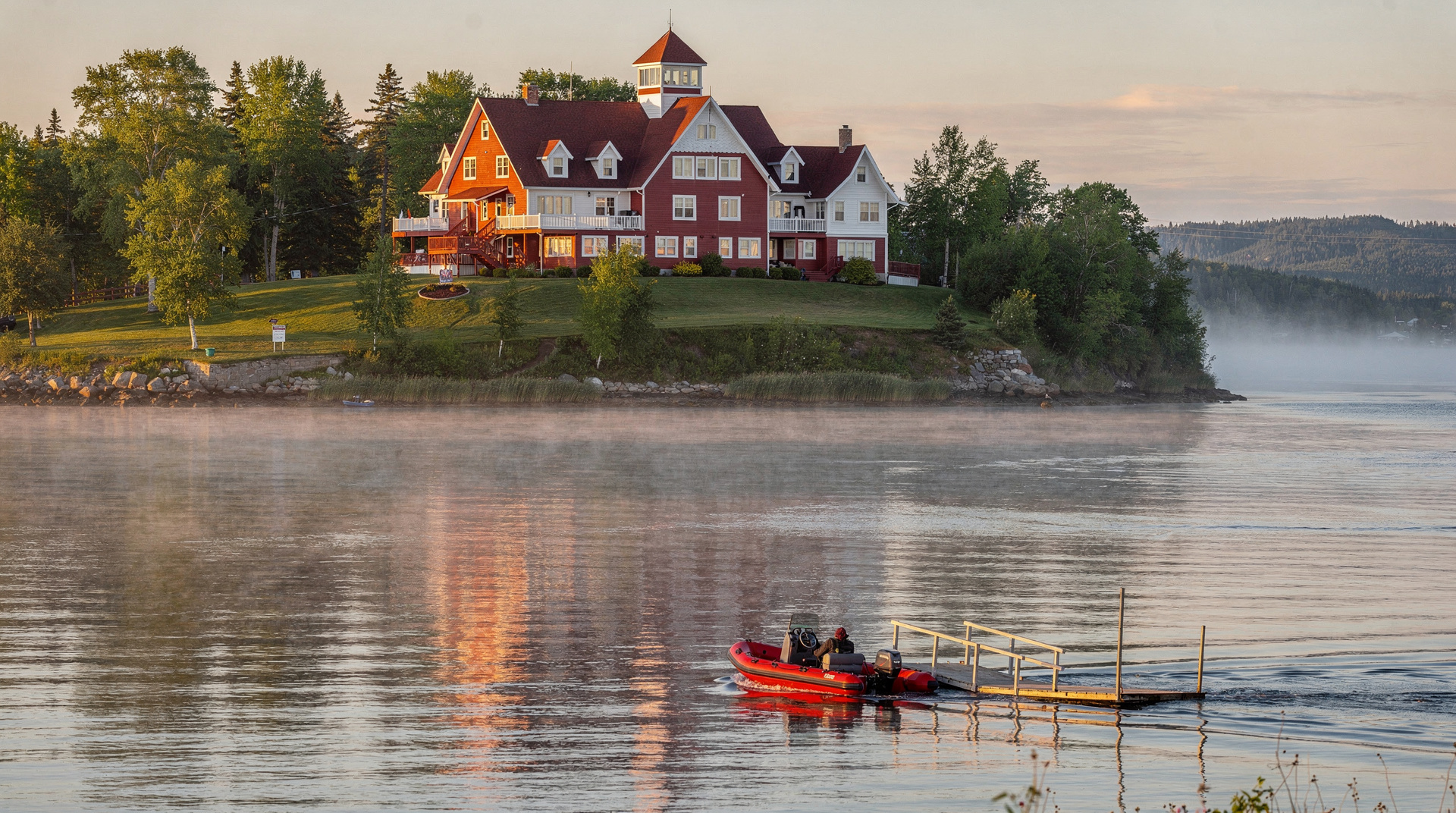
Hôtel Tadoussac (the red-roofed landmark visible from the ferry) is the heritage choice — a summer resort in continuous operation since 1864 (current building 1942), with rooms that range from modest to genuinely comfortable. Rates from 180 CAD in summer. Several smaller auberges and B&Bs in the village offer accommodation from 120–160 CAD; book months ahead for July–August.
Camping at the Saguenay–Saint-Laurent Marine Park adjacent area (Sépaq) is a good option; reserve through Sépaq well ahead of peak season.
Integrating Tadoussac into a Québec itinerary
Tadoussac sits at a geographic junction that makes it a natural pivot point for a broader Québec circuit. Most visitors approach from Québec City on Route 138; the drive takes 2h15–2h30 via the north shore, passing through Charlevoix.
From Québec City: The logical two-day extension is Québec City → Baie-Saint-Paul (1h30) for a night in Charlevoix, then Baie-Saint-Paul → Tadoussac (1h30) for whale watching, then return via the south shore ferry at Rivière-du-Loup (Route 20 back to Montréal). This covers the north shore of the Saint-Laurent in full.
From Montréal directly: Route 40 east to Québec City (~3h), then Route 138 east to Tadoussac (~2h30). Total drive ~5h30. Doable in a day but long; a midpoint night in Charlevoix is more comfortable.
Extension east to Saguenay: Tadoussac to Saguenay (Chicoutimi) via Route 138 east and Route 172 north takes about 1h30. This adds the Saguenay Fjord and Saguenay city to the itinerary, completing a full north shore circuit that covers the most wildlife-rich and geologically distinctive section of Québec.
Budget for a Tadoussac visit
Tadoussac is not a budget destination once accommodation is factored in. Honest benchmarks for one person per day in July–August:
- Accommodation: 120–200 CAD (B&B or auberge; Hôtel Tadoussac 180–250 CAD)
- Boat tour: 75–120 CAD per person
- Meals: 50–70 CAD (breakfast at hotel or bakery, lunch packed, dinner at a restaurant)
- Incidentals: 20–30 CAD
- Total: approximately 265–420 CAD/day per person
For budget travelers: camping at the Sépaq sites (25–40 CAD/night) with self-catering cuts the accommodation cost significantly. The whale-watching tours are the non-negotiable expense — there is no free or low-cost alternative that gives the same access to the blue whales.
Practical logistics
- Getting there: Route 138 north from Québec City to Baie-Sainte-Catherine (~2h15), then free ferry (10 min) to Tadoussac
- Parking: Limited in the village; arrive early or park near the ferry terminal and walk
- Fuel: Fill up before Baie-Sainte-Catherine; options in Tadoussac are limited
- Connection to Saguenay: The Saguenay Fjord begins at Tadoussac; boat tours enter the fjord mouth on combined itineraries
- Connection to Charlevoix: Baie-Saint-Paul is 100 km southwest on Route 138, ~1h30
Day trip from Québec City, or stay overnight?
Tadoussac is doable as a long day trip from Québec City — the drive plus ferry runs about 2h30 each way, leaving roughly 4–5 hours in Tadoussac once you subtract travel. That is enough for one boat tour and a walk through the village, but not much else, and it makes for a long day behind the wheel. Our Québec City to Tadoussac day trip guide breaks down the timing honestly, including which organized tours cover the transport for those without a car.
Staying one night changes the experience considerably: an early-morning or twilight tour becomes realistic, the village is worth an unhurried evening, and you are not racing the ferry queue at the end of a tiring day. If whale watching is the priority rather than a box to tick, the overnight version is worth the extra cost. The complete whale watching guide for Tadoussac covers trip planning in more depth, and the ferry practicalities from the Saint-Laurent side are worth reading before you commit to a route.
Tadoussac vs other whale-watching bases
Tadoussac is not the only place in Québec to see whales — Percé on the Gaspé Peninsula offers a different mix of species and a very different landscape, further from Québec City but worth considering for a longer trip. Closer to home, deciding between a zodiac and a larger boat matters more for comfort than for what you’ll actually see — both platforms access the same whales, regulated by the same exclusion distances.
Travellers who have done both routes generally report that the Tadoussac experience wins on species diversity (blue whales especially), while Percé wins on dramatic coastal scenery around the tour itself. Reading first-hand accounts — see the Tadoussac beluga encounter story and notes on the best month to go — is a useful sanity check against marketing copy from any single operator.
Frequently asked questions about Tadoussac
When is the best time for whale watching at Tadoussac?
July and August offer the highest diversity and density of whale species — blue whales, fin whales, humpbacks, minkes, and belugas are all present. Late June and September offer a nearly equal experience with fewer visitors and boat congestion. May and October are the shoulder months: whales are present but in lower numbers, and the cold adds to the physical demands of a zodiac tour.
What is the difference between going with Croisières AML vs a smaller operator?
AML operates larger enclosed vessels with 100+ passengers, consistent service quality, and the most tour departure times. Smaller operators (Otis, Dufour) run smaller boats with more personal guide interaction but less schedule flexibility. For families or first-timers, AML’s reliability and the enclosed boat comfort are the right choice. For experienced wildlife watchers who want a smaller group and are comfortable on the water, the smaller operators are preferable.
Is Tadoussac accessible without a car?
With significant difficulty. The free ferry from Baie-Sainte-Catherine is the only road access, and Baie-Sainte-Catherine is reached by Route 138 from Québec City — no regular bus service covers this final stretch. Some organized tours from Québec City include transport to Tadoussac (see the whale watching bus transfer option on GYG), making a car-free day visit possible. For an overnight stay, a car rental remains the practical choice.
Can I see whales from shore at Tadoussac?
Yes, particularly at Pointe-Noire interpretation centre at Baie-Sainte-Catherine (Parks Canada), where the shore observation platform provides excellent beluga sightings in July–August at no cost. From the Tadoussac beach itself, minkes and occasionally fin whales feed close to the Saguenay mouth and are visible with binoculars. Shore-based sightings are not guaranteed and cannot replace a boat tour for proximity, but they are a real and free complement to it.
How busy is Tadoussac in peak season?
Very. The village has 800 permanent residents and receives several hundred thousand visitors in the May–October window. In late July and August, the main street and marina area are crowded, parking is difficult, and restaurant wait times are significant. Book accommodation months ahead. Arrive before 9 AM for a morning tour to secure a good position on the boat. Mid-week visits in July are significantly more manageable than weekends.
Top experiences
Bookable activities with verified prices and instant confirmation on GetYourGuide.