
Quebec City
Plan your trip to Quebec City: UNESCO Old Town, food, winter Carnaval, day trips. Honest tips, verified prices, no fluff.
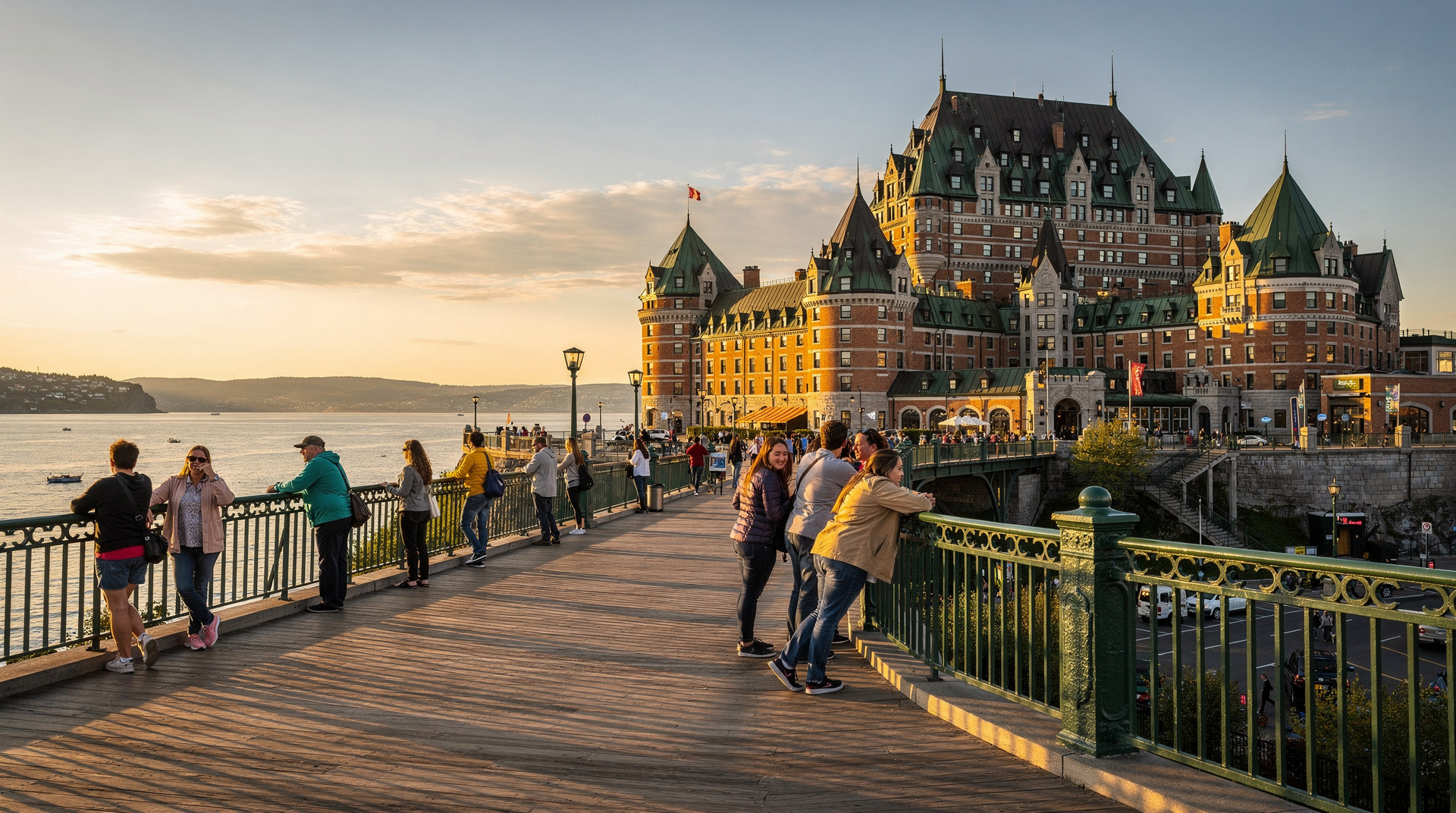
Old Quebec City: Grand Walking Tour
Duration: 2 hours
Quick facts
- Population
- ~550,000 (metro)
- Founded
- 1608 by Samuel de Champlain
- Language
- French (English widely spoken in tourist areas)
- UNESCO
- Old Town since 1985
- Airport
- YQB — Jean-Lesage, 15 km from Old Town
| Where | Capitale-Nationale region, at the funnel point of the Saint-Laurent River |
| Cost | Fortifications free; food tour ~80 CAD; helicopter from ~160 CAD; Hôtel de Glace overnight extra |
| Time needed | 3 days minimum; 4 if adding Île d’Orléans or Montmorency Falls without rushing |
| Getting there | Via Rail 3h from Montreal to Gare du Palais; YQB airport 15 km from Old Town |
| Best time | May–October for weather; late January–mid-February for Carnaval de Québec |
Why Quebec City stops you in your tracks
There are very few cities in North America where you feel genuinely transported. Quebec City is one of them. The stone walls of Old Quebec still stand as they did in the 18th century, the funicular still creaks between Lower Town and Upper Town, and the smell of fresh bread from a Petit-Champlain bakery drifts through streets that were laid out when New France was a going concern.
That said, this is not a museum piece. The Saint-Roch neighbourhood has a serious restaurant scene. Local breweries produce Quebec’s best craft beers. The Plains of Abraham, where the fate of North America was decided in 1759, is now where families jog on Sunday mornings. Quebec City holds its contradictions — historical gravity, lived-in neighbourhood energy, spectacular winter festivals — without effort.
Plan for three days minimum. Four is better if you want time for Île d’Orléans or Montmorency Falls without rushing. In January or February, budget at least four days if you’re timing your trip around the Carnaval de Québec.
Getting your bearings in Quebec City
Quebec City divides naturally into two distinct levels connected by the famous funicular and a series of staircases.
Upper Town (Haute-Ville) sits on Cap Diamant, 98 metres above the Saint-Laurent River. This is the fortified core — the Citadelle, the Château Frontenac, Terrasse Dufferin, the Plains of Abraham, and the main concentration of hotels and restaurants inside the walls. Navigating the narrow streets on foot is straightforward once you get your bearings around the Château Frontenac as a landmark.
Lower Town (Basse-Ville) includes Petit-Champlain, the oldest commercial district in North America, and the Place-Royale quarter where the city was founded. It’s quieter in the evenings and tends to be less crowded than the Upper Town circuit.
Outside the walls, Saint-Roch is the neighbourhood that locals actually eat, drink, and live in. A 20-minute walk or 10-minute bus ride from the Old Town, it has better value restaurants and a neighbourhood feel that is entirely absent inside the walls.
Limoilou, just east of Saint-Roch, is a working-class neighbourhood with a growing food scene and cheaper accommodation.
For most first-time visitors, staying inside or immediately adjacent to Old Quebec makes practical sense despite the premium pricing — the difference in convenience is real, especially in winter.
What to see and do
Walk the fortifications
Quebec City has the only remaining fortified city walls in North America north of Mexico, and they are free to walk. The 4.6-km circuit takes about 90 minutes at a comfortable pace. Start near the Citadelle, pass the Porte Saint-Jean and Porte Saint-Louis, and get clear views over the Saint-Laurent River and across to Lévis. Early morning is the best time — the cruise ship crowds have not arrived yet and the light is good.
Parks Canada manages interpretation at the fortification gates (free, seasonal). The experience requires no tour.
Old Quebec on foot — with a guide or without
Old Quebec is compact enough to navigate independently, but a guided walk adds the layer of historical storytelling that transforms a stroll into something memorable. The Crimes of New France tour is particularly well-regarded for its theatricality and accuracy about the more brutal realities of colonial life.
The two-hour Grand Walking Tour of Old Quebec covers the key sites — Place d’Armes, Terrasse Dufferin, the funicular, and the Petit-Champlain district — with commentary that contextualises rather than recites dates.
The Crimes of New France animated walking tour is a very different experience — theatrical, dark, and genuinely informative about colonial-era justice. Worth doing after dinner.
If you prefer to go independently, the best free walk is the loop from Place d’Armes down via the funicular to Petit-Champlain, along rue du Petit-Champlain, through Place-Royale, and back up via the Escalier Casse-Cou (Breakneck Stairs). Allow 90 minutes.
The Château Frontenac — insider note
Every visitor photographs the Château Frontenac, and the building is genuinely impressive. The 60-minute guided tour covers the grand history of the Fairmont property and gets you into rooms not otherwise accessible. At 19 CAD, it’s reasonable value.
What to skip: the Château’s high tea at 80–120 CAD is expensive for what amounts to mediocre finger sandwiches in a formal setting. Better alternatives within 10 minutes: Café-Boulangerie Paillard on rue Saint-Jean (25 CAD for pastries + coffee + a view of street life), or Le Café du Monde in Lower Town if you want a proper sit-down.
Food tour with 10+ tastings
Quebec City’s food scene inside the walls is uneven — tourist restaurants on rue Saint-Louis charge 40–60% premiums for mediocre poutine. A guided food tour with local stops sidesteps the obvious traps and introduces the producers who actually drive the local gastronomy: maple products, local cheeses, game meats, and ice cider.
The Old Quebec City food tour with 10+ tastings covers three hours and includes stops that most visitors would never find independently. The 80 CAD price includes all tastings — it works out cheaper than a mid-range dinner and more educational.
Plains of Abraham
The Plains of Abraham is where the 1759 battle effectively ended French control of North America in 20 minutes. Today it’s a large urban park with a serious interpretive museum (Musée des plaines d’Abraham, 20 CAD), a panoramic tower, and kilometres of walking and cross-country ski trails.
In summer, the Plains host major concerts including the Festival d’été de Québec in mid-July. In winter, the cross-country ski trails are among the best in any North American city.
The Martello towers are the park’s most photogenic remnant of post-conquest British military architecture. Entry to the park is free; museum admission is separate.
Hôtel de Glace in winter
Every winter from January to March, Valcartier Vacation Village (25 minutes from Old Town) builds an ice hotel from scratch. Around 3,000 tonnes of ice and 30,000 tonnes of snow produce 80 rooms, ice slides, a hot tub, ice sculptures, and suites that maintain a constant -5°C. It is cold and it is uncomfortable and it is also genuinely extraordinary.
The Hôtel de Glace overnight experience includes a sleeping bag rated to -30°C, access to the facilities, and the bragging rights. Do not book this if you are a light sleeper or run cold — the experience is memorable but physically demanding. Day entry tickets are available for those who want the photos without the overnight.
Helicopter views
A scenic helicopter flight over Quebec City gives you the sweep that ground-level exploration cannot — the fortifications seen from above, the Île d’Orléans bridge, the confluence of the Saint-Laurent and Saint-Charles rivers, and the scale of the wall circuit.
The 15, 30, or 45-minute scenic helicopter tour runs from a helipad near the airport. The 15-minute option at around 160 CAD is sufficient for first-timers; the 30-minute version adds the Île d’Orléans loop and Montmorency Falls.
Winter Carnaval de Québec
The Carnaval de Québec (late January to mid-February) is the largest winter carnival in the world and one of the best-organised mass events in Canada. Bonhomme Carnaval, the seven-foot snowman mascot, presides over ice canoe racing on the Saint-Laurent, night parades, ice sculptures, the ice palace, and concerts. Temperatures during Carnaval regularly drop below -20°C — dress accordingly.
Book accommodation for Carnaval at least two months in advance. Prices double or triple in the wall district. Consider staying in Saint-Roch or Limoilou and taking the city bus into the Old Town.
A first-time 3-day plan at a glance
For visitors who want a structured starting point rather than building an itinerary from scratch, this is a realistic baseline sequence — adjust freely based on season and interests.
| Day | Morning | Afternoon | Evening |
|---|---|---|---|
| 1 | Fortifications walk, Place d’Armes | Château Frontenac tour, Terrasse Dufferin | Dinner in Saint-Roch |
| 2 | Petit-Champlain, Place-Royale (funicular down) | Plains of Abraham, Musée des plaines d’Abraham | Crimes of New France ghost tour |
| 3 | Île d’Orléans or Montmorency Falls day trip | Continue day trip / return by mid-afternoon | Food tour or a Saint-Roch tasting menu |
| 4 (optional) | Côte-de-Beaupré and Sainte-Anne-de-Beaupré | Canyon Sainte-Anne | Relaxed dinner, pack for departure |
See the Quebec City 3-day itinerary for a fully detailed version of this sequence with timing notes.
Comparing the day trips: which one to pick with limited time
Quebec City’s surroundings offer more good day trips than most visitors have days for. This comparison helps prioritise:
| Day trip | Time from Old Town | Cost | Best for |
|---|---|---|---|
| Montmorency Falls | 15 min | Cable car ~15 CAD | Shortest trip, biggest single “wow” (taller than Niagara) |
| Île d’Orléans | 30 min | Free to drive; tastings extra | Food and wine, farmhouse architecture, a relaxed half-day |
| Wendake | 20 min | Site entry varies | First Nations culture, a serious restaurant, a different perspective on the region |
| Côte-de-Beaupré / Canyon Sainte-Anne | 45 min | Canyon entry ~15-20 CAD | Combining a pilgrimage site with a genuine outdoor thrill (suspension bridges) |
| Charlevoix | 90 min | Varies; better as overnight | A full scenic region rather than a single sight — needs more than a day trip to do justice |
With one afternoon free, Montmorency Falls delivers the most impact for the least time. With a full day, Île d’Orléans or the Côte-de-Beaupré/Canyon Sainte-Anne combination reward the extra distance. Charlevoix is better treated as a separate overnight than squeezed into a single day from Quebec City.
Where to eat
Budget (under 25 CAD per person): Chez Ashton on rue des Jardins is a Quebec institution for poutine — gravy is house-made, cheese curds fresh, and the whole operation is unpretentious. La Cuisinière (Saint-Roch) does excellent lunch plates using local producers at 15–18 CAD. Avoid the rue Saint-Louis tourist drag entirely.
Mid-range (40–80 CAD per person): Le Cercle (Saint-Roch) has the best tasting menu format for the price, with a focus on local Quebec products and a natural wine list that beats anything inside the walls. Café du Monde in Lower Town is reliable for French bistro cooking with a Saint-Laurent view. L’Affaire est Ketchup is a tiny BYOB (bring your own wine) restaurant in Limoilou that punches well above its price point.
Special occasion (100+ CAD per person): Légende par La Tanière, inside the walls, is the apex of Quebec City gastronomy — a tasting menu focused on Indigenous ingredients and Quebec terroir. Reservations required weeks in advance. Porte 8 (Limoilou) is excellent value for creative cooking at around 75–90 CAD all-in.
Where to stay
Budget (80–150 CAD/night): Auberge internationale de Québec on rue Sainte-Ursule is the best-located hostel in Old Town — both private rooms and dorms, well maintained. HI hostel quality; books fast in summer and Carnaval. In Saint-Roch, Hôtel PUR (on sale) offers good value mid-range rooms outside peak periods.
Mid-range (200–350 CAD/night): Hôtel 71 on rue Saint-Pierre in Lower Town occupies a converted 19th-century bank building; rooms are good-sized by Old Town standards, and the location puts you 5 minutes from Petit-Champlain on foot. Hôtel Le Priori (same street) is smaller and more characterful.
Luxury (400–700+ CAD/night): The Fairmont Le Château Frontenac is the obvious choice for the experience, though the rooms are old-fashioned for the price. The better luxury option within the walls is Auberge Saint-Antoine — purpose-built archaeology revealed during construction, and the artefacts are integrated into the design. One of the most distinctive hotels in Canada.
Old Town vs Saint-Roch: which neighbourhood to stay in
Choosing a base is one of the first real decisions for a Quebec City trip, and it meaningfully shapes the visit:
| Inside Old Town walls | Saint-Roch | |
|---|---|---|
| Price (mid-range) | 200–350 CAD/night | 130–220 CAD/night |
| Walk to fortifications/Château | 0–10 minutes | 20-minute walk or 10-minute bus |
| Restaurant scene | Tourist-oriented, premium pricing on the main streets | Where locals actually eat; better value-per-meal |
| Atmosphere in winter | Magical but crowded during Carnaval; premium pricing spikes further | Quieter, cheaper, a short bus ride from the festivities |
| Best for | First-timers prioritising convenience over budget | Repeat visitors, food-focused trips, budget-conscious travellers |
Neither choice is wrong. First-time visitors generally get more out of staying inside the walls despite the premium — waking up inside the fortifications and being able to walk to everything is a real part of the experience. Travellers on a tighter budget, or those who’ve already done the Old Town circuit on a previous trip, do better basing themselves in Saint-Roch and taking the short bus ride in.
When to visit
May–June: Quieter than summer, manageable temperatures (10–22°C), spring light, and most attractions open. Some outdoor terraces not yet running. Good for walking.
July–August: Peak summer. Festival d’été de Québec in mid-July brings major international artists to the Plains of Abraham (ticketed). Warm (22–28°C), sunny, but Old Town is crowded. Book everything in advance.
September–mid-October: The best compromise — foliage peaks in the Capitale-Nationale region around the last week of September. Fewer crowds than summer, comfortable temperatures (10–20°C), and the patio season is still running.
Late October–November: Off-season. Prices drop significantly, weather is grey and cold (0–10°C). Useful if budget is the priority.
December: Pre-Christmas market on Place d’Armes is genuinely beautiful (not kitsch). Cold (-5 to -15°C) but manageable with proper clothing.
January–February (Carnaval): The peak winter season. -15 to -25°C is normal. Carnaval runs late January to mid-February — the most distinctive time to visit but requires cold-weather preparation and advance booking. The ice hotel is only open January–March.
March–April: Spring thaw. Slushy, wet, not the prettiest. Cabanes à sucre (sugar shacks) open from early March to mid-April — a worthwhile day trip even in messy weather.
Practical tips
Getting around: Old Town is entirely walkable. The RTC city bus network serves Saint-Roch and Limoilou efficiently (bus 800 from Place d’Youville). Taxis and Uber are available but rarely necessary for the walk circuit.
Parking: Driving into Old Town is not recommended — the streets are narrow, parking is limited and expensive (25–35 CAD/day). If arriving by car, use the park-and-ride at Parc-O-Bus Duplessis near the highway and take the bus in. The Saint-Roch neighbourhood has accessible paid parking.
Getting from Montreal: Via Rail takes exactly 3 hours from Montréal Central to Gare du Palais (right in Old Town). Buses (Orleans Express) take 3–3.5 hours and cost 25–45 CAD. Driving takes 2.5–3 hours on the 20 Est.
Language: French is the dominant language. English is widely spoken in tourist areas but speaking a few words of French (bonjour, merci, s’il vous plaît) is appreciated and will get you better service.
Taxes: 15% total taxes (TPS 5% + TVQ 9.975%) are not included in displayed prices except at some restaurants and hotels. Budget accordingly.
Tipping: 15% at restaurants, 10–15% in taxis, 2–5 CAD per bag at hotels.
Packing by season: Summer (June–August) needs light layers, a rain shell for sudden showers, and comfortable shoes for cobblestones. Shoulder season (May, September–October) benefits from a warm mid-layer for evenings. Winter (December–March) requires genuine cold-weather gear — insulated boots, a proper winter coat, wool or synthetic base layers, and warm accessories; -20°C is routine during Carnaval, and cotton alone will leave you miserable within an hour outdoors.
Day trips from Quebec City
Quebec City’s surroundings are some of the most accessible and rewarding in the province:
Île d’Orléans (30 min by car): The island in the Saint-Laurent is the most agricultural of Quebec City’s day trips — orchards, cider producers, wine, strawberries (June–July), and the characteristic Québécois farmhouse architecture. See our full Île d’Orléans guide.
Montmorency Falls (15 min by car): Taller than Niagara and 10 km from Old Town. A cable car, suspension bridge, and zipline make it more than a viewpoint. See the Montmorency Falls page.
Côte-de-Beaupré and Sainte-Anne-de-Beaupré (45 min): The drive along Route 138 follows the Saint-Laurent with dramatic views. The basilica at Sainte-Anne-de-Beaupré is the most visited pilgrimage site in Canada. Canyon Sainte-Anne is 500 m of canyon with suspension bridges. See the Côte-de-Beaupré guide.
Wendake (20 min by car): The Huron-Wendat Nation’s territory, 15 km north of Old Town, has the best accessible First Nations cultural experience near Quebec City — a reconstructed traditional village, guided experiences, and a serious restaurant. See the Wendake guide.
Charlevoix (90 min by car): Baie-Saint-Paul and La Malbaie are within reach for a long day trip, though overnight stays are better for the full experience. See the Charlevoix guide.
How to integrate Quebec City into a longer itinerary
Quebec City works naturally as a standalone 3-4 day trip or as part of a longer Quebec circuit.
The most common pairing is Montreal + Quebec City — combine them with the Via Rail train and you have a car-free trip covering the two major cities. Allow 5 days minimum for both: 2 in Montreal, 3 in Quebec City. See the Quebec 5-day itinerary.
For the classic provincial loop, add Charlevoix and Tadoussac: Montreal → Quebec City → Charlevoix → Tadoussac → Saguenay Fjord, returning via the south shore or looping back. See the Quebec 10-day grand tour.
For the winter trip, Quebec City is the anchor: Quebec 7 days winter covers Carnaval + Hôtel de Glace + Mont-Tremblant skiing in a logical sequence.
Frequently asked questions about Quebec City
How many days do you need in Quebec City?
Three days covers Old Town thoroughly — the fortifications, Petit-Champlain, the Plains of Abraham, and a day trip to Île d’Orléans or Montmorency Falls. Four days allows you to also reach Côte-de-Beaupré (Sainte-Anne-de-Beaupré + Canyon Sainte-Anne) or spend an evening in the Saint-Roch neighbourhood without rushing.
Is Quebec City worth visiting in winter?
Yes, but it requires preparation. The Carnaval de Québec in late January to mid-February is genuinely spectacular — ice canoe racing on the Saint-Laurent, the Bonhomme Carnaval ice palace, concerts, and night parades. The Hôtel de Glace at Valcartier runs January through March. Temperatures drop to -20°C or below; layering is essential and wool or synthetic base layers are non-negotiable. See the hotel de glace guide.
What is the best neighbourhood to stay in Quebec City?
For first-time visitors: inside the Old Town walls, close to Place d’Armes. You pay a premium (150–350 CAD/night for mid-range) but the convenience is real, especially in winter. Budget travellers: the Saint-Roch neighbourhood is a 20-minute walk or 10-minute bus ride from Old Town and has restaurants and bars that locals actually use, plus significantly lower hotel prices.
Is English spoken in Quebec City?
Yes, widely in tourist areas — Petit-Champlain, the wall circuit, most hotels and restaurants inside Old Town. Outside the walls (Saint-Roch, Limoilou), English is less common but always manageable in commercial settings. Speaking bonjour on entering any establishment is both polite and practically useful.
How do I get from Montreal to Quebec City?
Via Rail is the easiest option — 3 hours, 50–100 CAD each way depending on advance booking, and the train arrives at Gare du Palais inside Old Town. Buses (Orleans Express) take 3–3.5 hours and are cheaper (25–45 CAD). Driving takes 2.5 hours on the 20 Est (straight highway). See the full Montreal to Quebec City transport guide.
What is the Carnaval de Québec?
The Carnaval de Québec is the world’s largest winter carnival, held over two weekends in late January and mid-February. Main events include the Grand Parade (night parade with illuminated floats), ice canoe racing on the Saint-Laurent, the Bonhomme Carnaval ice palace (free entry), and concerts on multiple outdoor stages. The event pass (20–40 CAD) gives access to most activities. It is cold — dress for -15 to -25°C.
Do I need a car for Quebec City?
No. Old Town is entirely walkable, and the city bus (RTC) covers Saint-Roch and the university district efficiently. Montmorency Falls is reachable by shuttle bus. Île d’Orléans and Côte-de-Beaupré are easier with a car but accessible via organised half-day tours. If you plan to do multiple day trips independently, a car adds flexibility.
What are the tourist traps in Quebec City to avoid?
The two clearest ones: the Château Frontenac high tea (80–120 CAD for mediocre quality) and the restaurants on rue Saint-Louis (overpriced generic poutine). For the high tea, go to Paillard on rue Saint-Jean instead. For poutine, Chez Ashton is the honest choice. See the full Quebec City tourist traps guide.
Top experiences
Bookable activities with verified prices and instant confirmation on GetYourGuide.
Old Quebec City: Grand Walking Tour
- GetYourGuide
Scenic Helicopter Tour 15/30/45-Minute
- GetYourGuide
Old Quebec City Food Tour with 10+ Local Tastings
- GetYourGuide
Historic District Walking Tour (3h)
- GetYourGuide
Hôtel de Glace Overnight Experience
- GetYourGuide
Crimes of New France Animated Walking Tour
- GetYourGuide