Montreal
Plan your trip to Montreal: Old Port, food scene, festivals, neighbourhoods, day trips. Verified tips, honest prices, no tourist traps.
The Original Old Montréal Walking Tour
Duration: 2 hours
Quick facts
- Population
- ~4.2 million (metro)
- Founded
- 1642 (Ville-Marie)
- Language
- French (official) + English widely spoken
- Airport
- YUL Montréal-Trudeau, 22 km from downtown
- Major festivals
- Jazz Festival (July), Just for Laughs (July), Osheaga (August)
Why Montreal operates by different rules
Montreal is the city that does not fit the Canadian template. It is bilingual in a way that is genuinely lived rather than administrative — a conversation here will often start in one language and finish in the other without the speakers marking the transition. The food scene is serious in a way that smaller cities envy, with a density of independent restaurants that has survived two years of pandemic disruption. The festival calendar is relentless: the Jazz Festival in early July, Just for Laughs, Osheaga, and the Festival des Films du Monde pile onto each other through summer.
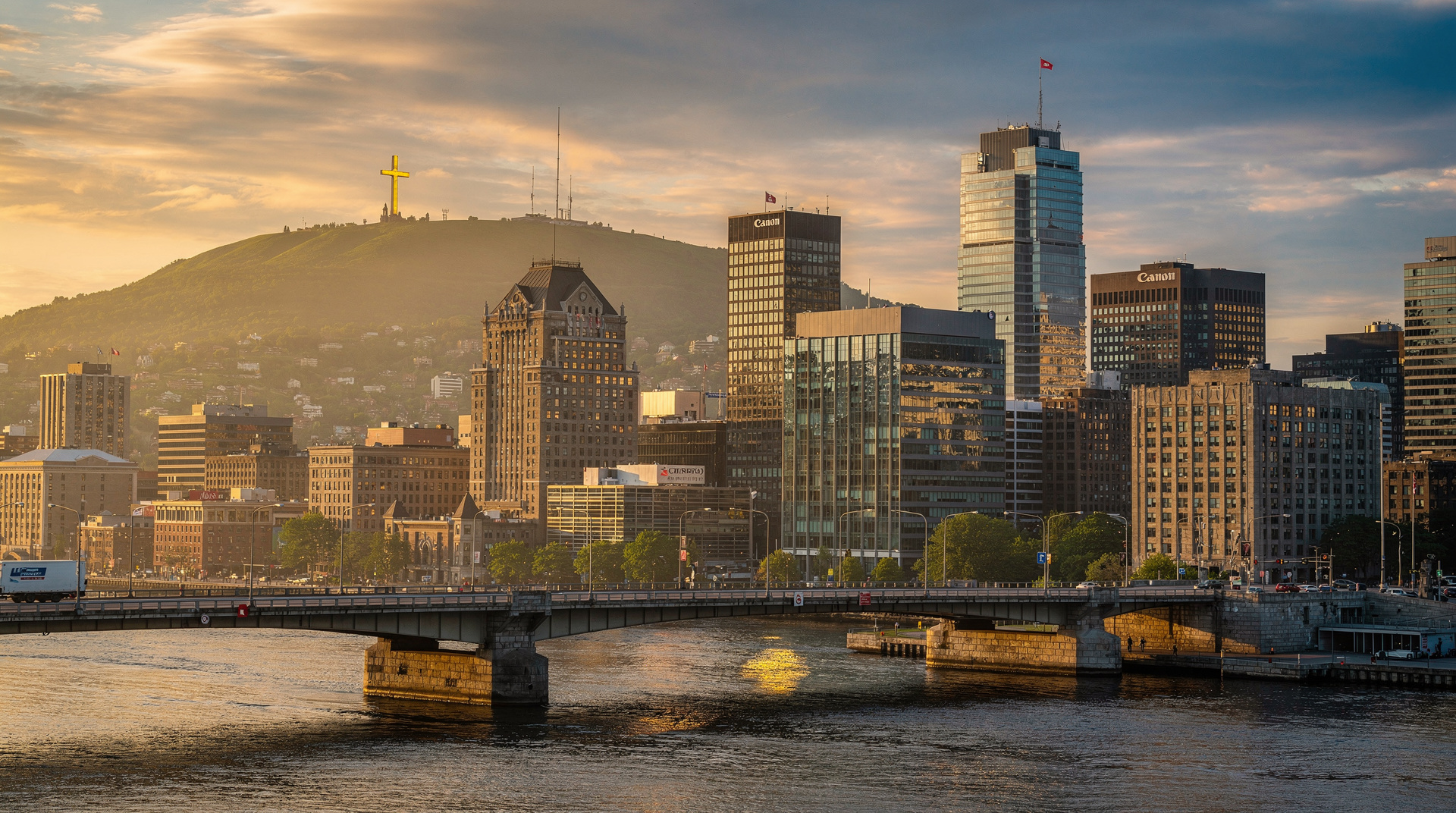
The city sits on an island in the Saint-Laurent River, and unlike most North American cities, its topography is legible from almost anywhere: Mont-Royal (the mountain that gives the city its name) rises 233 metres above the plateau and is visible from most of the central neighbourhoods. The grid stretches out from the mountain and the river, with the park at the summit serving as the city’s green centre of gravity.
Three days gets you through the essential picture: Old Montreal, the Plateau, Mile End, and Mont-Royal, with one excursion to Jean-Talon Market or the Lachine Canal. Four days allows for Westmount, the Latin Quarter, and a day trip north to Mont-Tremblant or east toward the Eastern Townships.
| Where | Island in the Saint-Laurent River, southern Québec |
| Cost | Mid-range meal 40–80 CAD; hotel 180–320 CAD/night |
| Time needed | 3–4 days |
| Getting there | YUL Montréal-Trudeau airport, 22 km from downtown |
| Best time | June–September for festivals; late January for Carnaval-adjacent events; March for sugar shacks |
Getting your bearings in Montreal
Montreal’s neighbourhoods cluster in a way that makes logical sense once you have the geography:
Old Montreal (Vieux-Montréal): The original settlement, at the southern end of the island along the Saint-Laurent waterfront. Cobblestone streets, 18th- and 19th-century stone buildings, Notre-Dame Basilica, the Old Port. Most tourist-heavy; also most historically significant.
Downtown (Centre-ville): The financial and commercial core, running north from Old Montreal along Rue Saint-Catherine. The McGill University campus, the Musée des Beaux-Arts, the Golden Square Mile (historic wealthy enclave), and the Underground City (RESO) pedestrian network.
Plateau Mont-Royal: The neighbourhood that defines Montreal’s cultural identity — long staircases, colourful exterior staircases (the “balconies” that define the Plateau’s visual character), the Main (Boulevard Saint-Laurent), and the densest concentration of independent restaurants and bars in the city. See the Plateau Mont-Royal guide.
Mile End: The northern continuation of the Plateau, with a distinctly different character — more artist studios, more Jewish delicatessen history (Fairmount Bagel, Wilensky’s Light Lunch), and the blocks around Bernard Ave that have become Montreal’s most concentrated artisanal food zone.
Outremont: Quiet, wealthy, francophone, and Mont-Royal-adjacent. Less visited by tourists, worth walking through for the architecture and the café scene.
Rosemont–Petite-Patrie: East of the Plateau, less tourist-facing, with Jean-Talon Market at its centre. The best neighbourhood for understanding Montreal’s actual food culture.
Hochelaga-Maisonneuve: East end, working-class history, industrial architecture now hosting artists and restaurants. The Olympic Stadium and Biodome are here.
What to see and do
Old Montreal on foot
Old Montreal is the foundation of any Montreal visit. The cobblestone streets (genuine 17th-century layout, though the paving dates mostly to the 19th century) and the scale of the stone buildings — bank headquarters, warehouses, merchant residences — give the district a specific weight that downtown does not have.
The Original Old Montréal Walking Tour provides the historical foundation in two hours — covering the founding of Ville-Marie in 1642, the fur trade era, the development of the banking district, and the relationship between the French and English merchant classes. More useful than attempting to read the district cold.
Notre-Dame Basilica (free entry to see the exterior, 6 CAD for interior) is worth the admission. The interior is extraordinary: blue-gold Gothic Revival with hand-carved woodwork and an acoustic that makes the space feel larger than it is. The AURA light-and-music experience in the evening (separate ticket, 20–35 CAD) is technically impressive but not necessary for understanding the church.
The Old Port (Vieux-Port) runs along the Saint-Laurent waterfront below Old Montreal. The 2.5-km promenade has the Science Centre (good for families), the Clock Tower (tour views), and several boat tour operators.
Food tour
Montreal’s food culture is arguably the most distinctive in Canada, and a guided food tour is the most efficient way to understand its layers — the Jewish deli tradition, the Italian influence in Little Italy and on the Main, the Québécois classics (smoked meat, poutine, tourtière), and the newer wave of natural wine bars and market-driven restaurants.
The Best of Montreal Food Walking Tour covers the three-hour format with 5–6 stops, focusing on the most distinctive aspects of the local food culture. At 60 CAD including tastings, it represents genuine value for the food introduction it provides.
For the Plateau-specific food experience, the Mile End tour covers the bagel bakeries and deli culture that the food walking tour uses as a starting point. See the Plateau Mont-Royal guide.
Jet boating the Lachine Rapids
The Lachine Rapids, at the southwestern tip of the island where the Saint-Laurent narrows, are a Class III–IV set of rapids that have been defining the Montreal shipping experience since the 17th century. The jet boat tour on them is the most physically engaging experience within the city limits.
Jet boating on the Lachine Rapids is loud, wet, and genuinely exciting. The 45-to-60-minute tour takes a specialised flat-bottom jet boat through the rapids — you will get wet regardless of conditions, so waterproof gear or the provided rain poncho is essential. At 70 CAD, it is priced like an experience rather than a sightseeing tour.
Not for young children or those with significant motion sensitivity.
Helicopter tour
The 20/30-minute helicopter tour over Montreal provides the view that no ground-level experience can replicate: the island geography, the Lachine Rapids, the Saint-Laurent, and the mountain in relation to the downtown grid. The 20-minute option at approximately 200 CAD is the minimum useful duration; the 30-minute version adds the bridges and the south shore.
Worth it if aerial perspective helps your spatial understanding of a city, or as a special occasion add-on.
Mont-Royal
Mont-Royal Park is the city’s green lung — 190 hectares of forested mountain designed by Frederick Law Olmsted (who also designed Central Park). The Kondiaronk Belvedere lookout at the summit gives the best Montreal skyline view; the chalet that sits beside it has a café and washrooms. The walk from the Plateau via the Peel Street path takes about 30 minutes from downtown.
The Mount Royal Tour covers the park’s history and landscape with a guide in 2–3 hours. The Olmsted design principles, the beaver lake, the three cemeteries (Protestant, Catholic, and Jewish) that surround the mountain’s lower slopes, and the role of the mountain in Montreal’s urban identity are the themes.
In winter, the mountain is for cross-country skiing and tobogganing. In summer, the Tam-Tams Sunday drumming gathering at the George-Étienne Cartier monument is one of the most authentically Montreal public events — free, spontaneous, and attended by 5,000–15,000 people weekly.
Plateau Mont-Royal and Mile End
The Plateau and Mile End are covered in detail in their own guide — see Plateau Mont-Royal & Mile End — but the key points for a Montreal overview: the Main (Boulevard Saint-Laurent) from Sherbrooke to Bernard is the best single street for understanding the city’s cultural layers. The neighbourhood’s distinctive exterior staircases date to a building code quirk from the 1890s that pushed stairs outside to maximise indoor space.
Jean-Talon Market
Jean-Talon Market (Marché Jean-Talon) in the Rosemont–Petite-Patrie neighbourhood is the best food market in Canada. Year-round, with 100+ vendors selling Quebec produce, artisan cheeses, local meats, maple products, and imported specialties. Summer and fall bring the full seasonal range; winter reduces to year-round producers.
Go on a weekday morning for the least crowded and most producer-focused experience. Saturday from 10:00 to noon is the busiest period.
What to skip
La Grande Roue (Old Port Ferris wheel): 27 CAD for a view that is inferior to the free Kondiaronk lookout on Mont-Royal. Skip unless you specifically need a Ferris wheel experience.
Underground City (RESO): It is a shopping mall. Not a unique tourist experience — just a way to walk between buildings in winter without going outside. Useful in -20°C February weather; not a destination.
La Ronde (Six Flags): The amusement park on Île Sainte-Hélène has been consistently criticised for high prices, long queues, and maintenance issues. At 60–90 CAD entry, the value proposition is poor compared to outdoor adventure alternatives. If you want an adrenaline experience near Montreal, the Lachine Rapids jet boat or a day trip to Mont-Tremblant are better choices.
Biodome: The Biodome reopened after renovations in 2020, but reviews remain mixed — the experience feels less impressive than the marketing suggests. At 24 CAD, the Botanical Gardens + Insectarium combination (same Espace pour la Vie complex, one ticket covers both) is better value and more impressive.
Underrated neighbourhoods: Griffintown and Verdun
Beyond the standard Old Montreal / Plateau / Mile End circuit, two neighbourhoods reward visitors with a spare afternoon and no fixed agenda.
Griffintown, immediately southwest of downtown, was Montreal’s Irish working-class district through the 19th and early 20th centuries and sat semi-derelict for decades before a wave of condo development transformed it into one of the city’s fastest-changing neighbourhoods. The result is an odd but interesting mix: converted industrial buildings, new residential towers, a handful of genuinely good restaurants (Le Richmond, Burgundy Lion for a proper British pub), and walking access to the Lachine Canal towpath. It is not conventionally picturesque, but it captures a side of Montreal’s urban change that the heritage districts don’t show.
Verdun, further southwest along the river, is a working-class-turned-family neighbourhood with a genuinely pleasant riverside promenade (the Verdun beach area, one of the only sanctioned urban river-swimming spots in Montreal in summer), a walkable main street (Wellington), and a noticeably lower tourist density than anywhere in the central boroughs. It’s reachable by metro (Verdun or De l’Église stations, Green Line) in about 20 minutes from downtown, and worth a visit for travellers who want to see how Montrealers actually live rather than just the postcard neighbourhoods.
Where to eat
Montreal’s restaurant scene is one of the most dynamic in North America, and the recommendations below skew toward places that represent genuine value and Quebec distinctiveness rather than just critical acclaim.
Budget (under 25 CAD): Fairmount Bagel (24/7, lineups on weekends) is the honest bagel choice — wood-fired, small, dense, covered in sesame. La Banquise (Plateau) for poutine, open 24 hours, has 30+ poutine variations at 15–22 CAD. Schwartz’s Smoked Meat (Saint-Laurent) for Montreal smoked meat at 15–20 CAD — the original, always a lineup, always worth it.
Mid-range (40–80 CAD per person): Joe Beef (Little Burgundy) is the most famous Montreal restaurant and remains excellent — nose-to-tail, French-Québécois, full wine cellar. Book two months in advance for dinner; the lunch service is easier to access. Liverpool House (next door, same group) is often easier to book and equally good. L’Express (Plateau) is the Parisian-style brasserie that Montreal does better than Paris does — steak frites, onion soup, good house wine. Opened in 1980 and still relevant.
Special occasion (100+ CAD per person): Toqué! (Old Montreal) has anchored the high end of Montreal’s food scene since 1993 and remains the most consistent fine dining experience in the city — seasonal Quebec ingredients, serious wine program, reliably excellent. Maison Boulud (Ritz-Carlton) is the most polished option for the international fine dining profile.
Where to stay
Budget (80–150 CAD/night): HI Montreal (Aylmer, Plateau-adjacent) is the best-located hostel in the city. Auberge Bonsecours (Old Montreal) for budget private rooms with good location.
Mid-range (180–320 CAD/night): Hotel William Gray (Old Montreal) occupies two historic buildings and has rooms with character — Old Montreal access, rooftop bar, not overpriced for the quality. Hôtel 10 (downtown) is good value for the design level, central location.
Luxury (400+ CAD/night): Fairmont Queen Elizabeth (downtown) is the historic choice — John and Yoko recorded “Give Peace a Chance” here in 1969. The rooms are well-maintained and the location is unmatched. Hôtel Le Crystal (downtown) for a newer, more design-forward option.
Choosing where to stay: a neighbourhood comparison
| Neighbourhood | Character | Best for | Walkability |
|---|---|---|---|
| Old Montreal | Historic, cobblestone, tourist-dense | First-timers, romance, photography | Excellent, compact |
| Plateau/Mile End | Bars, restaurants, local culture | Food and nightlife-focused visits | Excellent |
| Downtown | Business core, shopping, museums | Convenience, business travel, transit hub | Very good |
| Griffintown | New development, riverside, quieter | Value stays with canal access | Good, less central |
Old Montreal wins for first-timers who want to walk everywhere and wake up among the history; the Plateau wins for anyone prioritising the food and bar scene over sightseeing convenience; downtown is the practical default if you’re combining a Montreal stay with business or need direct metro access to everywhere; Griffintown suits travellers on a tighter budget who don’t mind a 15–20 minute walk or short metro ride to the core sights.
When to visit
June–early July: Festival season begins. Jazz Festival in the last days of June and first week of July is the anchor — outdoor stages throughout the Quartier des Spectacles with free concerts nightly and ticketed indoor shows. Warm (20–28°C). Book accommodation 3–4 weeks in advance.
July: Peak summer. Just for Laughs comedy festival. Osheaga (outdoor music festival, Parc Jean-Drapeau) late July. Hot (25–32°C), humid. Every terrace in the city is occupied from noon.
August–September: Consistently the best weather. Festival intensity decreases after Osheaga. Foliage in the Eastern Townships and Laurentides begins in late September.
October: Foliage peaks. Cooler (8–18°C), quieter, good prices. Halloween events throughout the city.
December–March: Deep winter. -15 to -25°C is normal in January–February. Montreal compensates with underground city access (useful for the commute, not for tourism), the Igloofest electronic music festival (outdoor, January), and hockey (Bell Centre). The city does not stop for cold weather.
March–April: Sugar shack season. Day trips to nearby cabanes à sucre are the best thing to do in early spring when the maple sap runs. See the sugar shack guide.
Shopping
Rue Sainte-Catherine downtown is the main commercial spine — flagship stores, department stores (Simons, Holt Renfrew), and the entrances to the Underground City’s retail network. Boulevard Saint-Laurent through the Plateau and Mile End has the city’s better independent boutiques, vintage shops, and Québec designer labels, with a noticeably different character block by block as you move from Sherbrooke north to Bernard. Marché Jean-Talon is the destination for food shopping rather than retail — vendors selling produce, cheese, and maple products rather than clothing or souvenirs.
For genuinely Québécois souvenirs beyond the standard maple syrup: look for local ceramics and textile work in Mile End boutiques rather than the mass-produced items in Old Montreal’s tourist shops, which carry the same imported trinkets found in most North American tourist districts.
Practical tips
Getting around: Montreal’s metro (STM) covers the central island efficiently. The BIXI bike-share system is excellent from May to November. Walking is feasible for most of the visitor circuit. A car is not useful within the city; it is necessary for day trips.
Language: French first, always. “Bonjour” when entering any establishment is the minimum social requirement. English is universally understood in tourist contexts but speaking French, even badly, will be appreciated.
Airport: YUL is connected to downtown by the 747 express bus (10 CAD, 45–60 minutes) and by taxi (45–55 CAD, 25 minutes with no traffic). The Réseau express métropolitain (REM) light rail line opened a YUL station in 2023 and connects to downtown via Brossard in about 25 minutes (5 CAD).
Taxes: 15% total (TPS + TVQ) on most purchases, not included in displayed prices.
Tipping: 15–18% in restaurants is standard; 15% in taxis. Service at bars: 1–2 CAD per drink.
Day trips from Montreal
Mont-Tremblant (130 km, 1.5 hours): The flagship Laurentian ski resort in winter; outdoor activities all year. See the Mont-Tremblant guide.
Quebec City (250 km, 3 hours by car or Via Rail): The most popular overnight extension. See the Quebec City guide and the Montreal to Quebec City transport guide.
Eastern Townships (100 km, 1.5 hours): Wine country, rolling hills, covered bridges. See the Eastern Townships guide.
Ottawa/Gatineau (200 km, 2 hours): The national capital for museums and galleries. See the Gatineau guide.
How to integrate Montreal into a longer itinerary
Montreal is almost always the entry and exit point for Quebec province trips, being home to the main international airport (YUL). The most natural sequences:
5 days Montreal + Quebec City: 2 nights Montreal, 3 nights Quebec City. Via Rail for the inter-city leg. See the Quebec 5-day itinerary.
7 days Montreal + Tremblant + Quebec City: Adds Mont-Tremblant to the classic circuit. See the Quebec 7-day classic loop.
10 days grand tour: Montreal → Quebec City → Charlevoix → Tadoussac → Saguenay Fjord. See the Quebec 10-day grand tour.
Frequently asked questions about Montreal
How many days should you spend in Montreal?
Three days covers the essential circuit: Old Montreal, Plateau, Mile End, and Mont-Royal, with time for one full meal at a restaurant that represents the city’s food culture. Four days allows you to add Rosemont’s Jean-Talon Market, a day trip to Mont-Tremblant, or more thorough exploration of the Musée des Beaux-Arts and the Mile End galleries.
Is Montreal safe for tourists?
Yes. Montreal is one of the safest major cities in North America by statistical measures. The areas tourists visit — Old Montreal, the Plateau, downtown — have low violent crime rates. Standard urban awareness applies: keep phones in pockets on the metro, don’t leave bags unattended at restaurant tables. The area east of the Gay Village and parts of Hochelaga have higher property crime rates but are rarely visited by tourists.
Do I need to speak French in Montreal?
No, but you should try. English is widely understood in every tourist context. The social expectation is to attempt French first (bonjour is the minimum) before switching to English. In heavily francophone areas like the Plateau at local cafés, French is the primary operating language — staff will switch to English without issue, but making the effort first is both polite and practically helpful.
What are the must-eat foods in Montreal?
The canonical Montreal food list: smoked meat (Schwartz’s or Main Deli), Montreal bagels (Fairmount or St-Viateur — the debate is genuine and worth having), poutine (La Banquise for variety, Au Pied de Cochon for luxury poutine), tourtière (meat pie, best at a traditional restaurant), and a sugar shack meal in spring. The Montreal food guide covers the full picture.
What are the tourist traps to avoid in Montreal?
Three clear ones: La Grande Roue (Ferris wheel at 27 CAD for a worse view than the free Mont-Royal lookout), La Ronde (overpriced Six Flags park), and the Underground City as a tourist destination (it’s a practical shopping mall). See the Montreal tourist traps guide.
How do I get from the airport to Montreal city centre?
Three options: the 747 express bus (10 CAD, 45–60 minutes to downtown), taxi/rideshare (45–55 CAD, 25 minutes with no traffic), or the REM light rail (5 CAD to the Brossard terminal, connecting via metro — total around 45 minutes). The REM is the most reliable time-wise; the 747 is cheapest. See the Montreal airport guide.
Top experiences
Bookable activities with verified prices and instant confirmation on GetYourGuide.