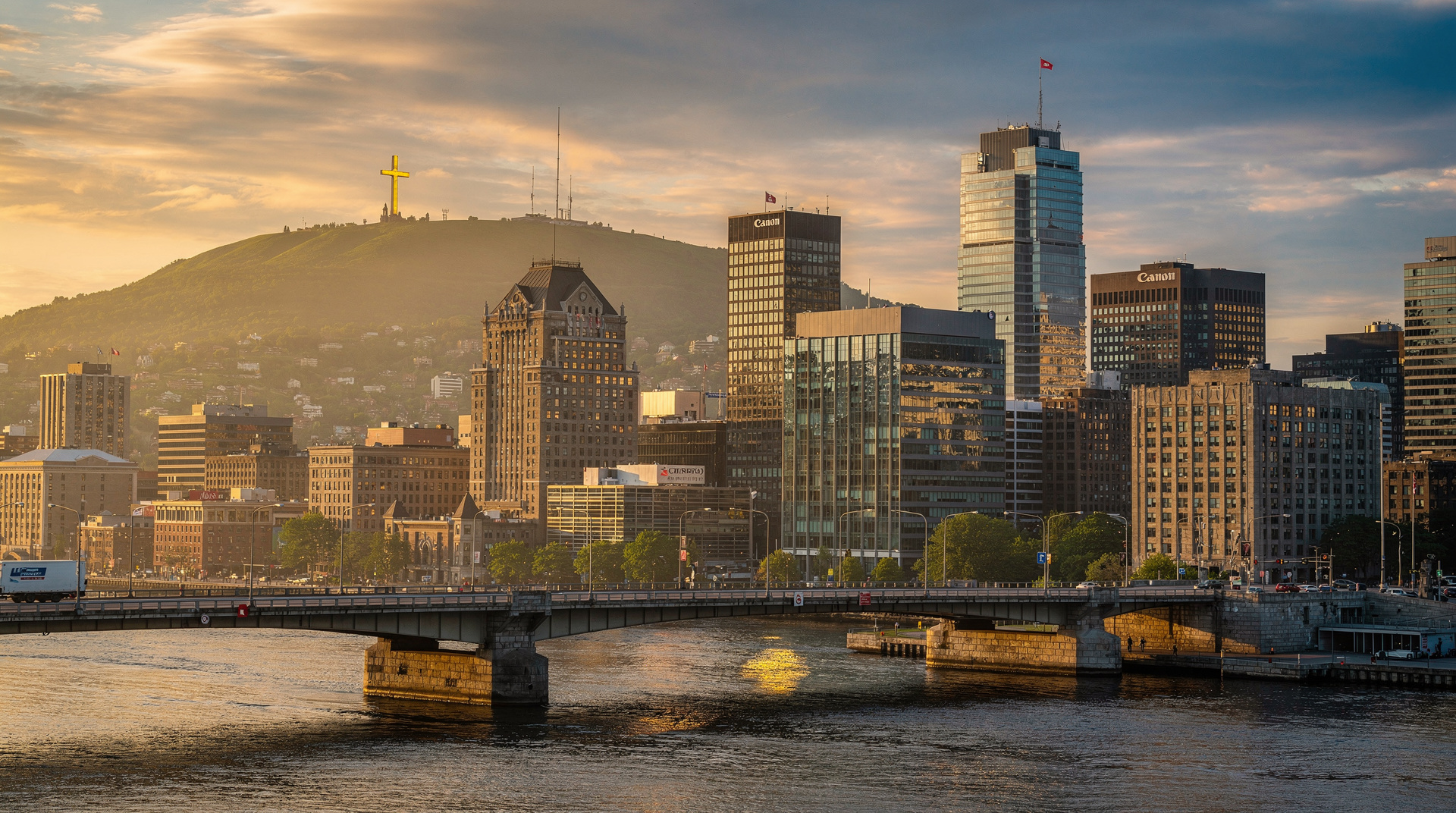
Plateau Mont-Royal & Mile End
Explore Plateau Mont-Royal and Mile End in Montreal: bagels, murals, the Main, exterior staircases, best restaurants and cafés.
Plateau Mont-Royal & Mile End Walking
Duration: 2-3 hours
Quick facts
- Character
- Montreal's most culturally distinctive residential neighbourhood
- Key streets
- Boulevard Saint-Laurent (the Main), Ave Mont-Royal, Ave Bernard
- Signature element
- Exterior spiral staircases — a Quebec architectural tradition
- Mile End
- North of Ave Van Horne; more arts/Jewish deli character than the Plateau proper
| Where | North and east of Mont-Royal Park, Montreal |
| Cost | Free to walk; guided tours 35–65 CAD; bagels 1–2 CAD each |
| Time needed | Half a day for a walk and a meal; a full day to combine with Jean-Talon Market |
| Getting there | Metro Mont-Royal or Laurier (Orange Line); BIXI bike-share throughout |
| Best time | May–October for terraces; fall (September–October) for the best balance of light and crowds |
Getting your bearings in the Plateau and Mile End
The Plateau Mont-Royal and Mile End make up the geographic and cultural heart of Montreal’s identity for many residents — and for many visitors who have been here before. If Old Montreal represents the colonial history, the Plateau represents what the city became when a large French-speaking urban working class developed its own cultural vocabulary in the 20th century.
The neighbourhood sits north and east of Mont-Royal Park. Its defining features are physical as much as social: the exterior staircases (a local building code adaptation from the 1890s, now classified as architectural heritage), the multiplexes with ground-floor commercial spaces, and the long flat streets that run east-west across the plateau. Boulevard Saint-Laurent — “the Main” — bisects the neighbourhood and has historically divided English-speaking (west) from French-speaking (east) Montreal. The division is far less rigid today, but walking south to north on Saint-Laurent still offers a compressed version of Montreal’s cultural layers.
Mile End, north of Avenue Van Horne and Avenue Bernard, is technically a separate neighbourhood but is functionally continuous with the Plateau. It has a different character — more arts-industry, more Jewish deli history (Fairmount Bagel is here), and the block around Ave Bernard that has become Montreal’s most concentrated artisanal food zone.
What to see and do
The Plateau walking tour
The Plateau Mont-Royal and Mile End walking tour covers 2–3 hours and the key streets — Saint-Laurent, Rachel, Saint-Denis, Laurier, the exterior staircase examples, the mural circuit, and the food stops that define the neighbourhood’s character. At 35 CAD, it contextualises the neighbourhood in a way that walking solo does not, particularly for understanding the historical development from working-class French-Canadian neighbourhood to its current form.
Boulevard Saint-Laurent (the Main)
The Main runs from the Old Port to the northern boundary of the island. The stretch that matters for the Plateau visit is from Sherbrooke to Bernard — approximately 2 km that includes the Plateau’s cultural institutions, restaurants, bars, and the transition into Mile End.
Specific points of interest:
- Schwartz’s Deli (3895 Saint-Laurent): the original Montreal smoked meat deli, in continuous operation since 1928. Takeaway or sit-in; the smoked meat sandwich at 15–18 CAD is the point of the visit. The lineup is part of the experience.
- The Main (Deli Steak House): across the street from Schwartz’s. The rival, also genuine, slightly less famous.
- Fairmount Bagel (Mile End): see below.
- The bookshops, record stores, and vintage clothing shops on Saint-Laurent between Mont-Royal and Rachel are the neighbourhood’s cultural hardware.
The bagel tour
Montreal bagels are meaningfully different from New York bagels: smaller, denser, sweeter (they are boiled in honey water), and baked in a wood-fired oven. The two historic bakeries — Fairmount Bagel (founded 1919) and St-Viateur Bagel (founded 1957) — are within 800 metres of each other in Mile End and both operate 24 hours a day.
The Montreal Bagel Tour covers both bakeries plus additional stops in Mile End’s food scene, with historical context for the Jewish community’s role in the neighbourhood’s development. At 50 CAD for 2.5 hours, it is a genuine food experience.
If you prefer to do it independently: buy a half-dozen from Fairmount, walk 800 metres to St-Viateur, buy a half-dozen, and compare. The consensus (hotly contested by partisans of each) is that Fairmount is slightly denser and sweeter; St-Viateur is slightly chewier and more savoury. Both are better than anything available outside Montreal.
Mile End food walking tour
The Mile End Foodie Walking Tour with 6 tastings covers the neighbourhood’s food producers in 3 hours — the bagel bakeries, the natural wine bars, the artisan cheese shop on Bernard, the local chocolate maker, and a contemporary café that exemplifies the current Mile End food culture. At 65 CAD including tastings, it is the best food introduction to the neighbourhood.
The exterior staircases
The spiral exterior staircases of the Plateau are the neighbourhood’s most distinctive architectural feature. They developed from an 1880s city ordinance that excluded staircases from the calculation of interior living space, causing builders to move them outside. The result — over a thousand surviving examples — is now considered an architectural heritage element unique to Quebec.
The best concentration of staircase examples is on the side streets between Rachel and Duluth, east of Saint-Laurent. Rue Boyer, Rue Fabre, and Rue Marquette have particularly well-maintained examples. In winter, the staircases covered in snow and ice are a photographic subject in their own right.
The mural festival circuit
Montréal is one of the world’s most active mural cities, and the Plateau is the historical concentration. The MURAL festival (June) commissions large-scale works on the building facades along Saint-Laurent and the adjacent blocks each year, leaving a permanent record of contemporary street art.
The current active mural circuit is 2–3 km along and around Saint-Laurent from Sherbrooke to Laurier. No guided tour is strictly necessary — the murals are impossible to miss — but a guided mural tour adds the context of which artist made what and under what circumstances.
Biking through the Plateau, Mile End, and Jean-Talon Market
The bike and e-bike tour of Plateau, Mile End, and Jean-Talon Market covers 3 hours and links the neighbourhood circuits with the market — the most efficient way to cover the full range of the neighbourhood’s character, including the transition from Mile End into Rosemont and the market approach.
Jean-Talon Market, 1 km north of the Plateau’s northern boundary, is the best food market in Canada. It is worth visiting independently (morning, any day except Sunday, when some vendors close) but the bike tour adds the market as a stopping point with context.
Fairmount vs St-Viateur: the bagel comparison
Every Montrealer has an opinion, and visitors are expected to develop one too. Here’s the honest comparison:
| Fairmount Bagel | St-Viateur Bagel | |
|---|---|---|
| Founded | 1919 | 1957 |
| Texture | Slightly denser, sweeter | Slightly chewier, more savoury |
| Hours | 24 hours | 24 hours |
| Distance apart | 800 metres | 800 metres |
| Best for | Purists who want the older recipe | Those who prefer a more bread-like chew |
The honest answer: buy a half-dozen from each, eat them side by side, and decide for yourself. Both are meaningfully different from — and, most visitors conclude, better than — anything available outside Montreal.
Where to eat
The Plateau and Mile End have the best value-per-meal ratio in Montreal for visitors. The neighbourhood’s restaurants are generally priced for local income levels rather than tourist expectations.
Budget (under 25 CAD):
Fairmount Bagel and St-Viateur Bagel for bagels at 1–2 CAD each. L’Gros Luxe (multiple Plateau locations) for poutine with interesting toppings at 15–20 CAD. Wilensky’s Light Lunch (Clark and Fairmount, Mile End) for the Wilensky Special — salami and bologna on a mustard roll, pressed. Still 5 CAD. One of the oldest unchanged lunch counters in Montreal, open since 1932.
Mid-range (35–75 CAD per person):
L’Express (Saint-Denis near Rachel): the Paris brasserie that Montreal does better than Paris. Steak frites, onion soup, good house wine. Book ahead for dinner; lunch is walk-in. Omnivore (Rachel) for inventive cooking with Quebec ingredients at fair prices. Le Filet (Saint-Denis) for seafood-focused tasting plates.
Special occasion:
Au Pied de Cochon (Duluth): Martin Picard’s restaurant, which put the Plateau on the international fine dining map in 2001, remains one of Montreal’s most distinctive. The foie gras poutine is not subtle but it is the dish you mention to people who ask what you ate in Montreal. 80–120 CAD per person. Book far in advance.
Cafés: Café Olimpico (Mile End, Saint-Viateur) is the longest-running Italian-style espresso bar in Montreal and operates at a different pace than the specialty coffee wave. Café Saint-Henri (Plateau branch) for specialty coffee with proper extraction.
When to visit
The Plateau and Mile End are functional year-round, but the character changes dramatically with the seasons:
Summer (June–August): Exterior staircases occupied, street vendors on the Main, terraces full, the neighbourhood at maximum social density. The MURAL Festival (June) brings the best street art activity.
Fall (September–October): The best season for the neighbourhood — still warm enough for terraces, the light is good, and the restaurants are running fully without peak-season waiting times.
Winter (November–April): The neighbourhood retreats inside. The restaurants and cafés are as good as ever; the streets are quieter. Montrealers deal with winter pragmatically rather than dramatically.
Practical tips
Getting there: Metro Mont-Royal (Orange Line) deposits you at the corner of Mont-Royal and Saint-Denis, in the centre of the Plateau. The Laurier metro station (Orange Line) serves the Mile End end. Both stations are a 30-minute metro from Old Montreal.
Walking time: The full Plateau + Mile End circuit (Saint-Laurent from Sherbrooke to Bernard, with detours) is about 3 km and takes 2 hours at a relaxed pace with stops.
BIXI bikes: The BIXI bike-share station on Mont-Royal at Saint-Denis is a good starting point for cycling the neighbourhood. Available April to November.
Connecting Plateau to the rest of your Montreal visit
The Plateau and Mile End make most sense as part of a full-day Montreal neighbourhood circuit: Old Montreal in the morning (history) → Plateau and Mile End in the afternoon and evening (food and culture) → Mont-Royal for sunset.
For the full Montreal context, see the Montreal guide.
For the area immediately west — the mountain and the Outremont neighbourhood — see Mount Royal & Outremont.
Day trips from Montreal: the Eastern Townships, Mont-Tremblant, and Quebec City are all accessible from the city.
For multi-day planning, see the 4 days in Montreal itinerary and the Quebec 5-day Montreal + Quebec City itinerary. For the smoked meat rivalry that mirrors the bagel debate above, see the Montreal smoked meat guide; for the neighbourhood’s museums and beer scene, the museums of Montreal guide and craft beer breweries guide both have Plateau and Mile End specific entries. For the fuller citywide picture, where to eat in Montreal situates this neighbourhood’s restaurants against the rest of the city.
Frequently asked questions about Plateau Mont-Royal & Mile End
Is the Plateau or Mile End better for a first Montreal visit?
Both, ideally as one continuous walk — the Plateau has the exterior staircases and the mural circuit, while Mile End (just north of Avenue Van Horne) has the bagel bakeries and the artisanal food scene. They’re functionally one neighbourhood for a visitor’s purposes, connected by a 15-20 minute walk up Saint-Laurent.
Do I need a guided tour, or can I walk it independently?
Independently works fine — the neighbourhood is walkable and self-explanatory, and the murals and staircases are impossible to miss. A guided tour (walking, bagel, or bike) adds historical context — the Jewish community’s role in Mile End’s development, the exterior staircase building-code history — that’s harder to piece together on your own.
Top experiences
Bookable activities with verified prices and instant confirmation on GetYourGuide.