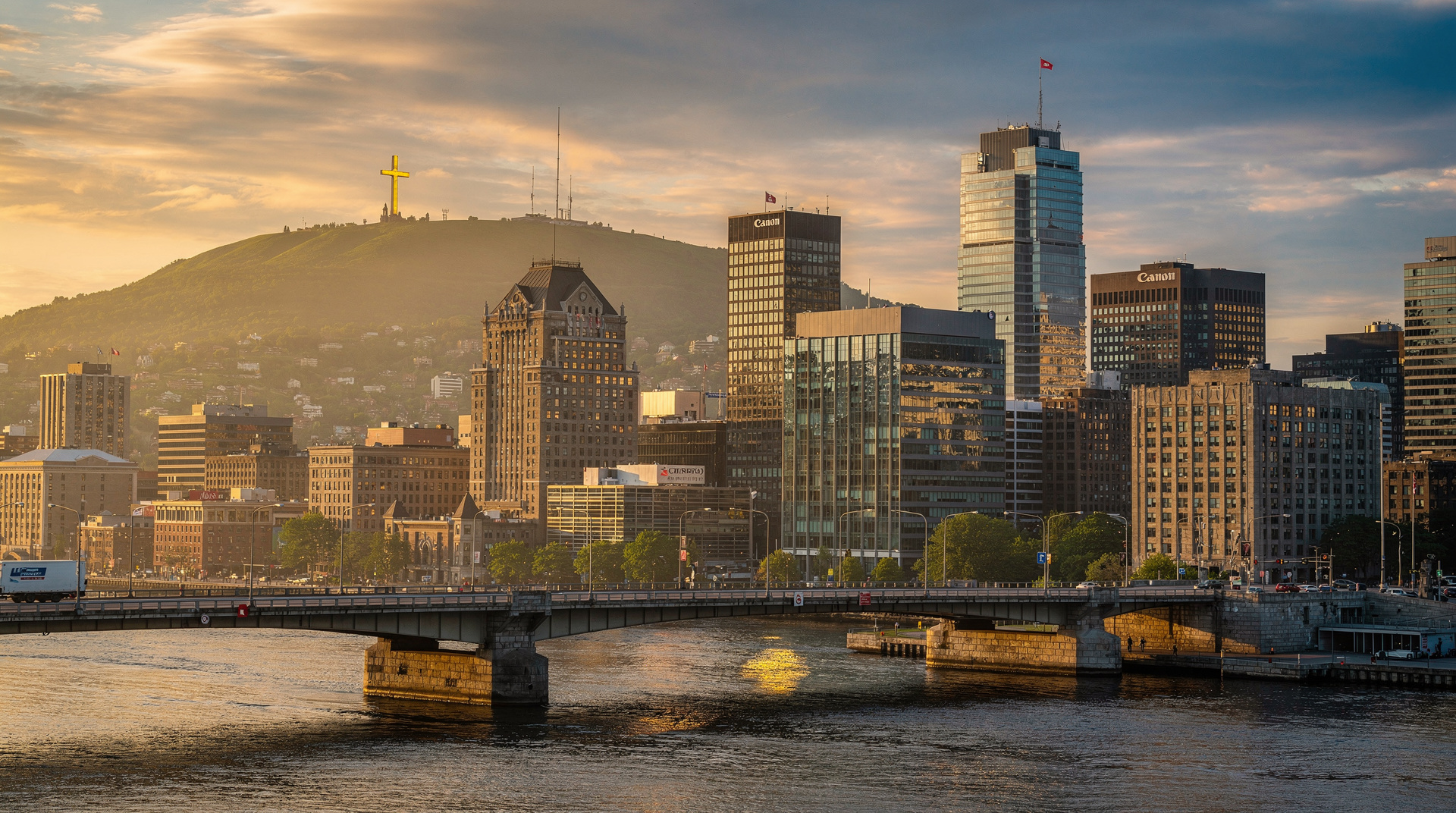
Mount Royal & Outremont
Explore Mount Royal Park and Outremont in Montreal: Kondiaronk lookout, e-bike, Saint Joseph's Oratory, quiet cafés. Honest practical guide.
Mount Royal Tour
Duration: 2-3 hours
Quick facts
- Height
- 233 metres above sea level
- Park area
- 190 hectares, designed by Frederick Law Olmsted (1876)
- Kondiaronk lookout
- Best free city view in Montreal
- Tam-Tams
- Free Sunday drumming gathering, George-Étienne Cartier monument, May–October
Getting your bearings around Mont-Royal
Mont-Royal — the mountain that gives Montreal its name — is the most legible geographic feature of the island. Rising 233 metres above the plateau, it is visible from most of the central neighbourhoods and serves as the spatial anchor that keeps the city’s grid intelligible. From the summit, the relationship between Old Montreal, the Plateau, downtown, and the Saint-Laurent River makes immediate sense.
The park itself (Parc du Mont-Royal) covers 190 hectares and was designed in 1876 by Frederick Law Olmsted — the landscape architect who designed Central Park in New York. The Olmsted plan deliberately preserved the mountain’s natural forest character while adding the formal elements: the chalet, the Kondiaronk lookout, the Lac aux Castors (Beaver Lake), and the network of paths.
Outremont, on the northwestern slope of the mountain, is a quieter neighbourhood than the Plateau — more francophone, more residential, with a café culture and a bookshop scene that provides a counterbalance to the Plateau’s more crowded energy. Together, Mont-Royal and Outremont form the quieter, greener half of the central Montreal experience.
| Where | Central Montreal, between the Plateau and Côte-des-Neiges |
| Cost | Free (park, lookout, Oratory); tours ~45–80 CAD |
| Time needed | Half to full day |
| Getting there | Metro Mont-Royal, Laurier, Côte-des-Neiges, or Outremont (all reachable on foot from the park) |
| Best time | Year-round; October for foliage, winter for skating and cross-country skiing |
What to see and do
Mont-Royal Park on foot
The Kondiaronk Belvedere — the lookout terrace at the summit near the chalet — is the best free view in Montreal. On a clear day, the downtown skyline, the Saint-Laurent, the islands downstream, and the Montérégie plain to the south are all visible. This is the view that makes the 27-CAD Old Port Ferris wheel obviously redundant.
The standard approach from downtown or the Plateau is via the Chemin Olmsted — a carriage road that winds gradually up the mountain’s south face, pedestrian-only. From the Peel entrance (bottom), the walk to the Kondiaronk lookout takes about 30 minutes at a relaxed pace.
The Mount Royal Tour covers the park’s history and design logic in 2–3 hours. The guide explains the Olmsted plan, the three cemeteries (Protestant, Catholic, and Jewish) that surround the lower slopes, the role of the Tam-Tams gathering in Montreal’s cultural calendar, and the geology of the mountain. At 45 CAD, it converts a pleasant walk into a genuinely informative experience.
Electric fat bike on Mont-Royal
Electric fat tire bike riding on Mount Royal covers the park’s path network in 1.5–2 hours with the e-bike assistance that makes the mountain’s inclines manageable for casual cyclists. The fat tire format provides traction on the packed-snow or wet gravel paths. At 65 CAD, it is the most physically active way to cover the park, and in winter the contrast between the snow-covered summit and the city visible below is photographically strong.
The Tam-Tams gathering
Every Sunday from May to October (weather permitting), the George-Étienne Cartier monument at the foot of the mountain hosts the Tam-Tams — a spontaneous gathering of drummers (djembes, bongos, djun-djuns) that attracts 5,000–15,000 people from noon to early evening. There are also costume enthusiasts, LARPers, families, and vendors. It is entirely free, entirely informal, and entirely specific to Montreal — one of the most authentic public social events in the city.
The Tam-Tams have been happening continuously since the mid-1970s with no formal organisation. They just happen. Show up between noon and 14:00 for the best energy.
Lac aux Castors (Beaver Lake)
The Beaver Lake sits in a hollow on the west side of the mountain. In summer, it has a café (the Pavillon du Lac-aux-Castors), paddle boats for rent, and walking paths around the perimeter. In winter, it becomes a free outdoor skating rink — one of the largest and most popular in Montreal. The surrounding meadow is the city’s main toboggan hill for families.
Saint Joseph’s Oratory
The Oratoire Saint-Joseph sits on the western face of Mont-Royal, visible from the Côte-des-Neiges neighbourhood below. It is the largest church in Canada — a domed basilica with a capacity of 2,200 — built between 1924 and 1967. The oratory was established by Blessed Brother André (now Saint André), a porter at the Collège Notre-Dame who began a healing ministry that drew millions of pilgrims over five decades.
The crypt church (1917) at the base is more intimate than the main basilica and has the wooden relics from the original chapel. The main basilica is architecturally impressive at scale — the dome, at 60 metres, is visible from much of western Montreal. Entry to both is free.
The Saint Joseph’s Oratory private tour provides the context that the scale of the building does not volunteer — the history of Brother André, the development of the pilgrimage, and the architectural decisions made over 43 years of construction. At 80 CAD for 2–3 hours, it is priced for the depth of the experience.
Outremont — the neighbourhood walk
Outremont is not a tourist destination in the traditional sense — it has no single landmark that commands a visit. Its value is in the texture of a prosperous, primarily francophone neighbourhood built around the avenues Bernard, Laurier, and Maplewood: independent bookshops, cafés with high standards, a farmers’ market (Marché d’Outremont on rue Hutchison, Saturdays in summer), and the extraordinary density of heritage duplex and triplex architecture on the side streets.
Avenue Bernard from Outremont metro to Bloomfield is the most pleasant walk: good coffee at the Café Union co-operative, books at the Libraire de Verdun outpost, and the pastries at Automne Boulangerie. None of these are on the tourist radar, which is part of the point.
Laurier Ave in Outremont (west of Parc Ave) has a denser restaurant scene and is the border with the Plateau. Good for lunch before a climb up the mountain.
The three cemeteries
The lower slopes of Mont-Royal hold three of Montreal’s largest cemeteries — Notre-Dame-des-Neiges (Catholic), Mount Royal Cemetery (Protestant), and the smaller Shaar Hashomayim and Baron de Hirsch grounds (Jewish) — a reflection of Montreal’s historically segregated religious geography carried into how the mountain itself was divided. Notre-Dame-des-Neiges, the largest, is the resting place of several Canadian prime ministers and is itself a place many locals walk and cycle through rather than avoid; the winding carriage paths were laid out with the same Olmsted-era sensibility as the park above.
These are working cemeteries, not tourist attractions in the conventional sense, but the combination of mature trees, quiet paths, and genuinely striking 19th- and 20th-century funerary architecture makes a walk through Notre-Dame-des-Neiges a legitimate addition to a longer Mont-Royal visit for anyone with an interest in Montreal’s social history — best approached respectfully and without treating it as a photo backdrop.
Where to eat near Mont-Royal and Outremont
Café Olympico (Mile End, Saint-Viateur — 15-minute walk): the longest-running Italian-style espresso bar in Montreal. Always full; the ritual of the standing espresso at the bar is the experience.
Laïka (Saint-Laurent): the best brunch in the Plateau adjacent to Mont-Royal. Eggs baked, granola, good coffee. 20–30 CAD.
Outremont cafés: Café Union (Ave Bernard) for the neighbourhood feel. Automatico (Laurier) for the specialty coffee wave applied to the Outremont demographic.
For a meal: Pastel (Laurier W) is the best casual restaurant near Outremont — small plates, market-driven, good natural wine list. 40–65 CAD per person. Maison de la poutine is on Laurier Ave and is exactly what it says: a good poutine restaurant at 15–22 CAD.
When to visit
Summer (June–August): The Tam-Tams are running. The Beaver Lake is at capacity on sunny weekends. The mountain paths are accessible to all fitness levels. Best visited on a weekday morning for solitude at the lookout.
Fall (September–October): The mountain’s forest turns before the city’s street trees. The Kondiaronk lookout at golden hour in October, with the fall colour behind and the city below, is a photograph that visitors come specifically for.
Winter (November–March): The Beaver Lake becomes the outdoor skating rink. The cross-country ski network on the mountain has 23 km of groomed trails. The summit in a clear winter morning — cold and quiet — provides a different experience than summer without losing the view.
Spring (April–May): The Tam-Tams begin again in May when the ground is dry enough. The mountain is at its least photogenic in mud season (March–April) but the first warm weekend brings locals out in force.
Practical tips
Getting there: Metro Mont-Royal (Orange Line) and Metro Laurier (Orange Line) serve the Plateau side. Metro Côte-des-Neiges (Blue Line) serves the Côte-des-Neiges side and the Oratory. Metro Outremont (Blue Line) serves the Outremont neighbourhood.
Walking time to the summit: 30–40 minutes from the Peel entrance via Chemin Olmsted. 40–50 minutes from the Mont-Royal metro via the park’s eastern access on Camillien-Houde. The summit chalet has washrooms and a seasonal café.
What to bring: Water, layers in any season (the summit is significantly cooler and windier than the street level below). In winter, proper boots — the Chemin Olmsted is groomed and packed for cross-country skiers but icy in spots.
Photography notes: The Kondiaronk lookout faces south — best light in the afternoon (the sun is behind you looking at the city). Early morning has mist in the valley below that can be photographically strong in fall.
Connecting Mont-Royal to the rest of your Montreal visit
Mont-Royal and Outremont function as the natural afternoon complement to an Old Montreal or Plateau morning. The standard circuit: Old Montreal (history) → Plateau lunch → Mont-Royal walk → Outremont café → Plateau dinner.
For the Plateau and Mile End, which are 10–15 minutes’ walk from the mountain’s east face, see Plateau Mont-Royal & Mile End.
For the full Montreal picture, see the Montreal guide.
For multi-day planning, see the 4 days in Montreal itinerary and the Quebec 7-day classic loop.
Frequently asked questions about Mont-Royal
Is Mont-Royal worth visiting if I only have one day in Montreal?
Yes, if walking or a view matters to you — the Kondiaronk lookout is free and gives the single best orientation of the city. On a tight one-day itinerary, treat it as a 1.5–2 hour add-on to an Old Montreal or Plateau morning rather than a standalone half-day, unless the Oratory or Outremont café scene specifically interests you.
Can you drive to the top of Mont-Royal?
Yes, partially — Camillien-Houde Way crosses the mountain and has parking near the Kondiaronk lookout side, though spaces are limited and fill quickly on weekends. Most visitors walk up via Chemin Olmsted from the Peel entrance, which is free of parking stress and part of the experience.
Top experiences
Bookable activities with verified prices and instant confirmation on GetYourGuide.