Québec tipping: a European traveller's reality check
The cultural collision nobody prepares you for
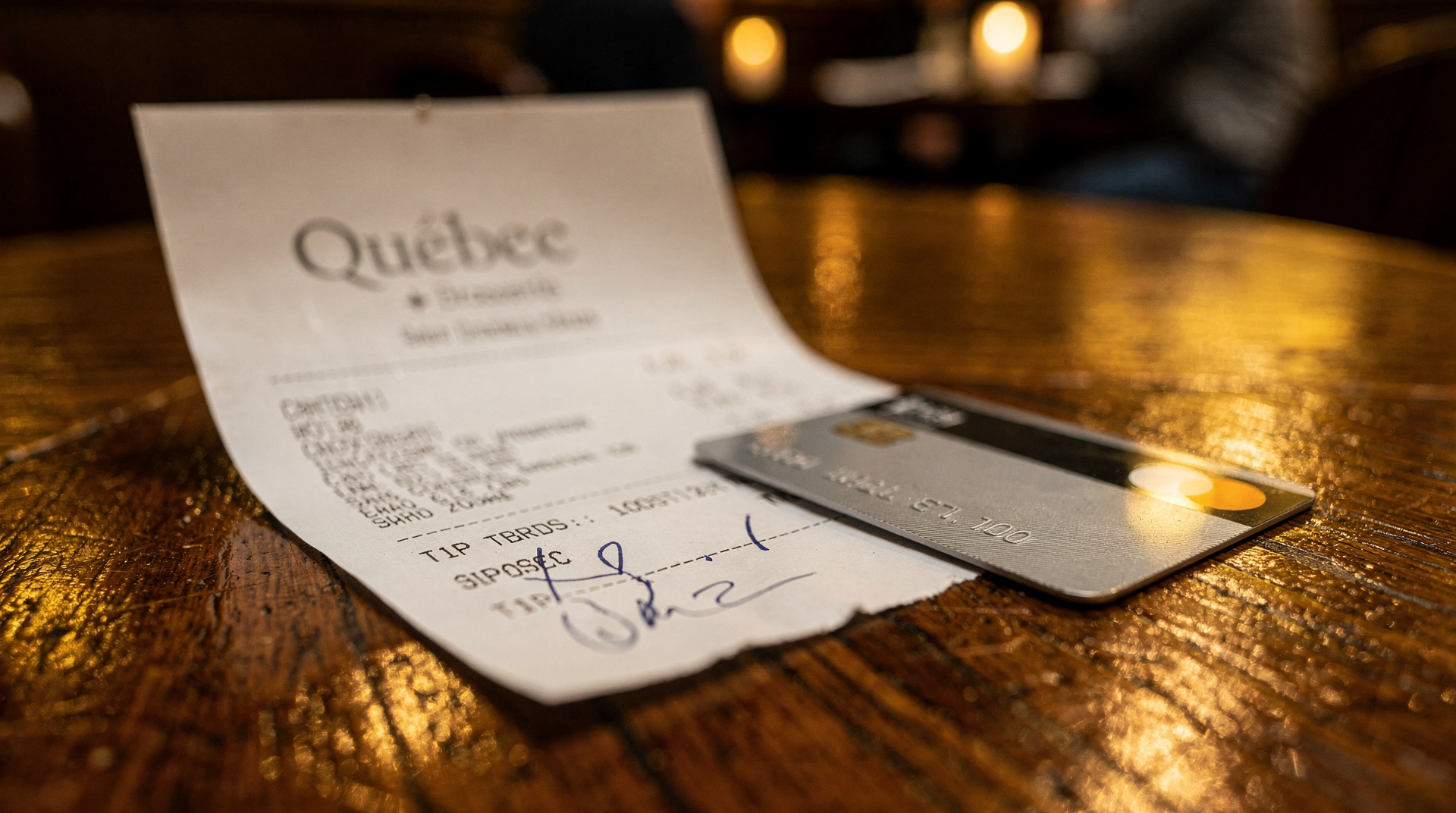
I remember my first dinner in Montréal. I was four days into my first visit to Québec, reasonably prepared (I thought) for the Canadian context. I knew the prices were in CAD. I knew the taxes were not included in menu prices. What I had not quite processed was the moment when the server brought the portable payment terminal to the table, turned it toward me, and the screen displayed: “Select tip: 15% / 18% / 20% / Custom.”
All three default options were above what I would consider an extraordinary tip in France. The lowest option — 15 percent — was the Canadian equivalent of “adequate.” I sat there for slightly too long, feeling genuinely confused about the social calculus I was being asked to perform.
This article is for anyone who has had or will have that moment. Here is what I have learned about tipping in Québec after several visits and many conversations with locals.
| Situation | Typical tip |
|---|---|
| Sit-down restaurant | 15–18% (20% for excellent service) |
| Counter service / café | None expected |
| Bar | 1–2 CAD/drink or 15% of tab |
| Taxi / rideshare | 10–15% |
| Tour guide | 10–15% of tour price |
Why tipping works differently in North America
The short explanation: North American hospitality workers, particularly servers in restaurants, are paid wages that are lower than the minimum wage specifically because tips are expected to make up the difference. In Québec (as in the rest of Canada), servers can legally be paid a special lower rate on the assumption that tips will compensate.
In practice, a restaurant server in Québec might earn 12 to 13 CAD per hour in base wages (the 2024 rate is approximately 12.45 CAD/hour for workers who receive gratuities, versus the general minimum of 15.75 CAD/hour). Their actual income depends heavily on tips.
This is a structural difference from most of Europe, where servers are paid the full minimum wage and tips are genuinely discretionary. In Québec, not tipping — or tipping badly — at a sit-down restaurant with table service is not just unusual, it is understood as stiffing someone for their income.
This is not a moral judgement on the system. It is just the system. Arriving and not tipping because “we don’t do that at home” is not standing on principle. It is transferring a cost onto the person serving you.
The standard amounts
Here is what the tipping norms look like in practice in 2024:
Sit-down restaurants (with table service): 15 to 18 percent is standard. 20 percent signals excellent service. Less than 15 percent is understood as dissatisfaction. Less than 10 percent is rare enough to be noticed and remembered.
Calculate on the pre-tax subtotal if you want to be technically correct. Most Canadians tip on the total including taxes, which ends up slightly higher. Either is acceptable; the difference on a 60 CAD meal is about 1.50 CAD.
Counter service, cafés, bakeries: No tipping obligation. The “tip” prompt on a card terminal at a café is a prompt, not an expectation. You can hit “no tip” without social consequence. However, if you have a regular spot and get consistent service, a tip jar donation is appreciated.
Bars: 1 to 2 CAD per drink is standard, or 15 percent of your tab if you are running a tab. More for complicated cocktails.
Taxis and rideshare: 10 to 15 percent. For an Uber, the app will default to 15 to 20 percent options. Choosing the lowest option is fine.
Hotel staff: 2 to 5 CAD per bag for a porter. 2 to 5 CAD per night for housekeeping (left on the pillow or at the desk with a note). Nothing for the front desk.
Tour guides: 10 to 15 percent of the tour price, split between guides and drivers if applicable. On a 60 CAD walking tour, 8 to 10 CAD per person is appropriate for a good guide.
The payment terminal situation
The mandatory confessional moment of the tip prompt is a genuine cultural shock for first-time visitors. The terminal faces you, the amounts are pre-set at generous levels, and the server is standing there while you decide. This is not designed to be comfortable. It is designed to default toward higher tips.
A few things worth knowing: the server cannot see which button you press. If you need to enter a custom amount, you can. “No tip” is a valid option on every terminal — pressing it will not summon the manager. But pressing it at a sit-down restaurant with good service is the sort of thing you will feel slightly awkward about if you are at all sensitive to social dynamics.
Some terminals show percentage options based on the total including taxes, which inflates the final tip by about 15 percent compared to tipping on the pre-tax amount. This is technically incorrect but so common that nobody objects.
What happens if you do not tip
At a café or counter service: nothing. Nobody notices or cares.
At a sit-down restaurant with genuinely poor service: leaving a minimal tip (5 to 8 percent) is accepted as a signal of dissatisfaction. If the service was actually bad — not just slow due to a busy night, but genuinely inattentive or rude — this is a legitimate response.
At a sit-down restaurant with adequate to good service: leaving nothing will be remembered. Not in a dramatic confrontational way, but restaurant servers talk. If you are eating somewhere more than once, or if the restaurant is in a neighbourhood where your face becomes familiar, this matters more than it might in an anonymous tourist context.
The tax confusion
Québec has two taxes applied to most goods and services: the TPS (federal GST, 5 percent) and the TVQ (provincial sales tax, 9.975 percent). Combined, that is approximately 15 percent added to every price that does not include taxes.
Restaurant menus almost always show prices without taxes. A main course listed at 28 CAD will actually cost 32.20 CAD after taxes. If you then add a 15 percent tip on 32.20 CAD, you are paying about 4.83 CAD in tip.
The practical effect: a 28 CAD main course at a mid-range restaurant costs roughly 37 to 38 CAD all-in (taxes plus a 15 percent tip). European visitors who are used to all-in pricing often have this calculation sneak up on them over a multi-course meal.
Budget planning with tips factored in
If you are trying to budget realistically for meals in Québec, add 25 to 30 percent above the menu prices to account for both taxes and a standard tip. A meal listed at 100 CAD for two (mains, drinks, dessert before taxes) will land at approximately 125 to 130 CAD all-in.
This is not unique to Québec among North American destinations, but it is a consistent surprise for European visitors who are accustomed to the price on the menu being what they pay.
For context, the complete tipping guide covers edge cases like tipping at fine dining restaurants, spa services, and guided excursions.
One thing that confused me
For my first two or three visits, I assumed that the tip percentages on payment terminals were calculated on the total bill. Sometimes they are. Sometimes they are calculated on the pre-tax subtotal. The difference matters on a larger bill.
The reliable approach: do the mental calculation yourself. Take the pre-tax subtotal, calculate 15 to 18 percent of it, and enter that as a custom amount if the terminal defaults are calculated on the wrong base. No server will think less of you for entering a custom amount.
The bigger picture
The tipping culture in Québec is not going away and it is not changing toward European norms. If anything, the pre-set percentages on payment terminals have shifted upward over the past decade — 15/18/20 percent is now more common than the 10/15/18 percent that was standard a few years ago.
The most useful frame for European visitors is to accept it as a line item in your budget rather than an optional extra. Build it in, tip 15 to 18 percent at restaurants, and you will have a much more relaxed experience than if you treat every payment terminal as a negotiation.
For the full practical breakdown of Québec trip budgeting, including accommodation, transport, activities, and food costs in CAD with approximate EUR conversions, see the Québec budget planning guide.
Tipping on tours and excursions
One category worth a separate mention: guided tours and excursions, which many European visitors don’t think to tip at all because guided activities in Europe rarely carry the same expectation. In Québec, a guide who has done a genuinely good job — sharp commentary, real effort, flexibility when the group needed it — is generally tipped 10 to 15 percent of the tour price, in cash if possible, at the end of the excursion. This applies whether it’s a walking tour, a whale-watching trip, or a multi-day guided excursion; drivers on bus tours are tipped separately and more modestly, often 2 to 5 CAD per person for a half-day trip.
Guided walking tour of Old Québec
None of this needs to be awkward once you know the numbers, and most guides will not mention it or expect it visibly — it simply becomes part of budgeting for the activity, similar to the way you would already budget for visa and eTA costs before the trip.