Riding Via Rail from Montréal to Québec City: the honest experience
The train that most visitors do not take
When I tell people in Europe that I took the train from Montréal to Québec City, the response is almost always some version of: “Oh, that sounds lovely, much better than driving.” And they are right, in many ways. But they are also imagining something that does not quite exist in the way they imagine it.
The Via Rail service between Montréal and Québec City is not a European high-speed train. It is a reasonably comfortable inter-city service that runs at speeds of 140 to 160 km/h, covers 250 kilometres in approximately three hours, and connects two of Québec’s most important stations in a way that is genuinely useful. It is not the TGV. It is also not a regional diesel rattler. It is something in between, and understanding what it is helps calibrate expectations.
I took the train in September 2024, both directions, once in economy and once in business class. Here is what I found.
| Route | Gare Centrale (Montréal) to Gare du Palais (Québec City) |
| Distance / time | 250 km, about 3 hours 10 minutes |
| Cost | Economy around 40–90 CAD; Business around 150–200 CAD, each way |
| Booking window | 2–3 weeks ahead for the best economy fares |
| Best departures | Early morning (06:40 / 09:15) for lower prices and fewer crowds |
The stations: both worth knowing
Gare Centrale in Montréal is underground, accessed from the Bonaventure Métro station, and part of the underground city network. It is large, functional, and considerably less beautiful than European terminus stations of comparable age — but it is convenient, with direct underground access from several downtown hotels.
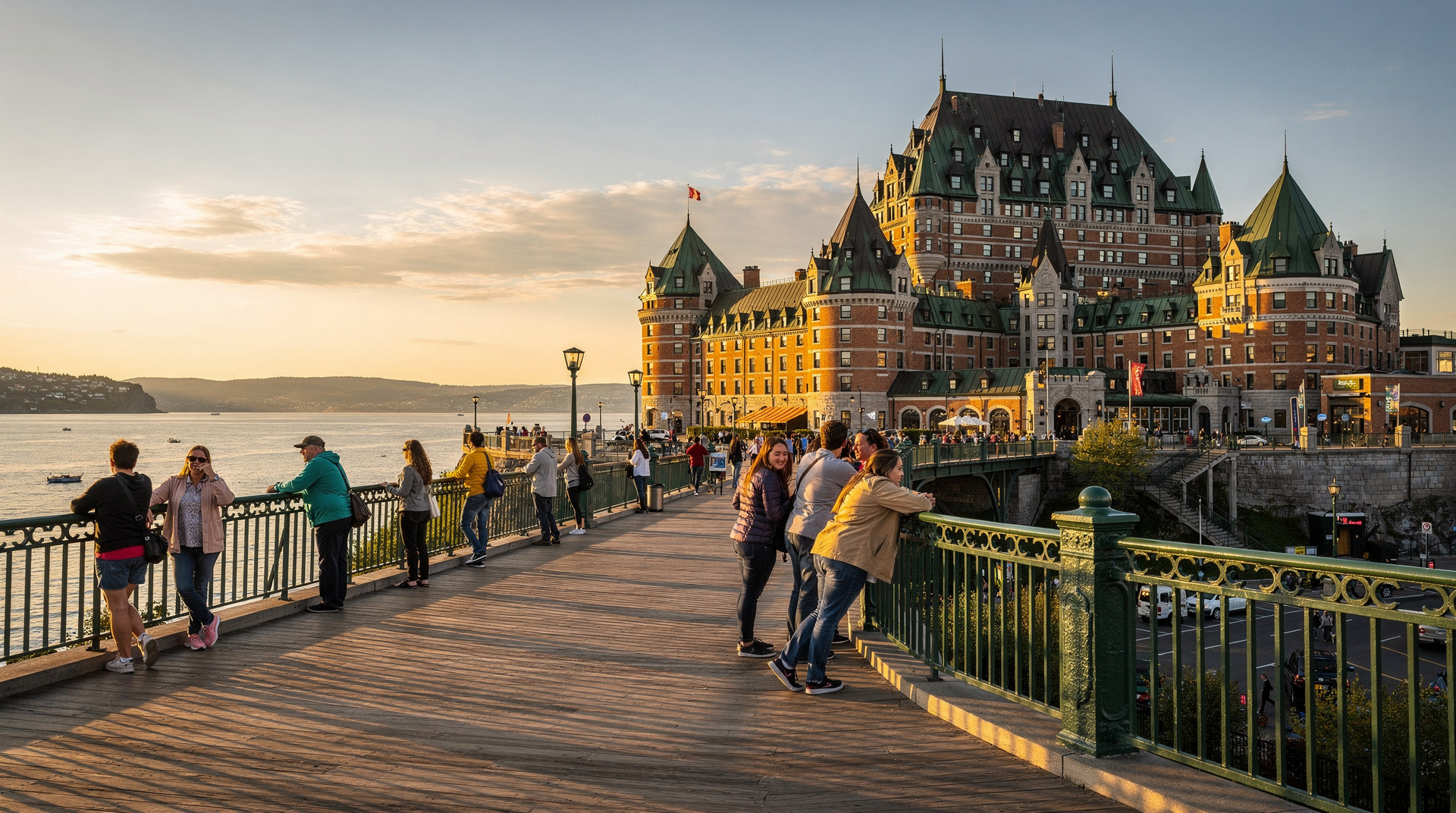
Gare du Palais in Québec City is a different matter. Designed by architect Bruce Price (who also designed the Château Frontenac) and completed in 1915, it is one of the most beautiful train stations in Canada — a kind of castle-style château that fits perfectly into the visual language of Vieux-Québec. It sits in the lower town, about a 20-minute walk from the centre of Vieux-Québec or a 10-minute taxi ride. The station itself is worth seeing even if you are not taking the train anywhere.
The economy experience
The economy cars on the Montréal-Québec City corridor are modern and comfortable by North American train standards. Two seats on each side of the aisle, good legroom (considerably more than economy airline seating), fold-down tray tables, power outlets at most seats, and large windows. The seats recline but only modestly.
In September, the train I took was about 70 percent full in economy. The journey took three hours and twelve minutes, which is standard for this route. I worked on my laptop for most of it — the WiFi connected but was slow enough to make video calls unreliable. Download email in advance, treat it as a working environment for offline tasks or reading.
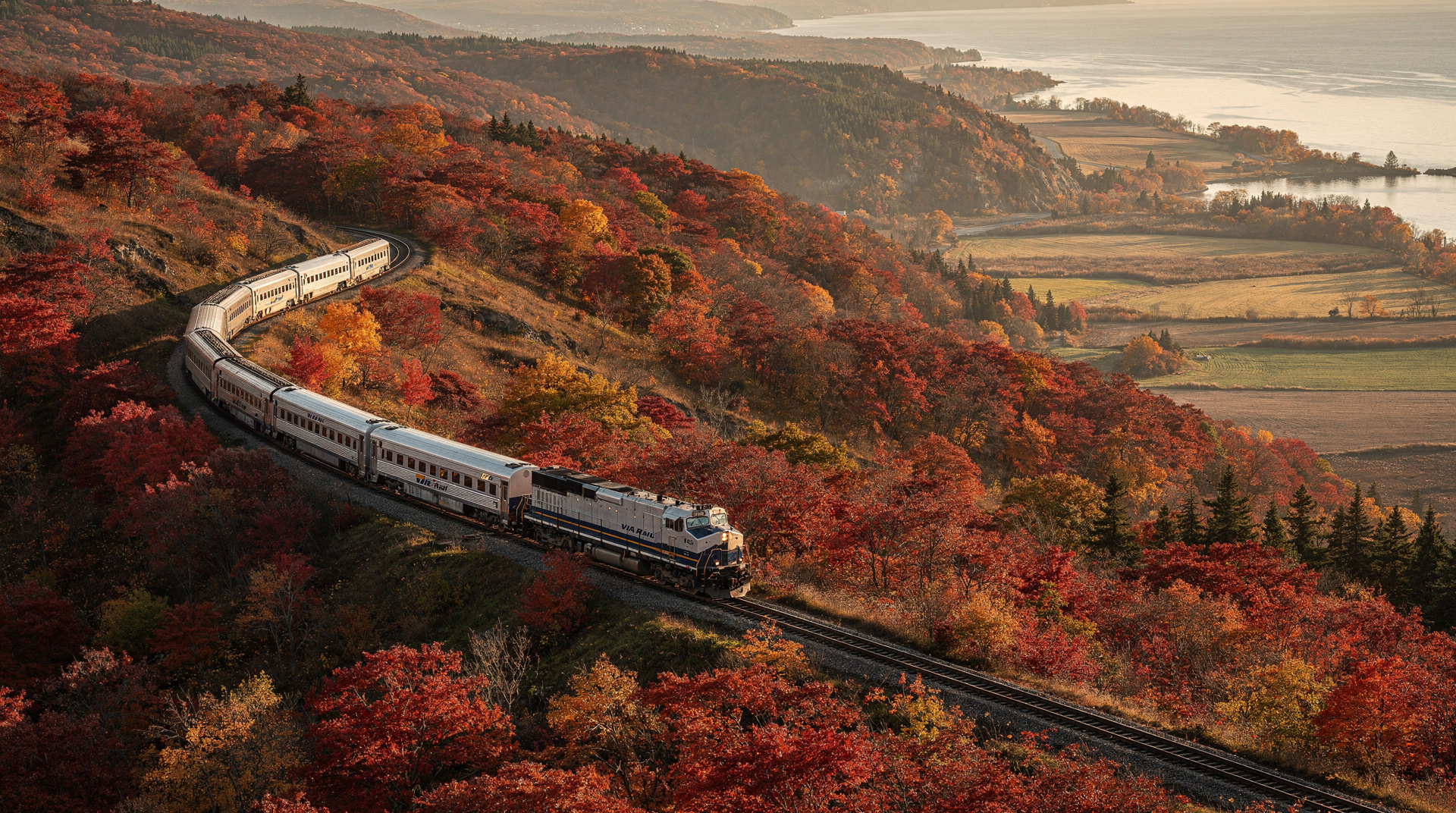
The view: this is the honest part. The Montréal-Québec City rail corridor does not run along the Saint-Laurent the entire way, despite what some descriptions imply. You pass through industrial suburbs, flat agricultural land, small towns, and some genuinely pleasant river and forest sections. The Québec City approach, when you come in along the river with the city visible on the bluff above, is dramatic. The rest of the journey is functional rather than scenic.
The economy ticket price in 2024: 40 to 90 CAD each way depending on how far in advance you book and which departure you choose. The 06:40 and 09:15 morning departures from Montréal tend to be less expensive than peak afternoon trains.
The Business class comparison
Business class on Via Rail occupies a separate car at the front of the train. The seats are leather, wider and with more recline than economy, arranged in a 2-1 configuration. Meals are included — a proper plate service rather than a snack, with wine available. The car has fewer passengers and a noticeably quieter atmosphere.
The meal service in September 2024 was genuinely good for train food: an appetiser (a cold duck terrine with pickled vegetables), a main course choice of salmon with roasted vegetables or a beef option, and a dessert. The wine poured was a Québec Cantons-de-l’Est white that I would not have ordered in a restaurant but was pleasant enough at altitude equivalent speed.
Business class in September cost approximately 150 to 200 CAD each way. That is real money for a three-hour train journey — more than most regional European business class equivalents for the same distance. Whether it is worth it depends entirely on what the alternative is.
Economy vs Business, side by side:
| Economy | Business | |
|---|---|---|
| Price (each way) | 40–90 CAD | 150–200 CAD |
| Seat | 2+2, modest recline | Leather, 2+1, wider recline |
| Food | None included, café cart available | Full plated meal with wine |
| Crowd | Can be near-full in peak season | Fewer passengers, quieter |
| Best for | Budget travellers, solo trips | Special occasions, work calls, comfort priority |
Via Rail versus driving: the honest calculation
This is the question that actually matters for most visitors.
Driving: Montréal to Québec City via Autoroute 20 takes 2 hours 45 minutes to 3 hours 15 minutes without traffic. On a clear weekday morning, you can easily do it in under three hours. On a Friday afternoon or a Sunday, traffic around Montréal can add 30 to 60 minutes. A rental car gives you total flexibility on both ends; the train deposits you at a station that requires onward transport.
Train: Three hours from station to station, with no driving stress, no parking costs in Québec City (which are high in the old town area), no road fatigue. You can work, read, or simply watch out the window. The stations are convenient in both cities.
The decisive factor: Do you have a car anyway? If you are renting a car for a Québec road trip, driving between Montréal and Québec City adds no cost and gives you flexibility. If you are staying urban — Montréal for a few days, then Québec City for a few days, using public transit and taxis — the train is the better option by a significant margin.
It is faster than an intercity bus, more comfortable, and deposits you closer to the city centre than a rental car return would. If you are still deciding how to structure the whole trip, the Montréal to Québec City travel guide compares every option side by side, and the car rental guide is worth reading before you commit to a road trip itinerary.
Arriving from the airport instead
Not everyone starts this journey from downtown Montréal. If you are flying into Montréal and heading straight to Québec City, the calculation changes: you would need to get from Trudeau Airport to Gare Centrale first, which adds 30 to 45 minutes and a taxi or metro fare before the train even leaves.
Some visitors skip Montréal entirely and fly directly into Québec City’s own airport — the YQB airport guide covers that route, which can be the simpler choice if Québec City is your priority and Montréal is a later add-on. For those keeping a tight budget across the whole trip, the Québec budget and cost guide puts the train fare in context against food, lodging and tours.
A private transfer is also worth knowing about if you are travelling with a group or heavy luggage and would rather skip the station altogether:
Private transfer from Montréal to Québec City
What nobody mentions: the bag policy
Via Rail has a somewhat different baggage policy from airlines in one important way: there is no fee for checked bags on trains. You can check bags at the station and travel light. This is worth knowing if you are moving between cities with luggage — no Tetris with overhead bins, no 25 CAD checked bag fees.
The downside is that you cannot track your bag in real time, and the checked bag retrieval at Gare du Palais is a brief delay at the end of the journey. For a three-hour trip, checking bags is usually not worth the friction; most travellers just keep their bags in the overhead rack.
The walking connection
The walk from Gare du Palais to the lower town of Vieux-Québec and up to Haute-Ville (the upper town) covers most of what you want to see on arrival. The funicular connects the lower and upper towns at the Château Frontenac end. With manageable luggage, the station-to-hotel walk is entirely pleasant in mild weather.
In winter, in significant snowfall or when it is very cold, a taxi or Uber is the better choice. The walk is doable but the hill to Haute-Ville in ice and wind is an unpleasant way to start a visit.
Old Québec classic walking tour with funicular
The booking reality
Via Rail’s booking system is functional but has quirks. Prices change based on availability (similar to airline dynamic pricing), which means booking two to three weeks ahead typically gets you a meaningful discount versus booking at the last minute. The website has improved in recent years but is still not as slick as European rail booking systems.
The full Via Rail guide for Québec covers booking tips, the full timetable, the Montréal-Halifax service (Le Océan), and comparison with bus alternatives for the corridor. For most visitors doing the Montréal-Québec City leg, the simple advice is: book two to three weeks ahead, travel economy in the morning, and expect a comfortable if not spectacular journey.
The train is, in the end, a good way to travel between these two cities. It is not transformative. It is not slow or unpleasant. It is a solid, functional service that does what it says it does, and in September with the light on the river as you come into Québec City, it is genuinely pleasant.