Tadoussac 2025 whale season recap
After the boats come in for the last time
The whale watching season in Tadoussac ends in mid-to-late October, when the water temperature drops enough that the krill and capelin concentrations that support the Saint-Laurent’s whale population thin out and the larger cetaceans move to deeper offshore feeding grounds. By early November, the zodiac fleet is dry-docked, the whale watching companies have closed their booking windows for the season, and Tadoussac itself — a village of about 800 permanent residents — returns to its winter quietude.
This is a recap of the 2025 season from someone who was there for three days in late August and has been following the reports since. I also spoke with a marine mammal observation naturalist who has been working in the Saguenay-Saint-Laurent Marine Park for the past eight years.
| Season | May to mid-October, peak mid-July to mid-September |
| Getting there | ~210 km from Québec City via Route 138, free ferry at Baie-Sainte-Catherine |
| Cost | Zodiac and large-boat tours around 70–120 CAD per adult |
| Booking | Advance booking essential for July–August, especially zodiacs |
| Species reliably seen | Belugas (year-round), minkes, finbacks; blue whales in summer |
The marine park context
The confluence of the Saguenay fjord and the Saint-Laurent estuary creates one of the world’s most productive coastal marine environments. The fjord brings cold, nutrient-rich water from depth up into the shallower estuary; the Saint-Laurent brings fresh water and organic material from the continent. The result is a dense concentration of krill, capelin, and small fish that attracts an extraordinary diversity of marine mammals.
Thirteen species of cetacean are regularly observed in the marine park: minke whales, fin whales, blue whales (the largest animals on earth), humpback whales, beluga whales (resident year-round), harbour porpoises, and others less frequently. The beluga population in the Saint-Laurent is a distinct population — genetically isolated from Arctic belugas — and represents one of the most closely studied cetacean populations in the world.
The 2025 season: what was seen
The 2025 season was strong by most measures. The krill bloom in the Saint-Laurent estuary was earlier and denser than average, which brought larger feeding concentrations of fin and blue whales into viewable range from mid-June onward.
June: Early season. Belugas present as always. Minke whales from the first week. Some fin whale activity. Blue whale sightings rare — a handful of confirmed observations in the outer estuary.
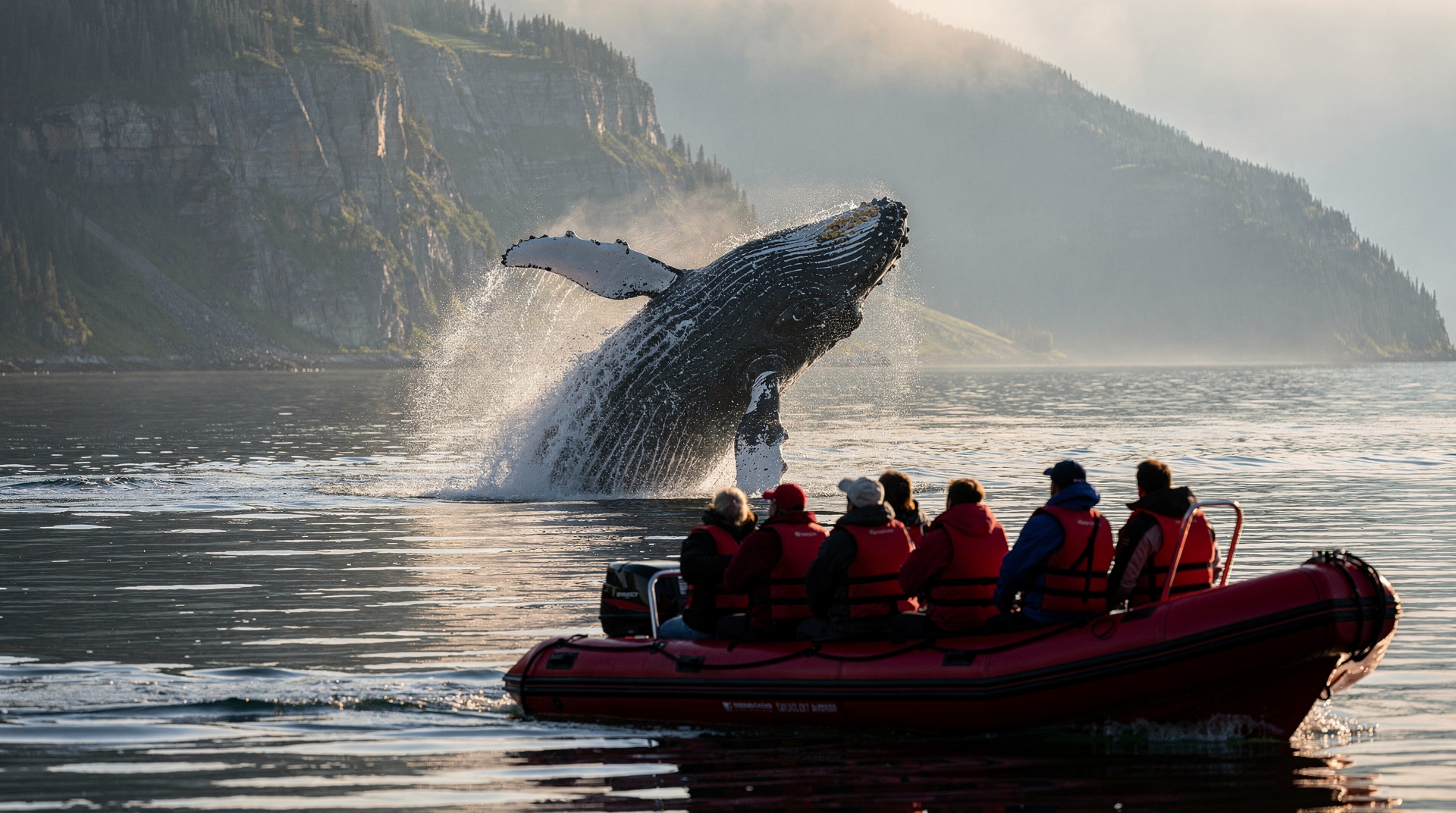
July: Peak diversity. Blue whale sightings increased significantly in the third week of July, with multiple daily observations at the confluence. The mid-July to mid-August period was the most productive for large whale sightings in 2025, consistent with recent years. Humpback whales were observed more frequently than in 2024, including some breaching behaviour that produced extraordinary photographs from boat operators.
August: Peak season continues. My visit in late August coincided with an exceptionally active period — on the zodiac tour I took, we observed five fin whales, two blue whale surfacing sequences at relatively close range (100 to 150 metres), and a large group of belugas moving upriver. This was, by the naturalist’s count, an above-average day even for peak season.
September: Activity gradually shifts. Fin and blue whales begin moving toward deeper water, but September remains productive for those willing to tolerate cooler conditions. The light is lower and more directional, which makes for better photography. Crowds are thinner.
October: End of season. Some fin whale activity into the first week of October. Blue whale sightings became rare after mid-September. Belugas remain year-round.
2025 season at a glance, month by month:
| Month | What was reliably seen | Crowd level |
|---|---|---|
| June | Belugas, minkes, some fin whales | Low |
| July | Peak diversity, blue whales from week 3 | High |
| August | Peak season, frequent fin/blue sightings | Very high |
| September | Belugas, fin whales, some blue whales | Moderate |
| October | Belugas, some minkes and fin whales | Low |
3-hour whale watching boat tour from Tadoussac
Zodiac versus large boat: the honest comparison
This question comes up constantly and deserves a direct answer.
Zodiac: You will be low to the water, close to any animals observed, and significantly more physically connected to the marine environment. You will also be cold (even in August, wear the jacket they give you), potentially wet, and unable to move around much. Passengers with mobility issues or a tendency toward seasickness should think carefully. The naturalist commentary is usually delivered by a dedicated guide, and the smaller group size (typically 12 to 24 people) means more one-on-one explanation. The zodiac tours can sometimes access areas where the large boats cannot go, but this varies by conditions.
Large boat: Enclosed cabin options, a bar, observation decks at multiple heights, the ability to move around and find a spot out of the wind. More stable in choppy water. Group size is larger (50 to 200 people depending on the vessel), which means you may be competing for rail space during a sighting. The onboard naturalist interpretation is usually good but necessarily more broadcast than interactive.
My preference, having done both: zodiac for the immersive experience if you are physically comfortable with it. Large boat if you are travelling with children, older adults, or anyone for whom cold and confined seating is a significant concern.
What the naturalist told me about the season’s end
I asked about the significance of the end-of-season moment — the last few days of October when the boats come in for winter — to someone who has been doing this for eight years.
“Every year it’s different,” he said. “Some years the large whales are still present in the third week of October. Some years they’re essentially gone by September 25. What hasn’t changed is the belugas — they stay. The river keeps them. And every year, even after hundreds of tours, a blue whale surfacing 100 metres from your zodiac still stops me. I think you lose something if it stops affecting you.”
The beluga population of the Saint-Laurent has been slowly recovering after decades of decline caused by industrial contamination and vessel traffic. The population, which was perhaps 7,000 animals in the 1800s and dropped to an estimated 900 in the 1970s, now numbers approximately 900 to 1,000 animals again after stringent protection measures. It is not recovered in any meaningful sense, but the decline has stabilised.
The belugas are visible year-round in the Saguenay-Saint-Laurent Marine Park. The best surface observations are possible from the headlands above the confluence (particularly the Cap de la Boule lookout above Baie-Sainte-Catherine) and from whale watching boats throughout the season. Even without booking a boat tour, you can often see belugas from the shore at the right locations.
Planning for 2026
If you are planning a Tadoussac trip for the 2026 season, the practical notes:
The drive from Québec City to Tadoussac is approximately 210 kilometres via Route 138, with a free ferry crossing at Baie-Sainte-Catherine (10 minutes, runs frequently). Allow three hours from Québec City, three and a half to four hours from Montréal via Québec City.
The peak season for large whale diversity is mid-July through mid-September. If you can only go once, that window maximises your chances. Early July and late September offer quieter conditions with somewhat reduced (but still good) sighting probability.
Book whale watching tours in advance for peak July and August dates. The zodiac tours in particular sell out well ahead.
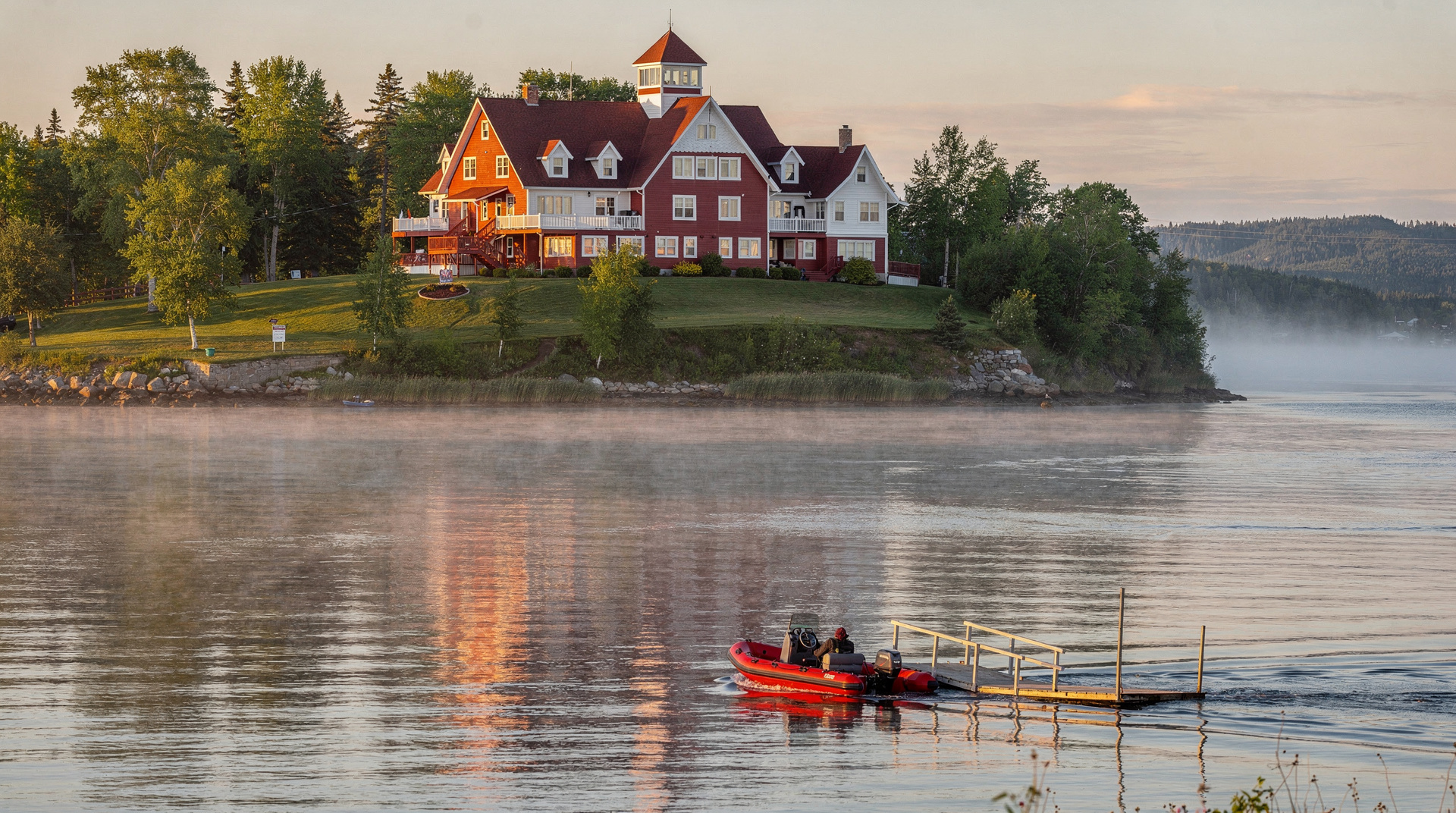
Accommodation in Tadoussac is limited — the village is small. The Hôtel Tadoussac (the red-roofed landmark visible from the river) and several smaller auberges and B&Bs make up the bulk of the options. Camping in the national park at Pointe-Noire is excellent and considerably cheaper than the village hotels.
Choosing your boat for 2026
If 2025 is anything to go by, the choice between a zodiac and a large boat will matter more than which week you book. The zodiac versus boat cruise guide breaks down the practical differences in more depth than the summary above. If you also want a shot at land-based wildlife alongside the whales, a combined tour is worth considering:
Whale and black bear observation tour from Tadoussac
And if you are weighing Tadoussac against other whale-watching regions on the Gaspésie side of the Saint-Laurent, the Tadoussac vs Percé comparison covers the trade-offs, while whale species of the Saint-Laurent is useful background before any trip so you know what you are looking at when a fin surfaces near the boat.
The complete Tadoussac and whale watching guide covers everything from how to read a naturalist’s whale sighting report to which boat operators have the best environmental credentials, and the Tadoussac destination page has the logistics for the village itself — where to stay, eat and park.