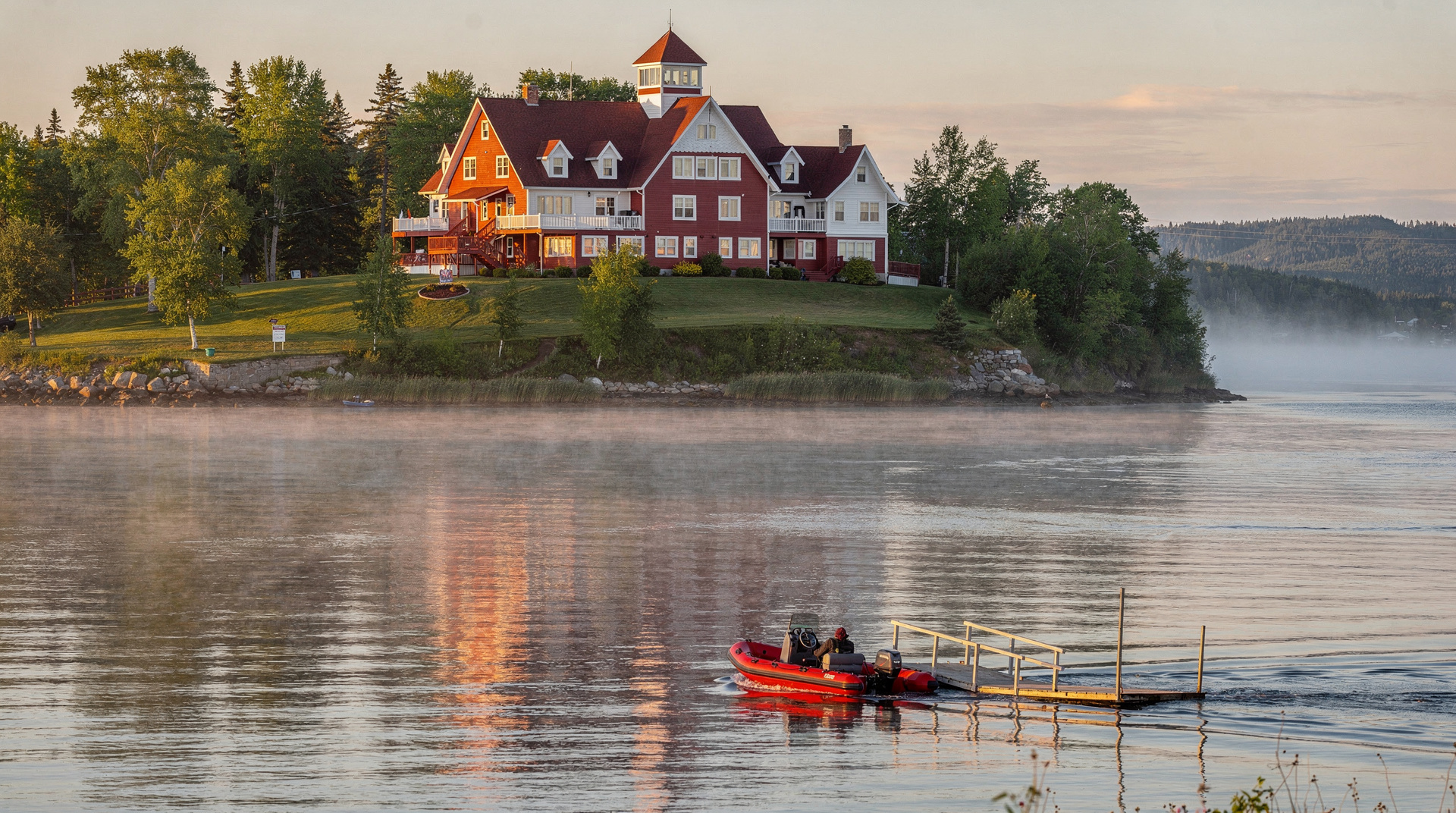
Whale watching in Tadoussac: the complete honest guide
3-Hour Whale Watching Boat Tour
Duration: 3 hours
Is whale watching in Tadoussac worth it?
Yes — Tadoussac is one of the best whale watching locations in the world, with blue whales, fin whales, humpbacks, and belugas accessible on 3-hour boat tours from 75–120 CAD. Season runs May to October with peak sightings July and August. Sightings are not guaranteed but common.
| Where | Tadoussac, ~200 km east of Québec City on Route 138 |
| Cost | around 75–120 CAD/person for a 3-hour tour |
| Time needed | 3 hours on the water, plus travel |
| Getting there | car required; free ferry from Baie-Sainte-Catherine |
| Best time | July–August peak; May and October lower odds |
Why Tadoussac is among the world’s great whale watching destinations
There are places on earth where whale watching is a commercial activity dressed up as wildlife tourism — boats circling open ocean hoping to spot a distant spout. Tadoussac is not one of those places. It is a location where the geography itself creates a reliable, year-after-year concentration of whales in quantities that genuinely astonish first-time visitors.
The reason is hydrogeological. The Saguenay Fjord, a 155-km-long glacially carved fjord that empties into the Saint-Laurent at Tadoussac, brings cold, oxygenated water from depth to the surface. When this water meets the warmer, saltier Saint-Laurent tidal flow, it creates an upwelling rich in krill and capelin — the preferred food of baleen whales. The result is a natural feeding ground that attracts blue whales (the largest animals on earth), fin whales, humpbacks, minke whales, and the year-round resident beluga population.
This guide covers everything you need to plan a successful whale watching visit to Tadoussac: why the whales are there, which species to expect, how to choose an operator and boat type, the important rules about belugas, and what to do if you want to see whales without getting on a boat.
Why the whales are here: the science in plain language
The confluence of the Saguenay Fjord and the Saint-Laurent at Tadoussac is one of the most productive marine feeding zones in the northern hemisphere for a simple reason: cold, dense, nutrient-rich water is constantly being pushed to the surface.
The Saguenay Fjord is cold and deep — up to 275 metres at its deepest point. Water from depth is rich in nutrients (phosphates, nitrates) because decomposing organic matter from above accumulates there. When this cold, dense water meets the shallower, warmer Saint-Laurent at the confluence, the denser Saguenay water slides under the Saint-Laurent but simultaneously the tidal action of the Saint-Laurent forces the Saguenay water upward. This upwelling carries the nutrients to the surface.
Krill, copepods, and capelin respond to the nutrient surge by concentrating in enormous quantities. Baleen whales, which feed by filtering massive volumes of water through their baleen plates, follow the food. The result: a seasonal concentration of large whales within 15–30 km of the Tadoussac dock, accessible to commercial whale watching boats in 3 hours.
Which whale species you will see
Blue whale (Balaenoptera musculus)
The largest animal that has ever existed on earth — up to 30 metres long, weighing 150-170 tonnes. Seeing one from a whale watching boat is genuinely disorienting: the scale does not process normally. The dorsal fin (small and set far back on the body) appears and disappears briefly; then the back rolls up for what seems like an impossibly long time before the fluke appears.
Blue whales are migratory visitors to the Tadoussac area, arriving in summer to feed. Sightings are common but not guaranteed on any given tour. The period mid-July through August is when concentrations are highest.
How to identify: the largest animal in the water, distinctive blue-grey mottled colouring, small dorsal fin set 3/4 of the way back, an extraordinary 9-metre-high blow (spout) visible from far away.
Fin whale (Balaenoptera physalus)
The second-largest animal on earth (up to 26 metres), and arguably the most commonly seen large whale at Tadoussac. Fin whales feed cooperatively and are often seen in small groups. They have a distinctive asymmetric colouring: the right side of the jaw is white, the left is dark — unique in the animal kingdom.
How to identify: large and fast (called “the greyhound of the sea”), white right jaw patch visible on surfacing, tall blow, pointed dorsal fin set far back.
Humpback whale (Megaptera novaeangliae)
The showman of the whale watching world. Humpbacks are known for acrobatic surface behaviour: breaching (leaping fully or partially from the water), tail slapping, flipper slapping, and spy-hopping (rising vertically to look around). Not every humpback puts on a show, but the probability of some surface behaviour is higher with humpbacks than other species.
The Tadoussac area hosts humpbacks primarily from June through October, with July and August being peak.
How to identify: long white pectoral fins (up to 1/3 of body length), distinct knobby tubercles on head and jaw, deeply notched flukes with unique markings used for individual identification.
Minke whale (Balaenoptera acutorostrata)
The smallest and most common baleen whale at Tadoussac. Minkes reach 8–10 metres and are fast, curious, and sometimes boat-approachable. They do not breach often and have a small blow barely visible except in cold air. Their abundance means you are almost certainly guaranteed at least one minke sighting even on lower-activity days.
How to identify: smallest baleen whale, pointed snout, white patch on each pectoral fin, fast swimming, erratic surfacing pattern.
Beluga whale (Delphinapterus leucas) — shore viewing only
The white beluga whales of the Saint-Laurent are one of Québec’s most iconic wildlife symbols — and one of the most important conservation stories in Canadian waters. The Saint-Laurent beluga population numbers approximately 900 individuals and is listed as endangered under Canada’s Species at Risk Act.
Canadian law under the Species at Risk Act and the Marine Mammal Regulations prohibits motorised vessels from approaching within 400 metres of belugas. This regulation is strictly enforced. Reputable Tadoussac operators will not approach belugas.
The good news: belugas can be observed excellently from shore. The best shore viewing points are:
- Pointe-Noire (across the Saguenay from Tadoussac, accessible by ferry): Parks Canada observation station with a high viewpoint directly over the confluence. Belugas regularly feed and socialise in this area.
- Cap-de-Bon-Désir (Les Bergeronnes, 30 km east on Route 138): another shore observation point managed by Parks Canada and Parcs Québec. See our dedicated shore whale watching guide.
Belugas are present in the Saint-Laurent year-round. Summer concentrations near the Saguenay confluence are highest.
Important: any operator that claims to offer beluga boat tours is either breaking the law or misinforming you. Avoid them.
The main whale watching operators
Croisières AML
The largest operation in the area, running large catamaran vessels with capacity of 200–600+ passengers. The larger AML boats offer interior heated seating, snack bars, and stability that makes them the best choice for families with children and those prone to seasickness. Onboard naturalists provide commentary in French and English.
AML also operates from Québec City (the whale watching plus bus transfer package from Québec City) and has boats at Baie-Sainte-Catherine as well as Tadoussac.
Best for: families, people prone to motion sickness, those prioritising stability and comfort.
Otis Excursions
A mid-sized local operator offering both large enclosed boats and zodiacs. Otis is a well-regarded family operation with experienced captains who have decades of local knowledge. Their zodiac tours are particularly popular for the close-to-water experience.
Best for: zodiac enthusiasts, experienced boat travellers wanting a local-operator feel.
Groupe Dufour
Another established local operator with both large boats and zodiacs. Dufour has a strong reputation for small-group VIP experiences and morning twilight tours that target peak whale feeding activity.
Best for: VIP options, early morning tours for maximum wildlife activity.
Mer & Monde Écotours
The smallest and most ecologically focused operator. Mer & Monde runs small-group sea kayaking and zodiac tours with a strong naturalist/interpretive focus. Their zodiac trips are lower capacity and more intimate, with guides who provide detailed species information and ecological context.
Best for: serious wildlife enthusiasts, those wanting interpretive depth, small-group experiences.
Choosing your boat: zodiac vs cruiser
This is the central practical decision for whale watching in Tadoussac. See the dedicated zodiac vs boat cruise comparison guide for full detail. In brief:
Large cruise boat — stable, heated interior, ideal for families and those prone to motion sickness. Less physical sensation of being near the water.
Zodiac — inflatable rigid-hull boat, much lower to the water. More thrilling, more immediate, physically engaging. Significantly more affected by waves. You may get wet. Experienced travellers in good physical health who are not prone to motion sickness generally prefer the zodiac experience.
3-Hour Whale Watching Boat Tour (Tadoussac) — the standard large-boat option, 3 hours, French/English naturalist commentary. Around 80 CAD per adult.
Whale Watching Zodiac Tour (Tadoussac) — zodiac option, 3 hours, same wildlife but a completely different physical experience. Around 75 CAD per adult.
VIP Lounge / Upper Deck Whale Watching (Tadoussac) — premium large boat option with access to the upper deck and VIP lounge for better sightlines and more space. Around 120 CAD per adult.
Whales and Fjord Morning or Twilight Tour (Tadoussac) — morning or evening departure to catch peak whale feeding activity and the dramatic light of the Saguenay Fjord. Around 85 CAD per adult. Often cited as the most atmospheric tour option.
What happens if you don’t see whales
Reputable operators do not guarantee sightings, because they are wild animals and no honest company can promise a specific encounter. That said, most large operators offer some form of protection: a free return trip on another date, or occasionally a partial refund, if the tour genuinely records zero cetacean sightings — check the specific policy when booking, since it varies by operator and season.
In practice, a true zero-sighting tour is rare during July and August; it becomes more plausible in the shoulder months of May and October, when whale numbers in the estuary are lower and less predictable. If your trip window is tight and you can only do one tour, book it earlier in your stay rather than on your last possible day, so a rebooking is actually usable if needed.
What a 3-hour tour looks like
Departure: most tours depart from the Tadoussac dock or the Baie-Sainte-Catherine dock (across the Saguenay, accessible by free government ferry). Large operators run multiple departures daily in peak season (typically 9am, 12pm, 3pm and sometimes additional slots).
First 30–45 minutes: transit from the dock out to the whale feeding grounds. The boat moves at comfortable speed. Your naturalist guide introduces the species you might encounter and explains the whale behaviour you will see. This is also a good time to get comfortable on the boat, take your seasickness medication position (stay on deck, look at the horizon), and decide where to position yourself for viewing.
The whale activity: when whales are located (either by the boat’s own observation or via radio contact with other boats and the research network), the captain slows and positions at an appropriate distance. Under Canadian Marine Mammal Regulations, boats must maintain at least 100 metres distance from baleen whales (except blue and fin whales where it is 200 metres). The whale behaviour at the surface — rolling, fluking, blowing — is the primary viewing experience.
Sightings last from minutes to half an hour depending on species behaviour. Multiple whale encounters across the 3-hour tour are common in peak season.
Return: 30–45 minutes back to dock. Total active wildlife time: typically 1.5–2 hours.
Practical tips for a successful trip
Book in advance: July and August tours fill up quickly, particularly for smaller operators. Book at least 1 week ahead for peak season. Last-minute walk-up tickets are sometimes available but not reliable.
Morning tours: generally, whale activity is higher in the morning when feeding is most active. Early tours (9am) are worth the early wake-up.
Weather: whale watching operates in most weather conditions, but rough seas can cause cancellation of zodiac tours. Large boat tours operate in higher sea states. Check the forecast and your operator’s cancellation policy before the day.
Clothing: even in July and August, temperatures on the water near the Saguenay can be 8–12°C. Dress in layers: a t-shirt, fleece, and a windproof shell is the minimum. Jeans become miserable when cold and damp; synthetic or wool trousers are better.
Binoculars: significantly enhance the experience for whale spout and behaviour watching at greater distances. A basic 8x42 pair is sufficient.
Getting to Tadoussac
From Québec City: Route 138 east. Approximately 200 km, 2h45 to 3 hours. A car is required — no practical public transport reaches Tadoussac.
The Tadoussac ferry: the final approach to Tadoussac from Baie-Sainte-Catherine involves a free government-operated ferry (traversier). The crossing takes approximately 10 minutes and runs frequently from early morning to midnight in summer. Wait times can be 30–60 minutes or more at peak summer weekends. Build buffer time into your schedule.
From Montréal: approximately 450 km, 5+ hours. An overnight stop in Québec City en route is strongly recommended. See the Tadoussac destination guide for accommodation options.
Where to stay in Tadoussac
Tadoussac is a small village with limited accommodation. Book well in advance for summer:
- Hôtel Tadoussac — the iconic red-roofed hotel on the cliff above the bay. Historic, atmospheric, wonderful views. Pricey.
- Gîtes du Passant — local bed and breakfasts. More personal, more affordable.
- Camping — municipal campground on the Tadoussac dunes, popular and relatively inexpensive.
- Baie-Sainte-Catherine and Sacré-Cœur — villages near Tadoussac with accommodation and more availability.
For more on the region, see the Côte-Nord destination overview and the best time for whale watching guide.
Combining Tadoussac with the rest of the trip
Most visitors do not treat Tadoussac as a standalone destination — it usually anchors a multi-day loop through the Côte-Nord and Saguenay. A 5-day whale and fjord itinerary is the natural template if whale watching is the priority, pairing a Tadoussac boat tour with the Saguenay Fjord and its own cruise options. If you also want a full species primer before you go — including which months favour which whale — read the whale species of the Saint-Laurent guide, which pairs naturally with this one.
Is a guided package worth it over independent travel?
Some operators, particularly AML, sell combined bus-and-boat packages departing directly from Québec City, which remove the need to drive or manage the ferry crossing yourself. These packages cost more than doing it independently (the bus and ferry logistics are not expensive on their own) but are genuinely useful if you don’t want to drive 400 km round-trip in a single day, or if you’re travelling without a car. If you do have a car, driving independently and choosing your own tour time and operator is usually the better value, and gives you flexibility to add Saguenay Fjord stops on the way.
Frequently asked questions about Whale watching in Tadoussac: the complete honest guide
Why are there so many whales at Tadoussac?
The confluence of the Saguenay Fjord and the Saint-Laurent at Tadoussac creates an exceptional natural phenomenon. Cold, nutrient-rich water from the Saguenay River meets the warmer Saint-Laurent tidal flow, forcing an upwelling of krill and small fish. This natural buffet attracts whales from as far as the Gulf of St. Lawrence and beyond, making the area one of the most reliably productive whale watching spots in the world.Can you see belugas on a whale watching boat in Tadoussac?
No — and this is important. Beluga whales in the Saint-Laurent are an endangered population. Canadian law prohibits motorised boats from approaching within 400 metres of belugas. Responsible operators will not approach belugas by boat. You can observe them from shore at dedicated observation points (Pointe-Noire, Cap-de-Bon-Désir, the Tadoussac dunes). Do not book with any operator that advertises guaranteed beluga boat access.What is the difference between whale watching operators in Tadoussac?
The main operators are Croisières AML, Otis Excursions, Groupe Dufour, and Mer & Monde Écotours. All are licenced and respectable. AML runs the largest boats (capacity 600+) with stability and interior seating. Otis and Dufour offer both large boats and zodiacs. Mer & Monde is the most eco-oriented, with smaller groups and naturalist-led focus. Price differences are small; the choice mainly comes down to boat type and group size preference.How likely am I to see whales on a Tadoussac tour?
Very likely in July and August — the peak season. Commercial operators track whale movements in real time via a network of guides and other captains, and will redirect boats toward active sightings during a tour. Operators do not guarantee sightings but most offer a partial refund or free return trip if no whales are seen. In May and late October, sighting probability is lower.How do I get to Tadoussac from Québec City?
Tadoussac is approximately 200 km from Québec City via Route 138, about 2h45 to 3 hours by car. The final leg includes a free government-run ferry from Baie-Sainte-Catherine to Tadoussac (10 minutes, runs constantly in summer). Tadoussac is not accessible by public transit — a car is required. Some tour operators offer bus-from-Québec-City packages.Should I take seasickness medication before whale watching?
If you are prone to motion sickness, take medication before boarding. Dramamine or Gravol (dimenhydrinate) should be taken 30–60 minutes before departure. On large boats in calm conditions, motion is minimal. On zodiacs in choppy water, motion is significant. Ginger candies are available on many boats. Staying on deck and looking at the horizon helps more than staying below.What should I bring on a whale watching boat in Tadoussac?
Layers — even in summer, temperatures on the water can be 5–10°C colder than shore. A windproof jacket is essential. Sunscreen (sun reflection off water is intense). Binoculars if you have them. Camera with zoom lens. Cash or card for the gift shop or onboard café. Seasickness medication if needed. Leave wheeled luggage at your accommodation.What is the best whale watching operator in Tadoussac?
For first-timers and families: Croisières AML for stability and comfort on larger boats. For intimate experience: Mer & Monde Écotours for naturalist commentary and small groups. For maximum wildlife proximity (weather permitting): Zodiac tours with Otis or Dufour. All four operators are reliable; personal preference for boat type is the main differentiator.
Top experiences
Bookable activities with verified prices and instant confirmation on GetYourGuide.