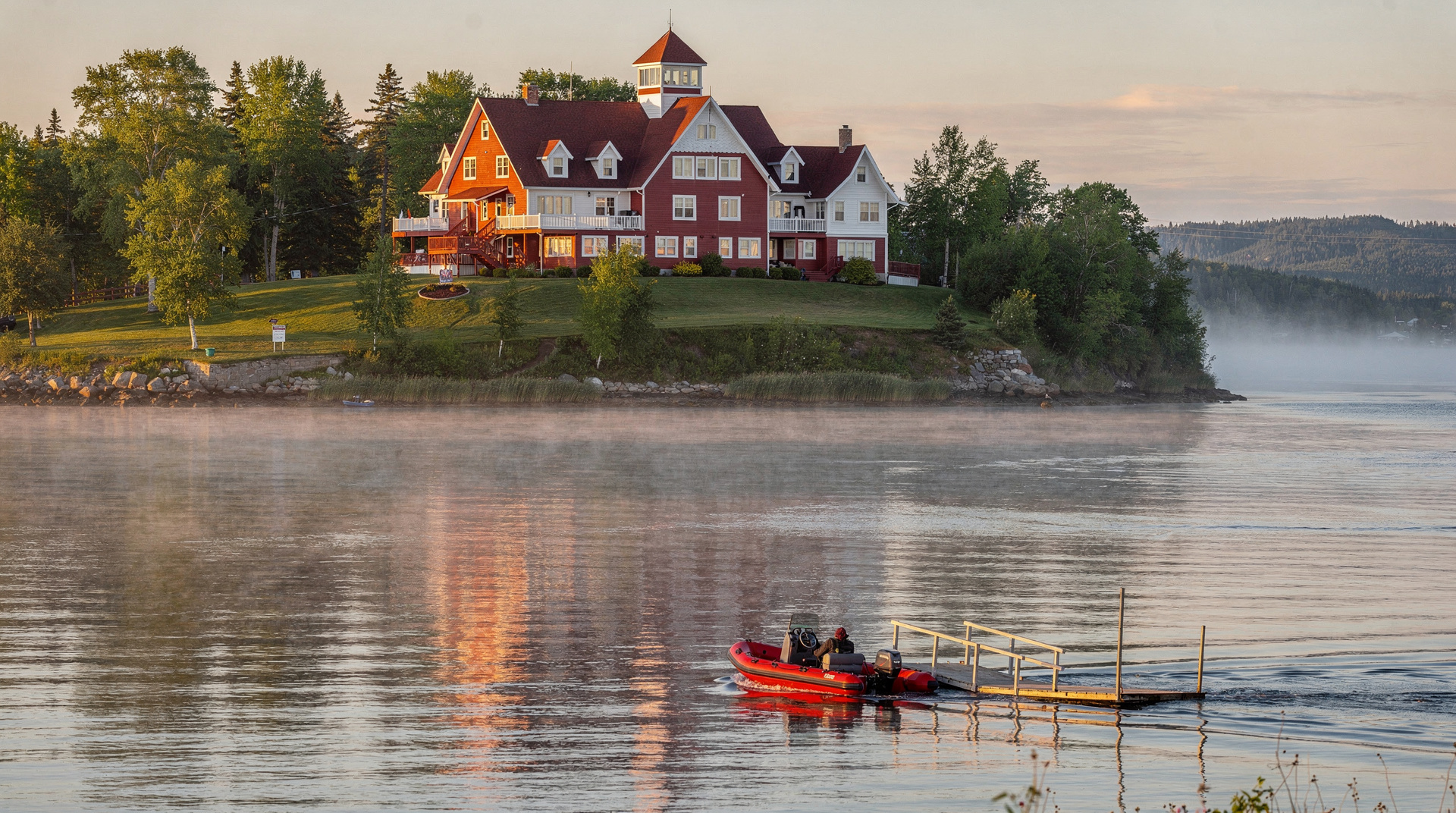
Tadoussac whale watching: zodiac vs boat cruise
3-Hour Whale Watching Boat Tour
Duration: 3 hours
Should I take a zodiac or a boat cruise for whale watching in Tadoussac?
Zodiac: lower to the water, more thrilling, better photography angles, but rougher ride and more affected by weather. Large boat: stable, heated interior, ideal for families and those prone to motion sickness. Wildlife access is similar for both — the choice is about the experience, not the whales.
The most common planning question about whale watching in Tadoussac
When visitors start planning whale watching in Tadoussac, the zodiac-versus-boat question comes up almost immediately. Both options are offered by all the major operators, prices are similar, the wildlife you are trying to see is identical — so what is the actual difference?
The short answer is: the wildlife experience is roughly equivalent; the physical experience is radically different. This guide explains exactly what those differences are, who each option suits, and what factors should drive your decision.
| Where | Tadoussac, at the Saguenay–St. Lawrence confluence |
| Cost | ~75 CAD zodiac, ~80 CAD large boat, ~120 CAD VIP |
| Duration | 3 hours, either format |
| Getting there | Free ferry from Baie-Sainte-Catherine, then dockside departure |
| Best time | July–August for lowest cancellation risk on either format |
If you genuinely can’t decide
Some visitors have the time and budget to try both, and it is worth considering deliberately rather than as an afterthought. Booking a morning zodiac and an afternoon large-boat cruise (or the reverse) on the same day gives you both physical experiences and a genuine backup if one is cancelled for weather — a real advantage in shoulder-season months.
If you only have one slot, default to the large boat unless you specifically know you want the more intense zodiac experience: the downside risk (a memorable trip is genuinely cold and bumpy for someone who didn’t want that) is higher than the upside risk of the reverse choice (a comfort-seeker on a calm-day zodiac still has a fine time). For the fuller context on how Tadoussac compares to Québec’s other major whale-watching base, see our Tadoussac vs Percé comparison.
Travelling as a mixed group with different comfort levels is common, and it’s worth deciding in advance rather than debating at the dock. A family with young children and grandparents is usually better served by putting everyone on the large boat together — splitting the group across two departures adds logistics and cost for a benefit that mostly matters to confident adult riders. A group of active adults with no seasickness concerns can reasonably let individuals choose independently, since both formats depart from the same dock at similar times.
What a zodiac actually is
A zodiac (also called a rigid inflatable boat or RIB) is an inflatable-hulled open boat with a rigid fiberglass or aluminum floor and outboard or stern-mounted engines. In whale watching context, zodiacs typically carry 12–24 passengers seated on tubes around the edge and centre of the boat, very close to the water surface.
The water surface sits approximately 20–40 cm below the tube you are sitting on. At speed, spray comes over the bow. When the boat slows near whales, you are genuinely at water level, in close proximity to the marine environment.
The driver sits at a small console near the stern. Naturalist guides (usually 1-2 per zodiac) move around the boat narrating whale behaviour and answering questions.
What a large whale watching cruise boat is
Large whale watching boats in Tadoussac are purpose-built catamaran or monohull vessels carrying 200–600+ passengers. They have multiple decks: an upper observation deck (open to weather), one or more interior heated salons with large windows, and on larger boats, snack bars, toilets, and small gift shops.
Passengers can move between decks during the tour — spend time on the upper deck for sightline and photography, retreat to the heated salon when cold or in rough weather.
The water surface sits 3–6 metres below the upper deck railing, and 1.5–2 metres below the salon windows.
Side-by-side comparison
| Factor | Zodiac | Large cruise boat |
|---|---|---|
| Water proximity | Very close (20–40 cm) | Moderate to distant (1.5–6 m) |
| Stability | Lower — affected by waves | High — stable in most conditions |
| Weather sensitivity | High — may cancel in moderate seas | Low — operates in rougher conditions |
| Speed to whale area | Faster, more agile | Slower, predictable |
| Passengers | 12–24 (intimate) | 200–600+ (crowd) |
| Heated interior | No (open boat) | Yes |
| Onboard facilities | None | Toilets, snack bar, seating |
| Photography | Ground-level angles, dramatic | Higher elevation, broader sightlines |
| Motion sickness risk | Higher | Lower |
| Suitable for children | 7+ (operator dependent) | All ages |
| Price | Approximately 75 CAD | Approximately 80–120 CAD |
| Cancellation risk | Higher (weather dependent) | Lower |
The physical experience: what actually happens
On a zodiac
You board from a floating dock, stepping from the dock to the zodiac tube, then seating yourself either straddling the tube or on a central bench, depending on the boat configuration. You are given a flotation device.
At transit speed (heading out to the whale grounds), the zodiac rides swiftly. In calm conditions, this is exhilarating — the boat skims the surface, spray occasionally mists the front passengers, and the low angle creates a dramatic sensation of speed. In choppy conditions, the ride becomes bouncy; in rough conditions it is genuinely uncomfortable and the naturalist guide will be holding on rather than talking.
When whales are located, the driver slows to drift speed. At this point the zodiac’s advantage is most apparent: you are essentially at water level when a 25-metre fin whale surfaces 50 metres away. The scale impression is immediate and physical. The whale’s exhalation — a tall, misty column of water vapour — is at your eye level, not above you. You can hear the blow clearly.
Water temperature on the Saint-Laurent near Tadoussac is cold — typically 8–15°C in summer. If spray catches your face it is chilly. If you fell in (which does not happen under normal circumstances), a dry suit would be the appropriate response — which is why all zodiac passengers wear life jackets and why operators have strict weather cancellation thresholds.
On a large cruise boat
You board via a gangplank or dock stairway. The boat is large enough that you do not feel the water move beneath you during boarding.
At transit speed, the boat cruises steadily. Interior passengers feel minimal motion. Upper deck passengers feel wind and occasional wave motion. In rough conditions, the interior salon remains comfortable while the upper deck becomes challenging.
When whales are located, the boat positions and slows. From the upper deck, you have a wide sightline — excellent for spotting distant spouts, easier to track multiple whales simultaneously. The photograph perspective is different from a zodiac: you are looking down at the whales from elevation, which gives context (you can see more of the whale’s body) but less of the dramatic close-up scale.
The interior heated salon is a genuine comfort on cold, windy days. The ability to warm up, use the toilet, and buy a coffee mid-tour is not trivial when temperatures on the water are 10°C.
Wildlife viewing: is one better?
Both options access the same whale activity. Operators communicate continuously by radio, and both zodiacs and large boats position at the same whale aggregations. If blue whales are in a particular area of the confluence, both zodiac and cruise boat passengers see them.
The perception is often that zodiacs “get closer,” but this is not entirely accurate. All operators in Tadoussac must follow the same minimum approach distances mandated by Canadian Marine Mammal Regulations:
- Blue whale: 200 metres minimum approach distance
- Fin whale: 200 metres minimum
- Humpback whale: 100 metres minimum
- Minke whale: 100 metres minimum
Both zodiacs and large boats must comply with these distances. What changes is the subjective experience of proximity — a whale at 100 metres looks closer from a zodiac at water level than from a large boat 5 metres above the surface.
Photography: zodiacs offer more dramatic angles for close-up photography (you are literally at water level). Large boats offer higher positions that allow capturing more of the whale’s length in frame. Neither is definitively better — they produce different types of photographs.
Weather and cancellation: the practical reality
This is the most significant practical difference between the two options.
Zodiac tours are cancelled in moderate sea conditions — typically waves above 0.5–1 metre or in sustained high winds. Safety is the reason. The inflatable hull and low freeboard mean that waves above a certain height create unacceptable risk of swamping or passenger injury from jostling.
Large cruise boats can operate in significantly rougher conditions — wave heights of 1.5–2 metres are manageable for large catamaran vessels with appropriate design margins. Most large-boat whale watching tours in Tadoussac operate in all but the most extreme weather.
In July and August, sea conditions on the Saint-Laurent estuary near Tadoussac are usually calm — cancellation risk for either option is low. In May, June, September, and October, the probability of cancellation for zodiac tours is meaningfully higher.
If your visit to Tadoussac is on a tight schedule (one day only, specific departure booked) and the period is outside peak summer, book the large boat tour for reliability. Alternatively, book both a morning zodiac and an afternoon boat cruise — if the zodiac is cancelled, you still have the afternoon boat option.
Check cancellation policies carefully before booking. Most operators will offer a refund or credit if they cancel due to weather; confirm this before handing over payment.
Who should choose what
Choose the zodiac if:
- You are physically active and comfortable with boats
- Motion sickness is not an issue for you
- You want the most immersive, close-to-water experience
- Photography at water level is a priority
- You are travelling without young children (under 7) or elderly relatives with mobility considerations
- Your trip dates are in July or August when cancellation risk is low
Choose the large boat if:
- You are prone to motion sickness (even mild)
- You are travelling with children under 7
- You are travelling with elderly people or anyone with mobility limitations
- The weather is variable or your visit is outside peak summer
- Comfort and facilities matter — you want a toilet, heating, and a snack
- You want to observe multiple whales simultaneously from a broader elevated perspective
For groups with mixed needs:
Some families or groups find that different members prefer different options. Most operators run both types from the same dock. If half your group wants the zodiac and half wants the large boat, some operators will accept this — check beforehand. Alternatively, book the large boat for everyone and ensure a positive experience for all.
The operators at a glance
The main operators in Tadoussac offering both zodiac and large boat options:
Croisières AML — runs the largest boats in the area (600+ passengers). Also operates zodiacs but is primarily known for the large catamaran experience. Best for groups wanting maximum stability.
Otis Excursions — well-regarded local operator offering both formats. Their zodiac captains have particularly deep local knowledge.
Groupe Dufour — both formats available; known for their VIP and morning/twilight premium options.
Mer & Monde Écotours — primarily small zodiac tours with a strong naturalist/eco-interpretation focus. Their group sizes are the smallest, often 8–12 per boat.
3-Hour Whale Watching Boat Tour (Tadoussac) — the standard large-boat option. Stable, comfortable, excellent for families. Around 80 CAD per adult.
Whale Watching Zodiac Tour (Tadoussac) — the zodiac experience, same duration, water-level wildlife encounter. Around 75 CAD per adult.
Practical advice before you book
-
Check the weather 48 hours before your departure — if you are booked on a zodiac and a storm is forecast, contact your operator early. Cancellations are communicated on the morning of the tour or the evening before.
-
Bring layers regardless of which option you choose — the open upper deck of a large boat is nearly as cold as a zodiac in wind. A windproof jacket is essential for both.
-
Seasickness medication — if there is any doubt, take it before boarding. Dramamine (dimenhydrinate) works best when taken 30–60 minutes before the tour. On the zodiac, face forward and focus on the horizon if you feel unwell.
-
The VIP option — VIP Lounge / Upper Deck Whale Watching (Tadoussac) provides access to premium upper-deck seating and a VIP lounge on the large boat — more space, better positioning, around 120 CAD. A meaningful upgrade for serious photographers or those who want maximum space on a crowded summer tour.
For everything else you need to know about whale watching in Tadoussac — species, operators, timing, logistics — see the complete Tadoussac whale watching guide.
Frequently asked questions about Tadoussac whale watching: zodiac vs boat cruise
Do zodiacs get cancelled more often than large boats?
Yes. Zodiac tours are more sensitive to sea conditions — waves above 0.5–1 metre typically trigger cancellation for safety reasons. Large boat tours can operate in significantly rougher conditions (up to 2+ metres of wave height in some cases). In July and August, sea conditions are usually calm and cancellations are rare for both. In May, June, September, and October, zodiac cancellations are more common.Is a zodiac tour appropriate for children?
Most operators have minimum age requirements for zodiac tours, typically 5 or 7 years old, and sometimes higher for solo seating. Check with your operator. Young children (under 7) are better accommodated on large boats with indoor seating, stable decks, and easy access to bathrooms. Older children (10+) generally love the zodiac experience.Do zodiac passengers wear dry suits?
Usually not dry suits — those are for full water immersion activities like kayaking or diving. Zodiac passengers typically wear a flotation device (life jacket) over their own clothing. Some operators provide waterproof splash gear for zodiac passengers. Expect to potentially get wet from spray, particularly on the bow. Bring a waterproof layer regardless.Is the wildlife viewing better from a zodiac or a large boat?
It depends on species and behaviour. Zodiacs sit lower, which gives a different perspective — blue whales surfacing close to a zodiac are especially dramatic. Large boats have higher decks with broader sightlines and may allow better spotting of distant spouts. In practice, both offer equivalent wildlife access since operators position to the same whale activity.How many people are on each type of boat?
Large cruise boats typically carry 200–600+ passengers. Medium enclosed boats carry 50–150 passengers. Zodiacs typically carry 12–24 passengers. Smaller numbers on the zodiac means less jostling for position and a more intimate experience when wildlife appears.Are there intermediate options between a zodiac and a massive cruise boat?
Yes. Some operators run medium-sized rigid inflatable boats (RIBs) that carry 30–50 passengers and offer a compromise: more stable than a zodiac but lower and more agile than a large cruise boat. Check operator boat specifications when booking.
Top experiences
Bookable activities with verified prices and instant confirmation on GetYourGuide.