Laurentides (region overview)
Québec's Laurentians: year-round outdoor playground 1h north of Montréal. Skiing, hiking, via ferrata, foliage, dog sledding, and snowmobiling.
Laurentian Mountains Fall Leaves Day Trip
Duration: 10 hours
Quick facts
- Distance from Montréal
- From 45 km (Saint-Sauveur) to 130 km (Mont-Tremblant)
- Main corridor
- Route 117 / Autoroute 15 north
- Foliage peak
- ~September 21–30
- Cycling trail
- P'tit Train du Nord: 232 km, Brébeuf to Mont-Laurier
- Currency
- CAD (taxes ~15% on top)
Québec’s outdoor backyard: a region that delivers in every season
The Laurentides — known in English as the Laurentians — is the broad swath of Precambrian Canadian Shield that begins about 45 km north of Montréal and extends 200 km north through a landscape of rounded hills, lakes, and boreal forest. It is the region that Montréalers have been fleeing to on weekends since the early twentieth century, and the infrastructure that has developed as a result — trails, resorts, restaurants, inns — is unusually dense for a primarily outdoor destination.
The Laurentides is not a single attraction but a corridor of distinct towns and villages along Route 117, each with its own character. Saint-Sauveur at the southern entry is the most populated and the most commercial. Sainte-Adèle offers a quieter, more residential feel with a genuine town centre.
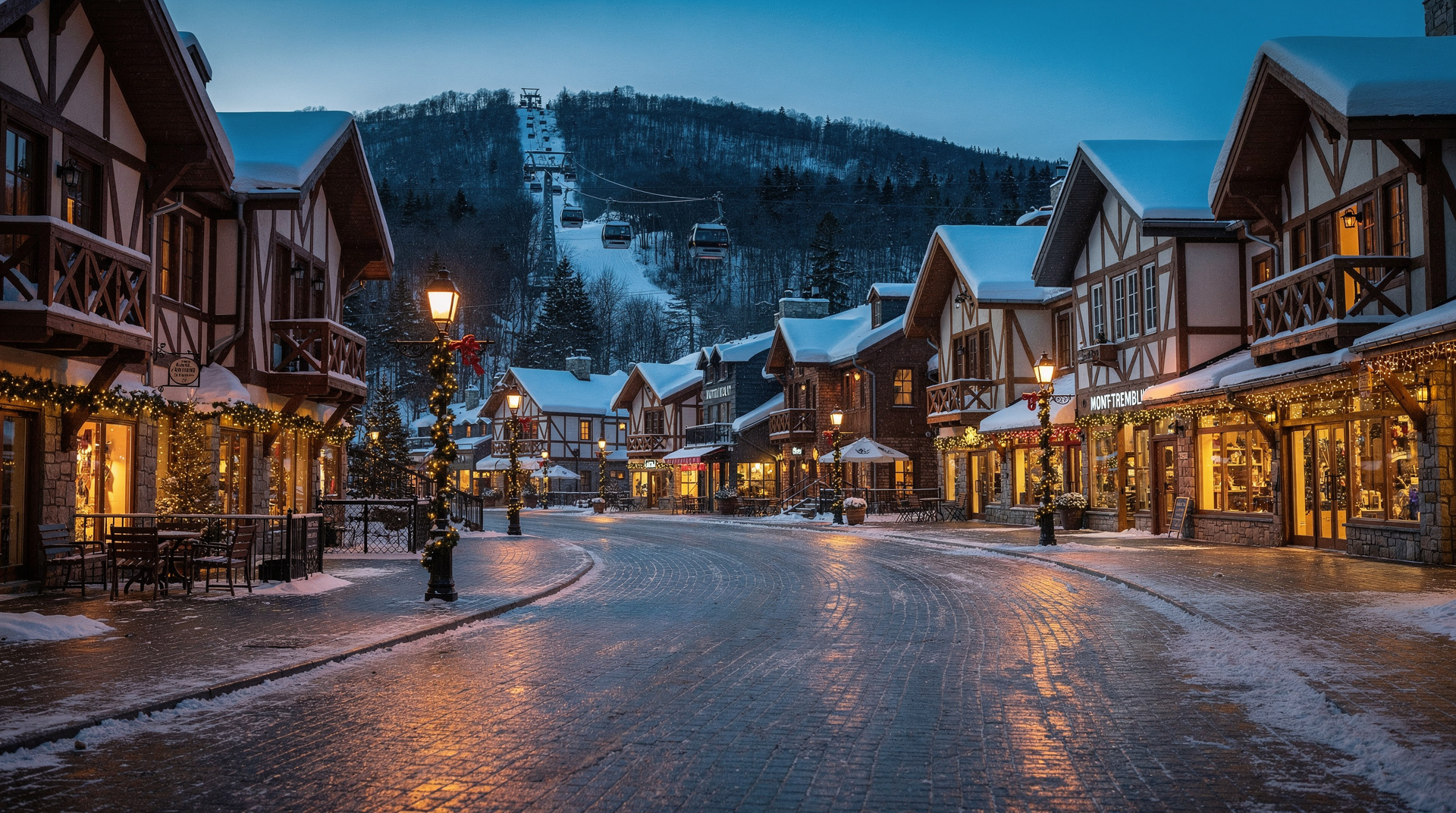
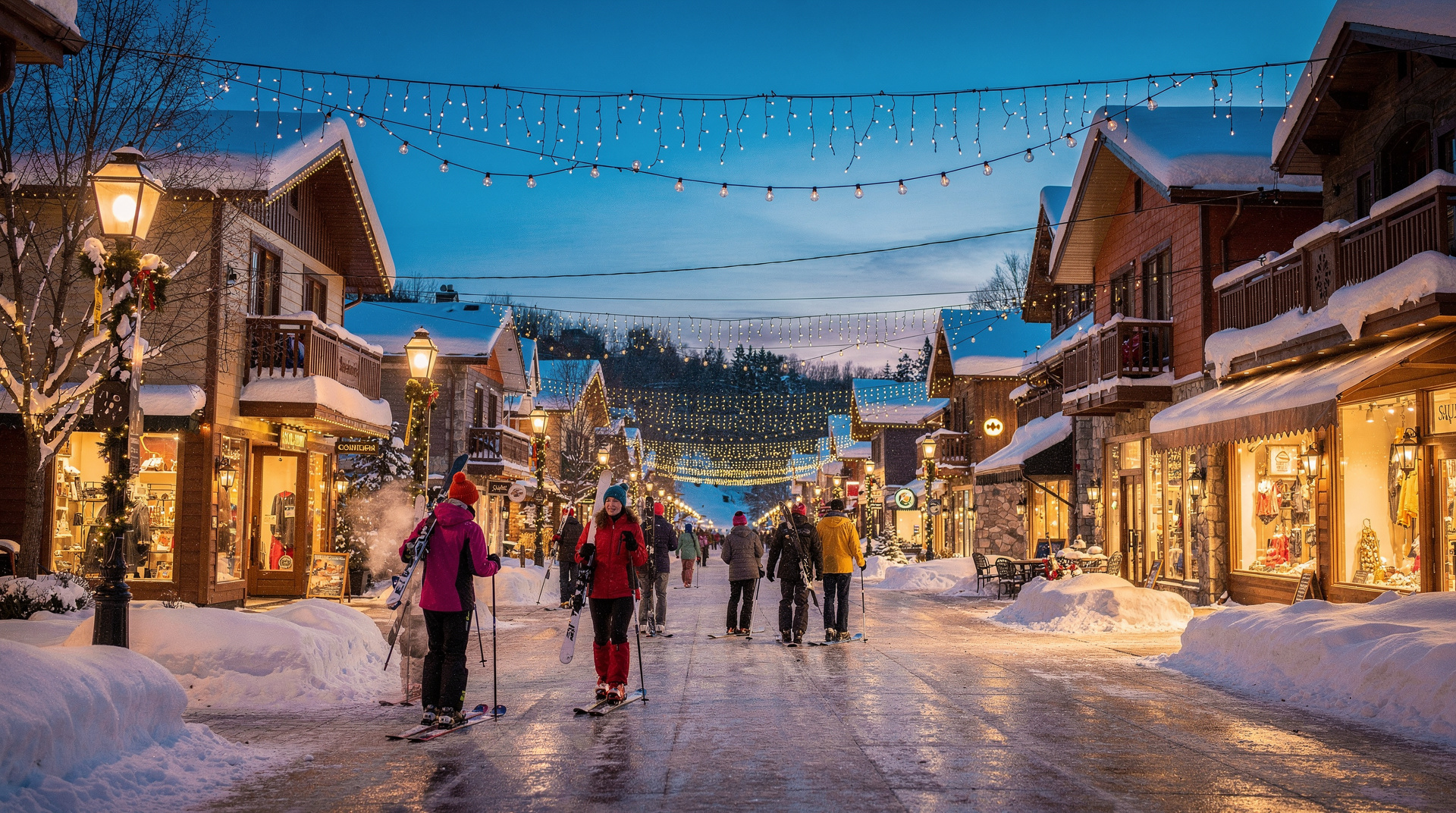
Val-David is an arts village beloved of rock climbers and cyclists. Sainte-Agathe-des-Monts sits on a lake and anchors the central Laurentides. Mont-Tremblant at the northern end of the main tourist corridor is the region’s flagship resort — the most developed, the most expensive, and, in ski season, the busiest.
Understanding the region as a corridor helps with planning: most visitors base themselves in one or two towns and day-trip along the highway rather than trying to stay in multiple places.
| Where | 45–130 km north of Montréal along Route 117 / Autoroute 15 |
| Time needed | 3–5 days to cover multiple towns; a single day trip is workable for one town |
| Getting there | Car (essential beyond town centres); Limocar bus reaches most towns |
| Cost | Ski lift tickets ~55–100+ CAD; guided tours 90–210 CAD; chalets 1,500–5,000 CAD/week |
| Best time | Dec–Mar for snow sports; late Sept for foliage; Jun–Sep for cycling and lakes |
The P’tit Train du Nord: the spine of the Laurentides
The former railway that connected Montréal to the northern Laurentides — decommissioned in the 1980s — was converted into what is now the P’tit Train du Nord multi-use trail: 232 km of rail-trail running from Saint-Jérôme in the south to Mont-Laurier in the north. It is one of the great cycling trails in North America.
In summer, the trail is paved or well-packed gravel and passes through every major village in the Laurentides, with former station buildings repurposed as cafés, restaurants, and information offices. The gradient is gentle — it is a railway bed — which makes it accessible to casual cyclists. You can rent bikes in most towns along the route, ride a section, and shuttle back.
In winter, the trail becomes a snowmobile highway and groomed cross-country ski trail — a different experience entirely, but equally popular. The trail connects directly to Tremblant’s snowmobile network.
The full 232 km point-to-point (south to north) takes 4–6 days by bike. Most visitors pick a 30–50 km section: the stretch between Sainte-Agathe-des-Monts and Mont-Tremblant is particularly scenic, passing lakes and mixed forest that hits peak colour in the last week of September.
Autumn foliage: peak Laurentides
The Laurentides has one of the most reliable foliage seasons in Québec. The combination of altitude (the hills top out around 900 m), latitude (45–47°N), and mixed forest composition — sugar maple, red maple, yellow birch, trembling aspen, white birch — produces an unusually consistent display. Peak colour in the main corridor (Saint-Sauveur to Sainte-Agathe) typically falls between September 21–28. Mont-Tremblant peaks slightly later, around September 28 to October 5.
The most scenic viewing spots: the gondola at Mont-Tremblant gives an aerial perspective over the forest bowl. The hills above Val-David and the lakeside circuit around Sainte-Agathe-des-Monts are equally spectacular on foot or by bike. The P’tit Train du Nord trail under full canopy during peak week is arguably the best possible way to experience the foliage — the elevation change and tree canopy produce a tunnel of colour.
A guided Laurentians fall foliage day trip from Montréal (around 91 CAD, 10 hours) makes sense if you want a curated experience without driving; the tour typically visits the Tremblant area and a few villages along the way.
Winter sports: the full menu
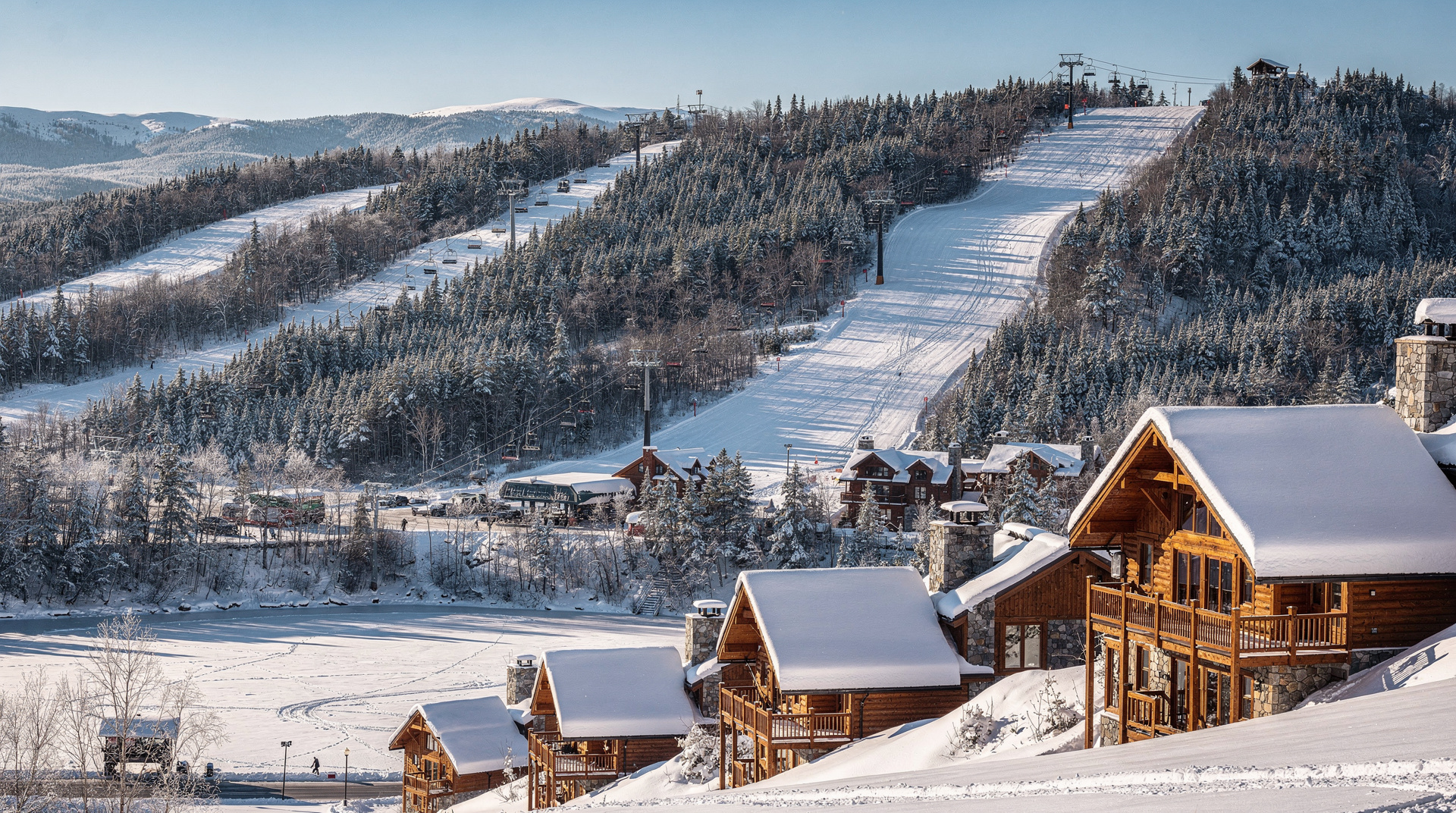
The Laurentides is the most densely developed ski region in eastern Canada. Within a 100 km stretch of Route 117, you have Mont-Tremblant (the flagship, 96 runs), Saint-Sauveur (7 interconnected hills, great for beginners), Mont-Gabriel, Chantecler, and several smaller hills. The breadth of options means you can calibrate difficulty, price, and crowd level: Saint-Sauveur is far cheaper than Tremblant for similar beginner-to-intermediate terrain.
Beyond ski: the region is the epicentre of Québec’s snowmobile culture. More than 4,000 km of groomed snowmobile trails fan out from the main towns. Rentals and guided tours are available from operators in Sainte-Agathe and Saint-Jovite (Mont-Tremblant).
A guided snowmobile tour in the Laurentian Mountains (around 210 CAD for 2 hours) departs from Sainte-Agathe and takes you into the network of groomed trails through boreal forest. Reserve well ahead for January–February.
Winter without skiing
Not every winter visitor skis, and the Laurentides has a genuine non-ski winter offer. Snowshoeing on the P’tit Train du Nord and the region’s provincial parks is accessible to any fitness level and requires no lessons. Sleigh rides and dog-sledding operators around Mont-Tremblant and Sainte-Agathe run half-day excursions that work well for families with young children who are not ready for skis.
Ice skating rinks (both natural outdoor and maintained) operate in most town centres, usually free or low-cost. For visitors who simply want the scenery, driving the Route 117 corridor after a fresh snowfall, with stops in Val-David and Sainte-Adèle for a hot chocolate, is a legitimate way to spend a winter day without ever putting on skis or a snowmobile helmet.
Via ferrata and adventure sports
For those who want vertical challenge without skis, the via ferrata routes around Sainte-Agathe are excellent. Tyroparc operates two distinct via ferrata circuits on Mont-Catherine and Cap Beauséjour, with a combined zip-line package that makes for a full-day adventure outing.
The Tyroparc via ferrata and zip-line combo (around 140 CAD, 3–4 hours) is one of the better adventure value propositions in the Laurentides — you get two complementary experiences in one booking. See the dedicated Sainte-Agathe-des-Monts page for full detail on the routes.
Zip-lining and treetop adventure at Tremblant
Beyond skiing and via ferrata, Mont-Tremblant’s summer adventure offer has expanded well beyond the gondola ride. It runs through the forest canopy on the mountain’s lower slopes and works as a half-day activity for visitors who want an adrenaline option without committing to a full via ferrata day.
Mont-Tremblant zip-line circuit, 5 lines, around 3 hoursIt pairs naturally with a gondola ride and lunch in the pedestrian village.
Lakes and water
The Laurentides sits above the Saint-Lawrence lowlands and the glacial action that shaped the Canadian Shield left thousands of lakes in the rock. Lac des Sables at Sainte-Agathe-des-Monts is the most visited, with a public beach and kayak rentals. Lac Tremblant, at the base of the mountain, is larger and more scenic but less accessible for swimming. Lac Ouimet near Val-David and dozens of smaller lakes throughout the corridor offer paddleboarding, canoeing, and fishing without crowds.
Lac Ouareau near Rawdon (slightly east of the main corridor on Route 125) is worth knowing about: a large, clear lake with good trout fishing and relatively few day-trippers, surrounded by provincial crown land that allows free camping.
Laurentides vs Charlevoix for foliage: which to choose
Both regions are strong foliage destinations, but they suit different trips. The Laurentides peaks earlier (September 21–28 in the main corridor) and rewards a cycling-and-lake-based visit along the P’tit Train du Nord; Charlevoix peaks slightly later and rewards a driving-based visit along Route 362’s cliff-top views over the Saint-Laurent. If your base is Montréal and you have only a weekend, the Laurentides is the easier logistics; if you have 3+ days and want river views alongside the colour, Charlevoix edges it out. Some visitors combine both across a longer trip — see the 7-day fall foliage itinerary for a routing that covers both.
Planning the corridor: town-by-town summary
| Town | Best for | Distance from Montréal |
|---|---|---|
| Saint-Sauveur | Outlet shopping, beginner skiing, nightlife | ~65 km, 1h |
| Sainte-Adèle | Quiet retreat, mid-range hotels, theatre | ~80 km, 1h10 |
| Val-David | Arts, rock climbing, cycling, markets | ~95 km, 1h20 |
| Sainte-Agathe | Lakes, snowmobiling, via ferrata | ~100 km, 1h30 |
| Mont-Tremblant | Flagship skiing, dog sledding, resort | ~130 km, 1h30–2h |
Where to base yourself
Short trip (1–2 nights): Base at Mont-Tremblant for the full resort experience, or Saint-Sauveur if you want more restaurants and nightlife options at lower prices.
Longer trip (3–5 nights): Consider Sainte-Agathe-des-Monts as a central base — you can day-trip north to Tremblant (35 km) and south to Saint-Sauveur (35 km) from there without repositioning your luggage.
Cyclists doing the P’tit Train du Nord: Saint-Jérôme (southern terminus), Sainte-Adèle, Val-David, and Sainte-Agathe are all logical overnight stops spaced 25–40 km apart.
A sample 3-day corridor itinerary
For visitors without a fixed activity in mind, this is a workable default routing through the main corridor:
| Day | Base | Focus |
|---|---|---|
| 1 | Saint-Sauveur or Sainte-Adèle | Arrive, short hike or lake swim, dinner in town |
| 2 | Sainte-Agathe-des-Monts | Lac des Sables morning, via ferrata or snowmobile in the afternoon |
| 3 | Mont-Tremblant | Gondola, pedestrian village, zip-line or lake time before heading back |
This sequence works in both summer (swap snowmobile for cycling the P’tit Train du Nord) and winter (swap the lake for skiing at whichever hill matches your day’s budget). Reverse the order if you are arriving from Charlevoix or Lanaudière rather than directly from Montréal.
Getting there and around
All towns in the corridor are accessible by car from Montréal via Autoroute 15 (exit numbers increase as you go north: exit 58 for Saint-Sauveur, exit 72 for Sainte-Adèle, exit 76 for Val-David, exit 89 for Sainte-Agathe). Public transport is limited: Limocar runs bus service from Montréal’s terminal to most towns in the corridor, but within the region a car is essential for anything beyond walking distance of your hotel.
Plan 1h to 1h45 from Montréal depending on destination and traffic. The A-15 becomes congested on Friday evenings and Sunday afternoons — leave after 7 PM or before 1 PM on Sundays to avoid the worst.
See our Laurentides road trip itinerary for a suggested 3-day route through the corridor.
Accommodation: what the region offers
The Laurentides corridor has the full range of accommodation types, from youth hostels in Saint-Sauveur to luxury chalets on private lakes near Tremblant. The key distinction is between town-based hotels and cottage/chalet rentals.
Town hotels: Available in all major towns, ranging from 80–350 CAD per night. Highest prices at Mont-Tremblant resort (Fairmont, Westin); most affordable in Sainte-Agathe and Saint-Jovite. Best value in the 150–200 CAD band.
Chalet rentals: The dominant accommodation model for the region. Private chalets on lakes, typically rented by the week (summer) or weekend (winter). Capacity 4–12 people. Weekly rates range from 1,500–5,000 CAD depending on size, location, and season. For groups, this is often the best-value option and provides the authentic Laurentides experience that no hotel can replicate — your own dock on a lake, a woodstove, privacy.
Auberges and B&Bs: Found in every town, usually in heritage houses with 4–10 rooms. Typically 100–160 CAD per night with breakfast. Many of the best in Val-David and Sainte-Adèle.
Booking timing matters: summer weekends (July–August) and peak ski weeks (Christmas, Carnaval, winter school breaks) sell out months in advance. Shoulder season (May–June, October–November) offers significant price reductions and fewer crowds.
Food and drink along the corridor
The Laurentides has moved beyond its reputation as a fast-food corridor over the past decade, with a genuine restaurant scene developing in the main towns. Some highlights:
Saint-Sauveur: Le Petit Poucet (classic Québécois since 1945); several newer gastropubs with local craft beer.
Sainte-Adèle: Le Bistro à Champlain (the best wine list in the region); La Muse for pizza and family dining.
Val-David: Au Profit du Pain (exceptional bakery); Le Grand Pub for pub food and local beer.
Sainte-Agathe: Auberge La Sauvagine (refined Québécois, dinner only); weekend market at the lake beach for local produce.
Saint-Jovite (Mont-Tremblant): More accessible prices than the resort village; several solid restaurants including Antipasto and Le Glacier for casual dining.
The sugar shack season — cabanes à sucre, March to mid-April — is one of the great Québec food experiences. Most of the cabanes in the Laurentides are north of Saint-Jérôme and operate for 6–8 weeks. The meal is a fixed menu of traditional Québécois food (pea soup, baked beans, salt pork, ham, eggs, crêpes, and tire sur la neige — maple toffee pulled on snow) accompanied by all-you-can-eat maple syrup in various forms. A reservation is essential on weekends. Ask locally for the best options; the names change by year and the quality varies significantly.
The honest guide to Laurentides weekend traffic
The Laurentides highway corridor (A-15 / Route 117) is one of the most predictably congested roads in Québec on certain days. The pattern is consistent: Friday evenings from Montréal (5–8 PM, worst on holiday weekends) and Sunday afternoons returning to Montréal (2–6 PM). On a winter holiday weekend — Christmas, Carnaval, school spring break — the southbound A-15 can be backed up for 30–50 km.
The mitigation strategies that work: leave Friday afternoon before 3 PM or after 8 PM. Return Sunday morning before noon or Monday morning entirely. If you are going to Tremblant specifically and have flexibility, the Route 323 alternative (via Prévost and Arundel) is longer but bypasses the main congestion points south of Saint-Agathe.
Frequently asked questions about Laurentides (region overview)
What is the best season to visit the Laurentides?
Every season has a clear identity: winter (December–March) for skiing and snow sports; spring (April–May) for sugar shacks and quieter prices; summer (June–August) for cycling, water activities, and hiking; autumn (late September–October) for foliage. The corridor is genuinely four-season and the choice depends on your priorities.
Do I need a car to visit the Laurentides?
Limocar provides bus service from Montréal to all major towns in the corridor, making it possible to visit without a car. However, a car gives access to the lake districts, the national parks, snowmobile trailheads, and restaurants outside town centres. For anything beyond a single-town stay, a car is strongly recommended.
Is the Laurentides good for families with young children?
Yes, especially for skiing beginners, snow tubing, and summer lake activities. Mont-Tremblant has dedicated children’s ski programmes. The P’tit Train du Nord trail is ideal for family cycling (flat, paved). Sainte-Agathe’s Lac des Sables has a safe beach and gentle water. The Aquaclub Belle Neige at Saint-Sauveur is a summer waterpark specifically designed for families.
What is the single best month to visit if I can only pick one?
Late September, for most travellers: foliage is at or near peak, prices are lower than summer weekends or ski season, and the P’tit Train du Nord and lakes are still fully open for cycling and hiking. July is the runner-up for warm-weather activities but comes with the highest crowds and prices of the year.
How cold does it get in winter?
January temperatures in the Laurentides average -15 to -20°C, with lows reaching -30°C during cold snaps. Wind chill can bring apparent temperatures to -35°C or below. Dress in proper layers (base, mid, shell), cover exposed skin in extreme cold, and warm the car before long drives. The cold is real and consistent from mid-December through February — plan accordingly.
Budget planning for the Laurentides
The Laurentides spans a wide budget range — it is possible to visit cheaply (camping in the national park, cooking in a rented chalet) or expensively (on-mountain hotel at Tremblant, resort dining every night). Some honest benchmarks for 2026:
Daily budget (per person, mid-range, 2 people):
- Accommodation: 100–175 CAD (split double room in a town hotel or B&B)
- Food: 50–80 CAD (one restaurant meal, one self-catered)
- Activities: 60–130 CAD (one ski day or one guided activity)
- Transport: 20–40 CAD (fuel per person in a shared car)
- Total mid-range: approximately 230–425 CAD/day per person
Budget corners: Ski at Saint-Sauveur instead of Tremblant (lift tickets ~55 CAD vs 100+ CAD). Eat in Saint-Jovite rather than the resort village (30–40% cheaper). Book accommodation mid-week for significant discounts. Use the P’tit Train du Nord for cycling days (free trail once you have a bike).
Premium splurge: Fairmont Tremblant in January, private ski lessons, the helicopter view over the mountain (~300 CAD for 10 minutes), dinner at the Fairmont’s Windigo restaurant. Realistic daily cost: 700–1,000 CAD per person.
Sustainable tourism in the Laurentides
The Laurentides’ year-round tourism economy has put significant pressure on the natural corridor. Some practical notes on responsible visiting:
The national park (Parc national du Mont-Tremblant) has a carry capacity model for overnight camping that limits impact — book through Sépaq rather than free-camping in undesignated areas.
The lakes of the Laurentides are under pressure from invasive species, particularly zebra mussels and Eurasian watermilfoil. Check your boat and equipment before transferring between lakes; do not carry water from one lake to another. The municipal cleaning stations at most major boat launches are mandatory.
Wildlife in the corridor — particularly moose and black bear — has adapted to human presence but is not habituated in the way managed park animals are. Keep food secured in a car or bear canister overnight, and maintain distance from moose: they are larger and more unpredictable than they appear and responsible for more wilderness injuries than bears in Québec.
Top experiences
Bookable activities with verified prices and instant confirmation on GetYourGuide.