Old Quebec (Vieux-Québec, UNESCO)
Explore Old Quebec (Vieux-Québec): fortifications, Petit-Champlain, Château Frontenac. What's worth it and what to skip.
Old Quebec City: Grand Walking Tour
Duration: 2 hours
Quick facts
- UNESCO status
- Historic District of Old Québec since 1985
- Wall circuit
- 4.6 km, only intact fortified city in North America north of Mexico
- Founded
- 1608 — oldest city in Canada
- Two levels
- Upper Town (Haute-Ville) + Lower Town (Basse-Ville)
First impressions of Old Quebec
Arriving in Vieux-Québec for the first time, there is a moment of genuine disorientation. You are expecting a North American city. What you find instead are 17th- and 18th-century stone buildings, an actual fortified wall, and streets laid out by French colonial engineers in 1608. The Château Frontenac, which looks like a Loire Valley château rendered in steel-reinforced stone, dominates the skyline from three kilometres away.
The UNESCO designation (1985) recognised what had been obvious for a long time: Old Quebec is the most intact example of a fortified colonial city in North America. This is not a reconstruction or a heritage precinct — it is a working neighbourhood where people live, work, and send their children to school, layered over three centuries of continuous occupation.
Two days spent thoughtfully in Old Quebec, including the fortification walk, Petit-Champlain, and the Plains of Abraham, gives you the essential picture. The third day is for the day trips — Île d’Orléans, Montmorency Falls, or Wendake — that add depth to the visit.
| Where | Cap Diamant, on the Saint-Laurent, Capitale-Nationale |
| Cost | Château Frontenac tour ~19 CAD; funicular ~4.50 CAD each way; walking tours 25–35 CAD |
| Time needed | 2 days |
| Getting there | Walkable within the walls; funicular or Escalier Casse-Cou between levels |
| Best time | May–October; January–February for Carnaval |
Understanding the two levels
Old Quebec’s geography is defined by Cap Diamant, the headland that rises 98 metres above the Saint-Laurent River. The result is two physically distinct zones connected by the funicular (running since 1879), the Escalier Casse-Cou (Breakneck Stairs), and several other stairways.
Upper Town (Haute-Ville) is the fortified administrative core: the Citadelle, the Château Frontenac, the seminary, the main churches, the government buildings, and most of the hotels. It sits on the plateau and is largely flat once you are inside the walls. This is where the tourist density is highest.
Lower Town (Basse-Ville) is the original commercial settlement along the river — Place-Royale (the exact site of Champlain’s 1608 habitation), and the Petit-Champlain district, which dates to the 1680s and claims to be the oldest commercial district in North America. Lower Town is quieter in the evenings and has a less frenetic atmosphere than the Haute-Ville.
The transition between them is itself part of the experience. The funicular costs 4.50 CAD each way and drops you directly from Terrasse Dufferin to rue du Petit-Champlain. The Escalier Casse-Cou (so named for a good reason — it is steep) is free and more characterful.
What to see and do
Walk the fortifications
The 4.6-km wall circuit is free, open year-round, and gives you the best orientation of Old Quebec’s geography. Start near the Citadelle, follow the walls counterclockwise past the Porte Saint-Louis, Porte Saint-Jean, and Porte Kent, and you get clear views over the Saint-Laurent and across to Lévis on the south shore. Allow 90 minutes at a relaxed pace; the interpretation panels at the gates are worth reading.
Parks Canada operates seasonal interpretation at the main gates and on the fortification walk itself. If you want more historical context, a guided tour is significantly better than the panels alone.
The two-hour Grand Walking Tour is the most efficient way to understand the relationship between the wall circuit, Terrasse Dufferin, and the transition to Lower Town, with a guide who can contextualise the 1759 battle and its aftermath.
Terrasse Dufferin and Château Frontenac
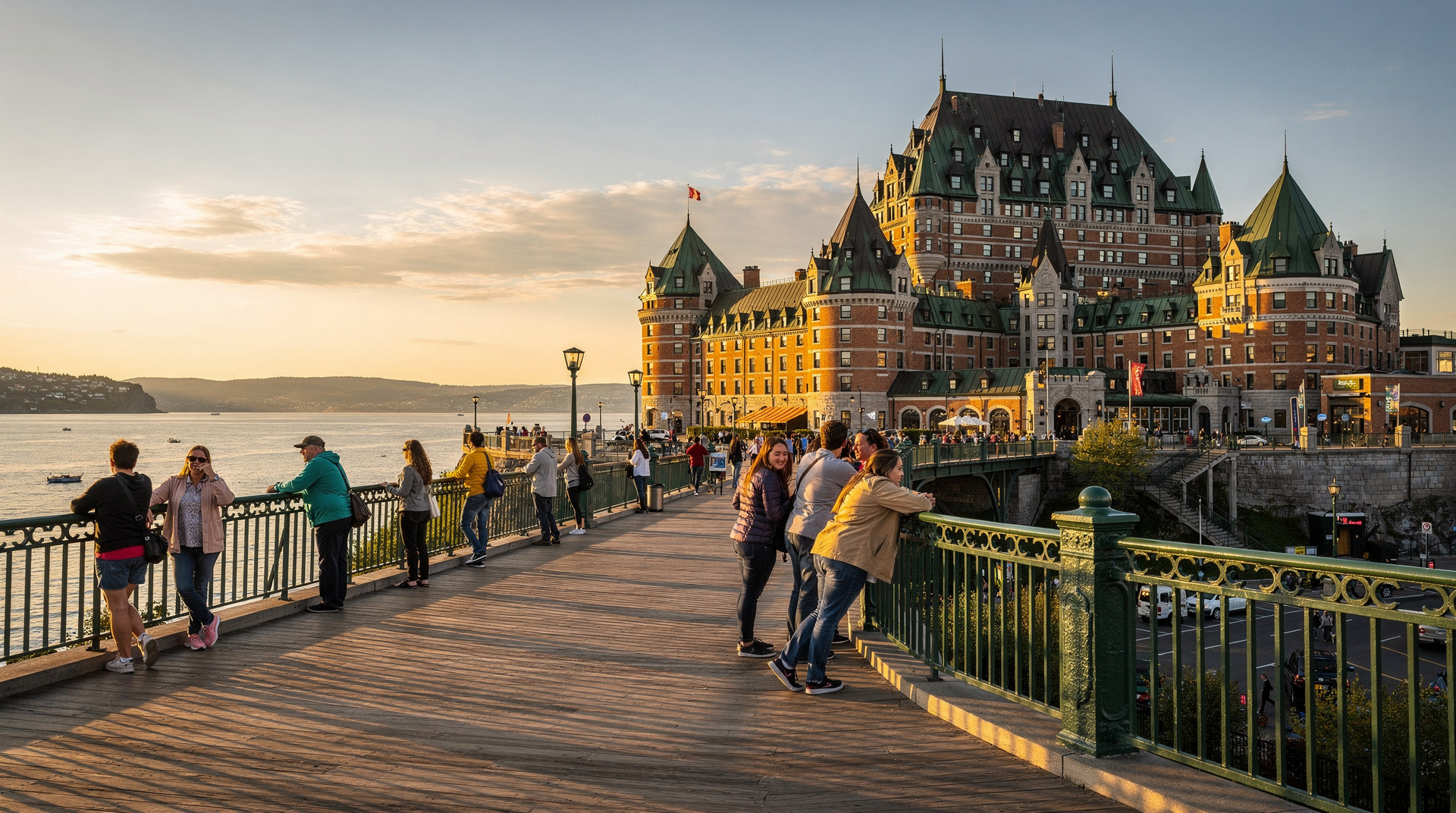
Terrasse Dufferin is the broad wooden boardwalk that runs along the cliff edge in front of the Château Frontenac. In summer it is a promenade with performers, ice cream vendors, and one of the best river views in the province. In winter, the city builds an ice slide that descends from the terrace — one of the more unusual urban diversions in Canada.
The Château Frontenac itself was built in 1893 as a CPR railway hotel and has been expanded several times since. It is genuinely beautiful. The guided interior tour (19 CAD) covers the grand dining rooms, the history of notable guests, and areas not otherwise accessible to non-guests.
Note: the Château’s high tea at 80–120 CAD is expensive for average-quality sandwiches. Better alternative: Café-Boulangerie Paillard on rue Saint-Jean, five minutes away, offers better food at a fraction of the price.
Petit-Champlain and Place-Royale
Rue du Petit-Champlain and the surrounding district are the most photographed streets in Quebec City — narrow, cobbled, lined with stone buildings from the 17th century, and tightly packed with galleries, restaurants, and boutiques selling Quebec-made products.
The practical advice: arrive before 10:00 or after 16:00 to avoid the cruise ship crowds, which can make the street nearly impassable between those hours in summer. The best light for photography is morning.
Place-Royale, 100 metres from Petit-Champlain, is the exact location of Champlain’s 1608 habitation — the founding site of Quebec City and of Canada’s French colonial history. The interpretation centre here (free entry to the square, small charge for the museum) is among the best free historical introductions in Old Quebec.
The three-hour historic district walking tour covers both Petit-Champlain and Place-Royale with a guide, which makes a significant difference to the experience — the built environment here is layered and the context is not obvious without help.
Ghost and history tours after dark
Old Quebec has a genuine tradition of theatrical evening history tours that are far better than they have any right to be. The Crimes of New France tour in particular has been running for years and treats its subject — crime and punishment in 17th- and 18th-century New France — with real historical seriousness alongside the theatrics.
The Crimes of New France animated walking tour is ideal after dinner. The 90-minute format starts at Place-Royale and covers several incidents drawn from actual judicial records. Not a ghost tour — a history tour with dramatic presentation.
The historical walking and tasting tour
The historical walking and tasting tour combines the history of Old Quebec with food stops that introduce the key Quebec gastronomy markers — local cheeses, maple products, ice cider, and charcuterie. The 2.5-hour format is a good compromise between history and food experience if you only have one day.
Citadelle de Québec
The Citadelle is an active military installation — the home of the Royal 22e Régiment (the “Van Doos”) and the official summer residence of the Governor General of Canada. The star-shaped fortification was completed in 1850, though its design dates to the British takeover of New France in 1759.
The changing of the guard ceremony (daily at 10:00 in summer, free to watch from outside the walls) is popular. The 90-minute guided tour that includes access to the interior buildings is 25 CAD and is the only way to see the residence and the regimental museum. Worth it if military history is your thing; otherwise the exterior and the views from the walls are sufficient.
Plains of Abraham
The Plains of Abraham (Parc des Champs-de-Bataille) sit just outside the walls and are the site of the 15-minute 1759 battle that ended French control of North America. Today the park has an interpretive museum (Musée des plaines d’Abraham, 20 CAD), a panoramic tower, and extensive walking and ski trails.
The museum is legitimately good — well-curated, bilingual, and honest about the complexity of what the battle meant for Indigenous peoples, French Canadians, and the emerging British colonial order. The 20 CAD entry is fair for the quality.
The seminary, the churches, and less-crowded stops
Beyond the marquee sights, Old Quebec has several worthwhile stops that see a fraction of the foot traffic at Château Frontenac or Petit-Champlain. The Séminaire de Québec, founded in 1663 and adjoining what is now Université Laval’s original campus, has an interior chapel and courtyard open to visitors at limited hours — a genuinely quiet counterpoint to the crowds outside. The Musée de l’Amérique francophone, housed within the seminary complex, covers the history of French settlement across North America with a scholarly depth that the more tourist-facing sights don’t attempt.
The Ursulines Monastery (founded 1639, one of the oldest religious communities in North America still on its original site) has a small museum covering the Ursuline nuns’ educational role in New France, including artifacts and needlework dating to the 17th century. Both stops work well as a rainy-day alternative to the outdoor circuit, or as a way to avoid the worst of the midday cruise-ship crowds around Place-Royale.
Where to eat in Old Quebec
What to avoid: The restaurants on rue Saint-Louis and the tourist-facing blocks of Saint-Jean inside the walls charge 40–60% premiums for poutine, tourtière, and crêpes that are not particularly good. The tourists will fill these places regardless.
Budget (under 25 CAD): Chez Ashton (multiple locations including one near the walls) is the honest Quebec poutine benchmark. Casse-Crêpe Breton on rue Saint-Jean has been making crêpes since 1978 and represents genuine value in a neighbourhood of tourist-priced restaurants.
Mid-range (50–90 CAD): Café du Monde in Lower Town has reliable French bistro cooking with a Saint-Laurent view that justifies the slightly elevated prices. Le Lapin Sauté (rue du Petit-Champlain) is popular for a reason — the rabbit dishes are well-executed and the terrace on the cobbled street is pleasant.
Special occasion: Légende par La Tanière (inside the walls) is the most serious restaurant in Old Quebec — a tasting menu focused on Indigenous ingredients and Quebec products. At 150+ CAD per person without wine, it requires advance planning, but it is genuinely excellent.
When to visit Old Quebec
July–August: Maximum crowds, maximum atmosphere — street performers, terrace restaurants full, every sight open. Best light for photography in the evenings.
September–October: Foliage begins around the last week of September in the Capitale-Nationale region. Fewer crowds, comfortable temperatures (8–18°C), full restaurant capacity. The best time for unhurried exploration.
January–February (Carnaval): The character of Old Quebec in winter — snow on the stone buildings, the ice slide on Terrasse Dufferin, Bonhomme Carnaval’s ice palace at the foot of the fortifications — is extraordinary. Temperatures drop to -15 to -25°C. Worth it with proper gear. See the Quebec City winter guide.
May–June: Quieter than summer, all attractions open, good prices. Some outdoor terraces not yet running in May.
Practical tips
Cruise ships: Quebec City is a major cruise port. Ships dock at the Louise Basin and passengers flood Old Town from 09:00 to 16:00. Arriving before 09:00 or after 17:00 gives you a different experience. Check the Port de Québec schedule online (free, publicly available) and adjust your walk timing accordingly.
The funicular: 4.50 CAD each way. Cash or contactless payment. The queue can be 10–15 minutes in peak hours — the Escalier Casse-Cou (free, 50 steps) is often faster. The funicular is the easier option with luggage or strollers.
Cobblestones: The streets of Petit-Champlain and rue du Trésor are cobbled. Flat shoes or walking shoes with grip are essential. Avoid heels.
Photography: The Terrasse Dufferin and the view from Côte de la Citadelle towards the river are the obvious spots. Less obvious: the view from Rue des Remparts along the fortifications at dusk, and the descent of Escalier Casse-Cou looking back up towards the Château Frontenac at dawn.
Day trips from Old Quebec
With Old Quebec as a base, the most logical day trips are:
- Île d’Orléans (30 min by car): farms, orchards, artisan producers, and the island circuit. See Île d’Orléans.
- Montmorency Falls (15 min by car or shuttle): more impressive than the name suggests — 83 metres, taller than Niagara. See Montmorency Falls.
- Côte-de-Beaupré (45 min): basilica at Sainte-Anne-de-Beaupré, Canyon Sainte-Anne. See Côte-de-Beaupré.
- Wendake (20 min): Huron-Wendat Nation territory with the best First Nations cultural experience near the city. See Wendake.
For multi-day extensions, see the Quebec City and Charlevoix 4-day itinerary or the Quebec City 3-day itinerary.
Frequently asked questions about Old Quebec
How many days do you need in Old Quebec?
Two full days covers the essential circuit — the fortifications, Terrasse Dufferin and the Château Frontenac, Petit-Champlain and Place-Royale, and either the Citadelle or the Plains of Abraham. A third day is best spent on a day trip (Île d’Orléans, Montmorency Falls, or Wendake) rather than lingering longer inside the walls, since the core sights are genuinely covered by day two.
Is Old Quebec walkable, or do you need transport?
It’s entirely walkable — that’s the point of a fortified colonial city built before cars existed. The only transport decision is between the two levels (Upper and Lower Town): the funicular (4.50 CAD each way) or the free Escalier Casse-Cou stairs. Day trips beyond the walls require a car, shuttle, or organised tour.
Top experiences
Bookable activities with verified prices and instant confirmation on GetYourGuide.