Upper Town & Citadelle
Visit Upper Town and the Citadelle in Quebec City: fortifications walk, changing of the guard, Château Frontenac tips, Plains of Abraham.
Citadelle de Québec Ticket and Guided Tour
Duration: 1.5 hours
Quick facts
- Wall circuit
- 4.6 km, free to walk
- Citadelle
- Active military installation, home of Royal 22e Régiment
- Changing of the guard
- Daily 10:00, June–Labour Day (free to watch from outside)
- Plains of Abraham
- Site of the 1759 battle; now a 108-hectare urban park
| Where | Cap Diamant plateau, inside the fortification walls, Quebec City |
| Cost | Fortifications walk free; Citadelle tour ~25 CAD; Château Frontenac tour ~19 CAD; Observatoire ~15 CAD |
| Time needed | A full day for the walls, Citadelle, Château, and Plains of Abraham |
| Getting there | Walkable within Old Quebec; park-and-ride at Parc-O-Bus Duplessis if arriving by car |
| Best time | Year-round; June–August for the changing of the guard ceremony |
Getting your bearings in Upper Town
Upper Town — the Haute-Ville — sits on the plateau of Cap Diamant, 98 metres above the Saint-Laurent River. This is where the administrative, military, and ecclesiastical power of New France was concentrated, and the built environment reflects that: the Château Frontenac anchors the skyline, the star-shaped Citadelle guards the headland, and the fortification walls that make Quebec City unique in North America run around the perimeter.
For first-time visitors, Upper Town is the obvious starting point. It contains the highest concentration of sights per square metre of any Quebec City neighbourhood, and it is compact enough to navigate on foot without a map after an hour of orientation.
The neighbourhood’s weakness is tourist pricing. The restaurants along rue Saint-Louis charge premium rates for average food, and some attractions are marketed more aggressively than their quality warrants. This guide points out the distinctions.
The fortifications walk
The 4.6-km wall circuit is the most underrated free activity in Quebec City. Starting from the Citadelle and walking counterclockwise, you pass through or near Porte Saint-Louis (with its drawbridge mechanism still visible), Porte Kent, and Porte Saint-Jean before reaching the fortifications above Lower Town with their clear view across to Lévis on the south shore.
The walls were reinforced by the British after 1759 and reached their current form in the 1820s–1840s. Parks Canada interpretation panels at the gates explain the successive layers of construction — French colonial, then British colonial — and the logic of the city’s defensive position at the confluence of the Saint-Lawrence and Saint-Charles rivers.
Allow 90 minutes for the full circuit. Early morning is better — cruise ship passengers arrive around 09:00 and the walls get busy. There is no admission charge.
The Citadelle de Québec
The Citadelle is the largest British fortification in North America. The star-shaped layout — a classic Vauban design — was completed in 1850 on a site that has been fortified since 1693. It remains an active military installation: the home of the Royal 22e Régiment (the “Van Doos”), the oldest French-speaking infantry regiment in Canada, and the summer residence of the Governor General.
The Citadelle guided tour (90 minutes, 25 CAD) is the only way to access the interior — the regimental museum, the Governor General’s residence, and the inner courtyards. The guide covers the regiment’s history (including service in both World Wars, Korea, and Cyprus) with genuine depth. Worth it for anyone with military history interest.
The changing of the guard ceremony runs daily at 10:00 from late June to Labour Day (early September). It is free to watch from outside the walls on the Promenade des Gouverneurs. The ceremony takes about 30 minutes and follows the British-style ceremonial guard change that the regiment inherited when it absorbed the Scots Fusiliers of Canada.
Château Frontenac and Terrasse Dufferin
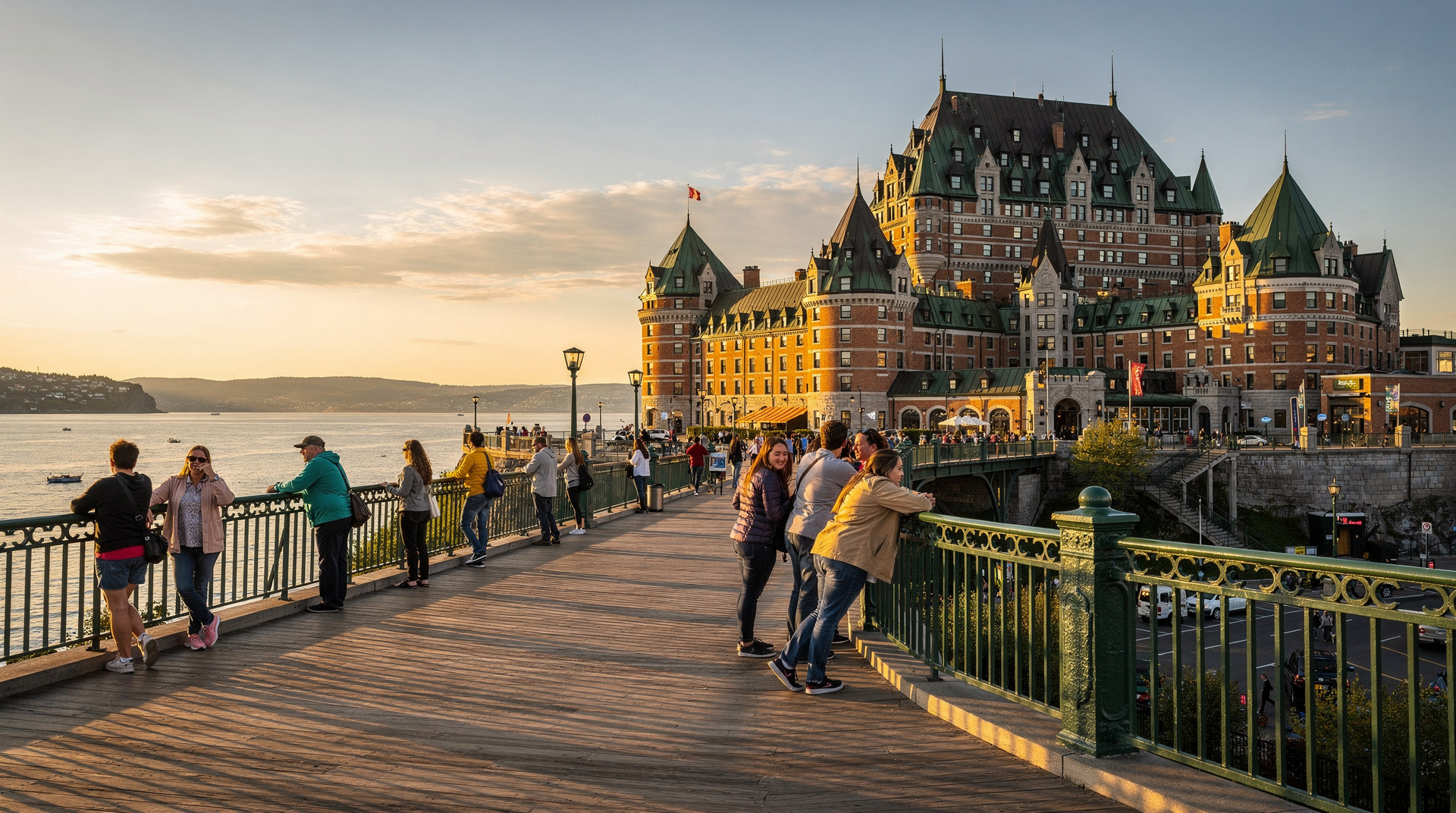
The Château Frontenac (officially the Fairmont Le Château Frontenac) was built in 1893 for the Canadian Pacific Railway as a grand hotel for transcontinental travellers. It has been expanded four times, most recently in 1993, and now has 611 rooms. It is one of the most photographed buildings in Canada.
The guided Château Frontenac tour (1 hour, 19 CAD) takes you through the main ceremonial spaces, the suite history (Roosevelt and Churchill used it for a wartime conference in 1943), and the history of the Dufferin Terrace below. It is the only way to see the interior properly without booking a room.
What to skip: The Château’s high tea (80–120 CAD) has been a perennial tourist trap — the quality of sandwiches and pastries does not justify the price. Better: Café-Boulangerie Paillard on rue Saint-Jean (5-minute walk, 20–25 CAD for pastries and coffee, genuinely good).
Terrasse Dufferin, the 425-metre wooden boardwalk in front of the Château, is free and has the best river view in Upper Town. In winter, a toboggan slide runs from the terrace. Year-round, street performers appear on the terrace from May to October.
Plains of Abraham (Parc des Champs-de-Bataille)
The Plains of Abraham are where the 1759 battle between Wolfe and Montcalm lasted approximately 15 minutes and determined the future of North America. Today the park covers 108 hectares of plateau just beyond the walls.
The Musée des plaines d’Abraham (20 CAD) is the interpretive starting point. It covers the battle, the colonial period, and the park’s subsequent history (it hosted Celine Dion’s largest-ever concert in 2008) with genuine rigour. The Odyssey multimedia show (included in admission) is well-produced and bilingual.
The two Martello towers (Tower 1 is accessible) are the most unusual element — squat, round, thick-walled defensive structures built by the British in the early 19th century. Tower 1 has a seasonal exhibition inside (small additional charge).
In summer, the Plains host the Festival d’été de Québec (mid-July) on open-air stages. In winter, the Plains have 9 km of cross-country ski trails that are among the best in any North American city, plus a lit loop for evening skating.
Observatoire de la Capitale
The Observatoire de la Capitale sits on the 31st floor of the Marie-Guyart building, 1 km outside the walls in the modern financial district. At 15 CAD, it provides a 360-degree view that contextualises the geography of Quebec City better than any ground-level position: the wall circuit from above, the Saint-Laurent River, Île d’Orléans in the distance, and the Laurentian Mountains to the north.
It is not as dramatic as the helicopter tour, but at a fraction of the price it provides the orientation that most first-time visitors need.
Citadelle vs Château Frontenac vs Observatoire: which paid attraction to prioritise
Upper Town has three main ticketed sights competing for the same afternoon. Here’s how they compare:
| Citadelle | Château Frontenac | Observatoire de la Capitale | |
|---|---|---|---|
| Cost | ~25 CAD | ~19 CAD | ~15 CAD |
| Duration | 90 min | 1 hour | Self-paced, 30–45 min |
| What you get | Regimental museum, Governor General’s residence | Ceremonial rooms, suite and Terrasse history | 360° city view from the 31st floor |
| Best for | Military history interest | First-time visitors, photographers | Orientation, budget-conscious visitors |
| Skip if | Not interested in military history | Short on time — the exterior alone is the photo | You’ve already done the helicopter tour |
With time for only one, first-timers get the most value from the Château Frontenac tour — it’s the building everyone photographs, and the interior context makes the exterior more meaningful afterward.
Where to eat in Upper Town
The tourist restaurant pattern in Upper Town is to charge 40–60% premiums for poutine, tourtière, and crêpes on rue Saint-Louis. Avoid this street for food.
Better options within the walls:
Paillard (rue Saint-Jean, outside the walls but 5 minutes walk): best bakery near Upper Town, good coffee, sandwiches at lunch. 15–25 CAD.
Le Moine Échanson (Grande-Allée Est, just outside walls): natural wine bar with small plates. One of the most interesting wine lists in Quebec City. 20–35 CAD for a small plate dinner with wine.
Café Temporel (rue Couillard, just inside walls): the most neighbourhood-feeling café inside the walls. Good soups, sandwiches, and coffee at non-tourist prices.
Practical tips
Parking: Do not drive into Upper Town. The streets are narrow, parking is expensive (25–35 CAD/day) and limited. Use the park-and-ride at Parc-O-Bus Duplessis near the Autoroute Dufferin-Montmorency and take the bus.
Cobblestones: Most of Upper Town inside the walls is cobbled. Flat walking shoes are essential.
Best photography positions: The view along rue des Remparts (the wall street with the Château visible above) at golden hour. The view from Terrasse Dufferin looking toward the river at any time of day. The Côte de la Citadelle with the Château Frontenac framed in the background.
Connecting Upper Town to the rest of your visit
Upper Town works best as the first half of a full-day Old Quebec visit, followed by Lower Town and Petit-Champlain in the afternoon. See the Old Quebec guide for the full picture.
For context on the broader Quebec City visit, see the Quebec City guide.
Day trips within reach: Île d’Orléans, Montmorency Falls, and Wendake are all under 30 minutes by car. For the deeper story behind the Château, the Château Frontenac history guide is worth reading before your visit, and the UNESCO Old Quebec walking guide covers how Upper Town’s fortifications fit the wider heritage designation. If your trip coincides with the Festival d’été de Québec on the Plains, the Québec music festivals guide has the practical details.
Frequently asked questions about Upper Town & Citadelle
Is the Citadelle worth the guided tour, or can I just see it from outside?
The exterior — the star-shaped ramparts and the view from the Promenade des Gouverneurs — is free and gives a real sense of the fortification’s scale. The guided tour is worth the 25 CAD if you have specific interest in the Royal 22e Régiment’s history or want access to the regimental museum and inner courtyards; casual visitors can reasonably skip it.
What time should I watch the changing of the guard?
The ceremony runs daily at 10:00 from late June to Labour Day and is free to watch from outside the walls. Arrive 10-15 minutes early for a clear view along the Promenade des Gouverneurs; the ceremony itself takes about 30 minutes.
Top experiences
Bookable activities with verified prices and instant confirmation on GetYourGuide.