Sherbrooke
Eastern Townships' largest city: museums, university culture, a Nordic spa, and easy access to wine country — 1h45 from Montreal.
History and Food Tasting Walking Tour
Duration: 2 hours
Quick facts
- Distance from Montreal
- 155 km (1h45 by car)
- Distance from Magog
- 45 km (40 min by car)
- Population
- ~175 000 (metro area)
- Universities
- Université de Sherbrooke, Bishop's University (Lennoxville)
Quebec’s undiscovered university city
Sherbrooke sits at the confluence of the Magog and Saint-François rivers, about 155 km southeast of Montreal at the heart of what the Québécois call les Cantons-de-l’Est and anglophone tradition knows as the Eastern Townships. It is the largest city in the region — roughly 175,000 people in the metro area — and its role is more central than most visitors realise. This is not simply a service town you pass through on the way to the vineyards or the lake resorts. It is a genuine mid-sized Quebec city with a functioning cultural life, two universities, a serious restaurant scene, and a Nordic spa that ranks among the better wellness facilities in the province.
| Where | Eastern Townships, ~155 km southeast of Montreal |
| Cost | Museums ~10–12 CAD; Nordic spa ~75–100 CAD |
| Time needed | 1 day; 2 with the spa and a leisurely dinner |
| Getting there | Car (~1h45), Autobus Galland/Flixbus (~2h30–3h) |
| Best time | Year-round; best June–October |
The two institutions that shape the city’s personality are the Université de Sherbrooke — a large francophone university on the western hill above the city — and Bishop’s University, an anglophone institution 10 km south in the village of Lennoxville. Together they push the city toward youth and ideas: independent bookshops, small music venues, craft breweries with chalkboard menus, community markets that actually reflect what local farms produce. Sherbrooke has the animated street energy that university cities hold even in the off-seasons, when smaller resort towns in the Eastern Townships go quiet.
For most international visitors, Sherbrooke works best as a full day within an Eastern Townships loop — a city counterpoint to the rural pleasures of vineyard country and lakeside walking. But those who dismiss it as merely a waypoint miss something worth seeing.
The city’s layout and character
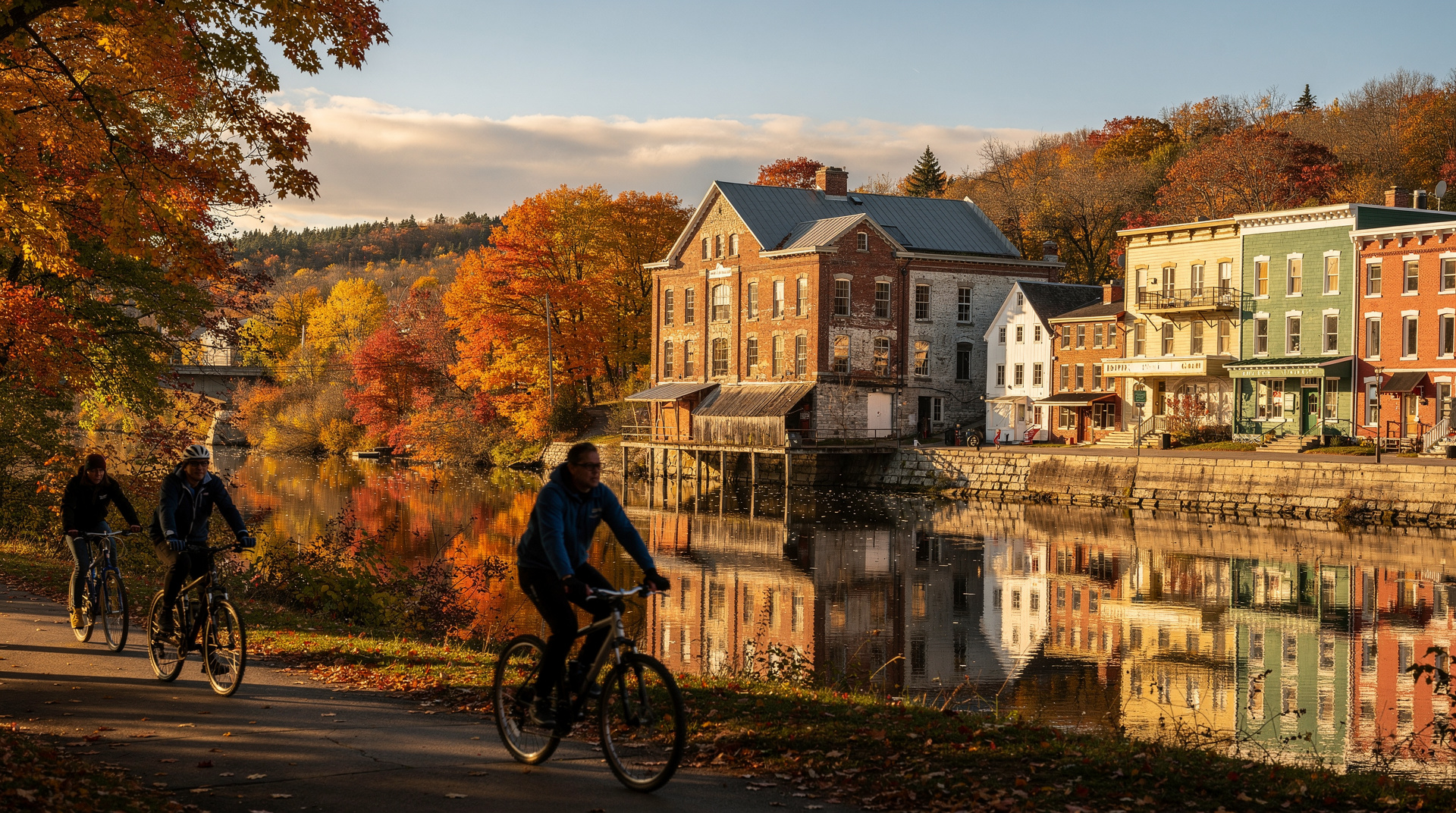
The historic heart clusters around the confluence of the two rivers, where the old industrial buildings of Wellington Nord neighbourhood have spent the last decade converting into galleries, lofts, and food-focused businesses. There is a small gorge cut by the Magog River through the city — genuinely unexpected in an urban setting — and the Promenade du Vieux-Sherbrooke follows the riverbank for several kilometres, passing old mill buildings and bridges before opening onto the broader Saint-François valley below.
Rue King is the main commercial artery, where the shopping streets run parallel to Lac des Nations, an artificial lake at the city’s centre that serves as Sherbrooke’s urban park. The museum quarter — the Beaux-Arts and the Nature et Sciences museum sit almost opposite each other — occupies the older stone buildings north of the lake. The overall tone is of a place still discovering what it wants to be: some blocks feel polished and confident, others retain a rough industrial edge that has not yet been gentrified away. Both qualities have their appeal.
What to see and do
Musée des Beaux-Arts de Sherbrooke
The Fine Arts Museum occupies a heritage building in the Old Northern quarter and holds a permanent collection of Quebec art from the 18th century to the present day. What distinguishes it from the larger collections in Montreal and Quebec City is the curatorial emphasis on Estrie artists — painters and sculptors whose work responds specifically to this landscape of rolling farmland, frozen lakes, and autumn maple light. The result is a collection that feels regionally coherent rather than generically comprehensive. Admission is approximately 10-12 CAD, and the first Sunday of each month is free.
Musée de la Nature et des Sciences
Across the street from the Beaux-Arts, the interactive science museum is pitched primarily at families but holds genuine substance for adults in its regional geology and natural history sections. The material on the St-François valley and the underlying rock formations of the Appalachian foothills is particularly good — the Eastern Townships sit on a very old and complicated piece of geology, and the museum explains it clearly. Admission is around 10 CAD.
Wellington Nord and the Magog gorge
The former industrial district along the Magog River gorge is the neighbourhood that most rewards wandering without a specific destination. The gorge itself — a rocky, steep-sided slot cut by the river through the city’s underlying bedrock — is modest in scale but striking in context: you round a corner on what feels like an ordinary city street and suddenly the ground drops away into a wooded ravine with the river running green at the bottom. The Promenade du Vieux-Sherbrooke follows the river, passing former mill buildings now occupied by lofts and studios, under several iron bridges, and through sections of riverbank that feel almost rural despite being five minutes’ walk from the centre.
The brewpub anchoring the neighbourhood change is the right place to stop mid-afternoon: local drafts on tap, good food, and a terrace that overlooks the gorge.
Strøm Nordic Spa Sherbrooke
The Strøm Nordic Spa outside Sherbrooke is, frankly, one of the most worthwhile experiences in the Eastern Townships for the right type of traveller. One of three Quebec Strøm locations — the others are in Old Montreal and on Nuns’ Island — it runs a thermotherapy circuit through hot pools, cold plunge baths, steam rooms, and outdoor hammock zones set within boreal forest. The full circuit runs 60-90 minutes; combining it with a massage extends the afternoon into something close to a half-day experience.
The philosophy behind Nordic spa culture — the contrast principle of heat and cold repeated until the body simply releases all tension — works particularly well after a day of hiking at Mont-Orford or a morning of mountain biking at Bromont. The practical reality is that a couple’s trip to Sherbrooke that includes one morning at the spa, an afternoon in the museums, and dinner at a good restaurant constitutes a convincingly complete short break in its own right.
Advance booking is essential on weekends; midweek visits are calmer and sometimes available at reduced rates. Budget approximately 75-100 CAD for the circuit alone. The full Strøm Nordic spa guide covers the circuit in more detail, including how it compares to the Old Montreal and Nuns’ Island locations.
Lac des Nations
The artificial lake at the city’s centre is not spectacular — it is a managed urban park, with the main shopping street on one side and the museum quarter on the other — but it is a pleasant place to walk for an hour, especially on summer evenings when open-air concerts are held on the waterfront on Friday evenings through July. Watch Sherbrooke doing what mid-sized Quebec cities do well: families by the water, food stalls, a band playing, teenagers on the steps of the cultural centre. Unpretentious, lively, and completely local.
Eating and drinking
Chez Auguste is the restaurant that Sherbrooke points to with quiet pride: a focused menu driven by local ingredients, a well-chosen wine list without being ostentatious about it, and cooking that sits confidently in the tradition of contemporary Quebec cuisine — root vegetables, cured meats, freshwater fish from the surrounding rivers, Quebec cheeses making appearances at every course. Plan 75-100 CAD per person with wine, and book ahead on weekends.
Brûlerie des Cantons is the specialty coffee roaster that has anchored the Wellington Nord neighbourhood’s transformation: a café with its own roasting operation, serious about technique, with a light lunch menu and the kind of atmosphere — exposed brick, coffee smell, people working on laptops — that makes a slow morning feel completely reasonable.
Marché de la Gare (the farmers’ market, running weekends from May through November) is one of the Eastern Townships’ best: local cheeses from Lac Brome and Brome County fromageries, ice cider and dry cider from the Dunham area, prepared foods, and seasonal produce from the surrounding farmland. Saturday morning is the main event; arrive early.
Pilsen Restaurant-Pub in North Hatley, 40 km away at Lac Massawippi, earns a mention here because it is the kind of place that justifies the detour: a pub-style restaurant with a serious tap list and a kitchen that does more than pub food suggests. Not in Sherbrooke, but within the orbit.
Sherbrooke versus Magog: which city base?
Visitors doing an Eastern Townships loop often ask whether to base themselves in Sherbrooke or Magog. The honest answer depends on priorities:
| Sherbrooke | Magog | |
|---|---|---|
| Character | University city, museums, urban culture | Lakeside resort town, closer to vineyards |
| Best for | City pleasures, the Nordic spa | Lake Memphrémagog, wine-route access |
| Restaurant scene | Deeper and more varied | Smaller but pleasant |
| Distance from Montreal | 155 km | ~130 km |
Most travellers doing a multi-day Eastern Townships trip base in both — a night in each — rather than choosing one over the other. If you only have one night, choose Sherbrooke for culture and food, Magog for lake scenery and easier vineyard access. The Eastern Townships wine route guide covers the vineyard side of that choice in detail.
Where to stay
Hotel Gouverneur Sherbrooke is the central, full-service reference: reliable, straightforward, well-positioned for the museum quarter and the restaurant strip. Rooms run approximately 130-180 CAD depending on season.
Auberge Hatley in North Hatley (40 km north at Lac Massawippi) is the elevated option for anyone who wants to sleep well outside the city: a lakeside property with elegant rooms and a kitchen that uses the same local produce the best Sherbrooke restaurants depend on. More expensive at 200-400 CAD, but the right choice for a romantic night.
University-adjacent B&Bs and small auberges near Bishop’s University in Lennoxville offer affordable alternatives at 80-120 CAD — quieter, less central, but pleasant for those who prefer a smaller scale.
Getting there
From Montreal: Autoroute 10 Est, exit 143 (Sherbrooke/Lennoxville). 155 km and approximately 1h45 with no traffic — close enough for a day trip, comfortable enough for an overnight. The autoroute runs through increasingly rolling countryside from Bromont eastward, the Appalachian foothills building steadily into the distance.
By bus: Autobus Galland and Flixbus both serve the Montreal-Sherbrooke route with several daily departures and journey times of 2h30-3h. The bus station is central, close to the museum quarter. For a city visit without a car, this is a practical option.
From Magog: Route 112 Est, 45 km and 40 minutes — the natural pairing for anyone doing an Eastern Townships circuit with a lakeside base at Memphrémagog.
From Quebec City: Route 55 South from the Thetford Mines axis, 190 km and approximately 2h15.
Combining with other destinations
Sherbrooke works best as the city component of an Eastern Townships loop — a day of museums, the gorge walk, the Nordic spa, and dinner in the city, before moving south to Magog the next morning for the vineyard circuit or north toward Mont-Orford for hiking. The rhythm of city and countryside, urban pleasures and outdoor ones, is exactly what the region is designed for.
The Strøm Nordic Spa is particularly good at the end of a hiking day on the Mont-Orford trails — an hour of hot and cold contrast followed by a quiet evening in the city. For the broader regional context, the Eastern Townships weekend itinerary and the guide to Quebec wellness retreats both cover how Sherbrooke fits into a longer visit to the cantons.
Frequently asked questions about Sherbrooke
Is Sherbrooke worth visiting if I’m mainly interested in the Eastern Townships wine route?
It’s a worthwhile detour rather than a core stop for wine-focused visitors — the vineyards themselves cluster closer to Magog and Dunham. Sherbrooke earns its place for the Nordic spa, museums, and restaurant scene, which pair naturally with a wine-route trip rather than replacing it.
Do I need a car in Sherbrooke itself?
No — the museum quarter, Wellington Nord, Lac des Nations, and the downtown restaurant strip are all walkable from a central hotel. A car becomes useful mainly for reaching the Strøm Nordic Spa (just outside the city) and for day trips to Magog, North Hatley, or Bromont.
Top experiences
Bookable activities with verified prices and instant confirmation on GetYourGuide.