Ice canoeing on the Saint-Laurent (canot à glace)
Sunset Ice Canoe Experience with Sauna
Duration: 2 hours
What is ice canoeing (canot à glace) in Québec?
Canot à glace is the tradition of crossing the Saint-Laurent River in winter using a flat-bottomed canoe, alternately paddling through open water and dragging the canoe over ice floes. Born from necessity in the 18th century, it is now a competitive sport and a guided tourist experience. Season: December to March.
One of the most uniquely Québécois winter experiences
There are activities you can do in winter in many places — skiing, snowshoeing, ice fishing. And then there is canot à glace: crossing the Saint-Laurent River in a canoe in the middle of winter, hauling your boat over moving ice floes while freezing water laps at the edge. This is a uniquely Québécois experience, and it exists nowhere else in the world in quite this form.
It sounds extreme. On a guided tour, it is genuinely accessible to fit adults with no prior experience. It is also one of the most memorable physical experiences you can have in Québec — wet, loud, cold, exhausting in the best possible way, and over in about 90 minutes leaving you grinning beside a sauna.
This guide explains what ice canoeing is, where it comes from, where to try it as a visitor, and what to expect on the water and ice.
| Where | Saint-Laurent River, launching from Old Québec’s waterfront |
| Cost | Around 95–100 CAD per person, guided 2-hour session |
| Time needed | Around 2 hours including briefing and sauna |
| Getting there | On foot from Old Québec — no car needed |
| Best time | January and February, most reliable ice conditions |
Month-by-month ice conditions
| Month | Conditions | Notes |
|---|---|---|
| December | Variable, less consistent | Cold years only; some sessions run |
| January | Reliable | Peak Carnaval season approaching |
| February | Most reliable | Ideal ice-floe conditions, Carnaval race |
| March | Declining | River opens up by late month; season ends |
A brief history: the passeurs and their canoes
Before the first bridge was built across the Saint-Laurent (the Victoria Bridge in Montréal, completed in 1859, and the Québec Bridge, completed in 1917), crossing the river in winter was a genuine challenge. In summer, ferries and boats made the crossing easily. In the depths of winter, when the river froze completely solid, you could walk across. But the most dangerous period was when the river was partially frozen — ice floes drifting and churning in the current, with open water between them.
The men who made a living crossing the river during this hazardous period were called les passeurs — the crossers. They used flat-bottomed wooden canoes with reinforced hulls, paddling through open water and hauling the canoe over ice floes when necessary. It was skilled, dangerous work, and passengers paid well for the privilege of not having to do it themselves.
The practice died out commercially once bridges were built. But the tradition was kept alive by sports clubs in Québec City and Lévis, and in 1894 it was formalised as a competitive sport. The annual race between Québec City and Lévis — a two-way crossing of the 900-metre-wide river — is now one of the most famous events of the Carnaval de Québec.
What ice canoeing actually involves
A modern ice canoe team consists of 5 paddlers in a purpose-built canoe, usually made from fiberglass or Kevlar with metal runners on the bottom to slide over ice. Each paddler is equipped with a paddle and a pick (a small metal spike for gripping ice when hauling the boat).
The crossing procedure:
Open water sections: Team paddles hard and fast, reading the current and positioning for the next ice field.
Ice transitions: When the canoe reaches the edge of an ice floe, the team leaps out (if ice is thick enough) or hauls themselves up while holding the canoe. Using the picks and their body weight, they drag the canoe across the ice surface to the next open water section.
Ice floe navigation: Ice floes in the Saint-Laurent during race season are rarely stable — they tilt, break, and grind against each other. Reading which ice is safe to step on and which will dump you in the river is a skill learned over seasons of practice.
A competitive crossing takes 10–25 minutes in race conditions. A guided tourist crossing takes longer — 60–90 minutes of active time, usually over a shortened course (not necessarily the full width of the river).
Doing it as a visitor: guided experiences in Québec City
Several operators in Québec City run guided ice canoeing experiences for visitors from December through March. These sessions are not competitive — they are designed to give you the physical sensation of the sport in a safe, supervised environment.
Sunset Ice Canoe Experience with Sauna (Québec City) — a 2-hour session combining ice canoe practice on the river with a post-experience sauna session. The sunset timing means you finish as the sky darkens over the Château Frontenac — a genuinely spectacular setting. Around 100 CAD per person.
Ice Canoeing with Hot Chocolate and Sauna (Québec City) — a similar 2-hour guided ice canoe session followed by hot chocolate and sauna access. Around 95 CAD. A popular choice for those who want the physical experience without the added sunset premium.
Both experiences include all gear: drysuit or waterproof suit, boots, paddle, pick. No prior experience needed. Basic fitness is recommended — you will haul a canoe over ice, which requires effort.
Booking note: these tours run December to March but are weather and ice condition dependent. The river needs to be partially frozen (ice floes present) but not completely solid — a window that varies year to year. Operators will cancel or reschedule if conditions are unsafe. Book in advance but check cancellation policies carefully.
The Carnaval de Québec ice canoe race: how to watch
The highlight of the competitive ice canoeing calendar is the race held during the Carnaval de Québec, Québec’s famous winter carnival typically held in late January and mid-February.
The race format:
- Teams of 5 cross the Saint-Laurent between Québec City (below the Château Frontenac) and Lévis (directly opposite on the south shore).
- A complete race consists of two crossings — Québec City to Lévis and back.
- Teams from Québec, across Canada, and occasionally international competitors participate.
- Crossings typically take 10–25 minutes; the whole competition runs over several hours.
The event is free to watch from the shore. Best viewing positions:
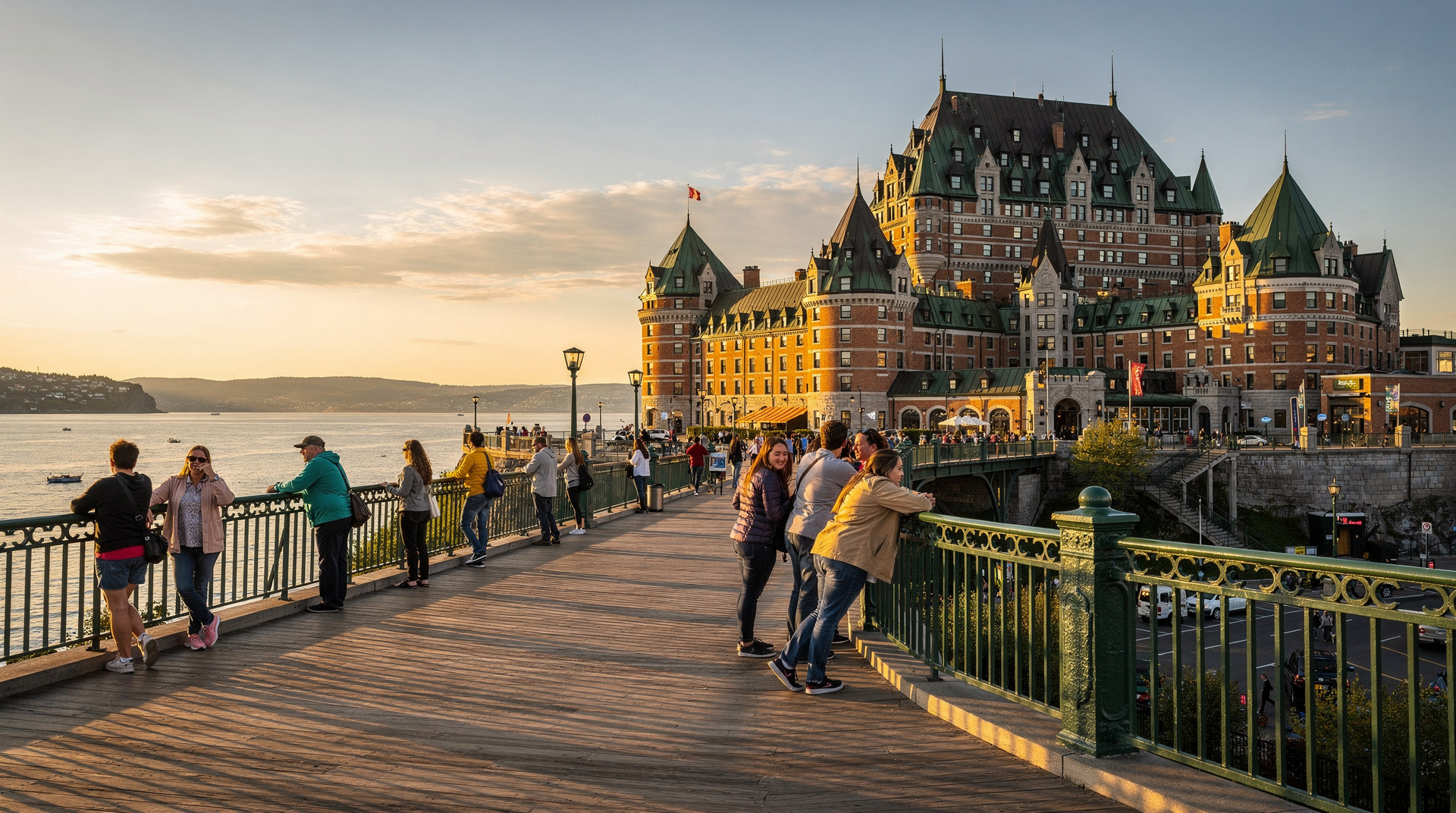
- Terrasse Dufferin (Québec City): the elevated promenade in front of the Château Frontenac gives a wide view of both shores and the river.
- Quai des Cageux / Avenue Champlain (Québec City): at water level, closer to the launch point.
- Lévis waterfront (from the south shore ferry): the Lévis side gives a different angle and is often less crowded.
The Carnaval de Québec is itself worth planning a trip around — see our Québec City destination guide and the Hôtel de Glace guide for more context on the full Carnaval experience.
The season: when conditions are right
Ice canoeing requires a specific river condition: partially frozen, with ice floes moving in current, but with enough open water for paddling. The window is typically December to March.
January and February are the most reliable months. The river is usually partially frozen with active ice movement — ideal conditions.
December can work in cold years but the ice coverage is less consistent.
March conditions vary — by mid-March the river begins opening up, and by late March most tour operators have closed for the season.
The Carnaval de Québec ice canoe race is specifically timed to coincide with peak mid-winter ice conditions.
Physical preparation
Ice canoeing is a genuine physical workout, not a passive experience. You should be:
- Reasonably fit — you will paddle hard and haul a canoe over ice
- Comfortable getting wet — drysuits protect you from cold water but are not totally waterproof in heavy submersion; cold water contact on exposed skin is possible
- Free from major mobility limitations — climbing in and out of a canoe on ice requires agility
This is not appropriate for people with heart conditions, back injuries, or who are uncomfortable with cold water. Pregnant women should not participate.
That said, “fit” here means a baseline of activity, not athlete-level conditioning. Most physically active adults can complete a guided ice canoeing session without difficulty. You will be tired afterward, and you will feel it the next day, and you will be glad you did it.
Travelling with a group of mixed fitness levels? Operators generally place stronger paddlers at the front and back of the canoe, and guides adjust pace so slower or less confident participants aren’t left struggling. It’s rare for a group to be turned away for fitness reasons alone — the bigger factor guides screen for is genuine mobility or medical limitations, not general fitness level.
What to do after: warming up properly
After 60–90 minutes on the river, warming up correctly matters. Most operators include sauna access in their packages — take the full time available. A Nordic spa session (see the Québec wellness guide) is an excellent complement for the afternoon after an ice canoeing morning.
If you are staying in Québec City, the Vieux-Québec has numerous restaurants and cafés well positioned for post-activity recovery. The Petit-Champlain neighbourhood, just below the funicular, has excellent options.
Combining with other winter activities in Québec City
Ice canoeing is particularly well positioned for combination with other Québec City winter experiences:
- Hôtel de Glace — stay at the ice hotel one night, ice canoe the next morning. Both are deeply unusual experiences unique to Québec. See the Hôtel de Glace guide.
- Carnaval de Québec — if timing aligns with the Carnaval (late January–mid-February), ice canoeing as a tourist activity and watching the competitive race are natural partners.
- Snowshoeing in Parc Jacques-Cartier — a quieter nature complement after the physical intensity of the river. See the snowshoeing guide.
- Fat biking — another active urban winter option from Québec City that pairs well with ice activities.
Getting to the launch point
Ice canoeing operators in Québec City typically launch from the waterfront below Old Québec — accessible on foot from the Lower Town (Basse-Ville). The area is served by the funicular from Terrasse Dufferin or on foot via the Escalier Casse-Cou (Breakneck Stairs). From Québec City airport, a taxi or rideshare is about 30 minutes. No car is required — this is one of the few Québec winter activities accessible without driving.
Choosing between watching the race and doing a tour
If your budget or fitness rules out the guided session, watching the Carnaval race from shore costs nothing and is still a genuinely memorable experience — the ice-floe crossing is dramatic to watch even from Terrasse Dufferin. If you want the physical sensation yourself, prioritise booking the guided tour in January or February, when ice conditions are most reliable and cancellations are less likely. Combining both — watching the race one day, doing a guided session another — gives you the full picture of the sport from both sides.
Frequently asked questions about Ice canoeing on the Saint-Laurent (canot à glace)
Is ice canoeing dangerous?
Supervised ice canoeing on a guided tour carries minimal risk. The guides are experienced, the canoes are equipped with safety handles and flotation, and you wear a dry suit or protective gear. The river's currents and unpredictable ice floes make unsupervised crossings genuinely dangerous — do not attempt it alone.What does ice canoeing feel like physically?
It is a genuine physical workout. You paddle in sections of open water, then scramble out onto ice floes and drag the canoe by handles attached to the gunwales. The ice surface varies — sometimes slippery smooth, sometimes rough and ridged. Core strength, balance, and upper body endurance all come into play. Most people are warm within minutes despite the cold.What should I wear for an ice canoeing session?
Operators provide drysuits or protective waterproof overalls. Underneath, wear warm merino or fleece layers — you will get warm quickly but need insulation during briefings. Waterproof boots are essential. Leave jewellery and valuables behind. Gloves must be warm but allow grip.What is the Carnaval de Québec ice canoe race?
The canot à glace race is one of the signature events of the Carnaval de Québec (late January to mid-February). Teams of 5 cross the Saint-Laurent between Québec City and Lévis, racing in both directions. Paddling in freezing water between ice floes, teams reach the opposite shore in 10-25 minutes depending on ice conditions. It is the most visually dramatic event of the Carnaval.Can I watch the ice canoe race without participating?
Yes. The Carnaval de Québec race is free to watch from the shore. The best viewing spots are on the Terrasse Dufferin in front of Château Frontenac and along the boardwalk in Lévis. Arrive early — crowds gather quickly. The race schedule is published on the Carnaval website in January.
Top experiences
Bookable activities with verified prices and instant confirmation on GetYourGuide.