Snowshoeing in Québec: from city parks to backcountry
Jacques-Cartier National Park Snowshoeing
Duration: 2-3 hours
Where is the best snowshoeing in Québec?
Parc national de la Jacques-Cartier (40 km from Québec City) and Mont-Tremblant National Park are the top destinations. Mont-Royal in Montréal is the most accessible with no car needed. Season runs December to March; no prior experience required.
The most accessible winter activity in Québec
Snowshoeing has a reputation as the “boring” winter option — the thing you do when you are too old or too unfit for skiing. This reputation is undeserved. In Québec’s parks and wilderness, snowshoeing takes you places that skis cannot: through dense forest, up steep ravines, along frozen stream beds where the snowpack is too irregular for any other tool.
It is also, genuinely, the easiest winter outdoor activity to learn. Five minutes of instruction are enough to get moving confidently. No lifts, no lessons, no technique anxiety. You strap on the frames, pick up the poles, and walk. The snowshoes do the rest.
Québec’s winter trail infrastructure is built partly around snowshoeing. Most cross-country ski parks maintain separate snowshoe trails, and many of the province’s best winter views are only accessible on foot.
This guide covers the best snowshoeing destinations from Montréal to the far north, what equipment you need, and how to combine snowshoeing with other Québec winter activities.
| Where | Mont-Royal (Montréal), Parc Jacques-Cartier, Mont-Tremblant, Forillon |
| Cost | Park entry ~9–12 CAD/day; rental 15–25 CAD/day |
| Experience needed | None — if you can walk, you can snowshoe |
| Season | December to March, best January–February |
| Getting there | Mont-Royal needs no car; other destinations need a rental car |
How to choose your destination
The right destination depends on whether you have a car and how much of a wilderness experience you want. Based in Montréal without a vehicle? Mont-Royal is your only realistic option, but it genuinely delivers a real forest outing without leaving the city. Based near Québec City with a car for a half-day? Parc national de la Jacques-Cartier is the best overall choice in the province — dramatic gorge scenery, well-groomed trails, and a naturalist-guided option if you want interpretation.
Staying at Mont-Tremblant already for skiing? Its dedicated snowshoe network is an easy half-day add-on between ski sessions. Doing the full Gaspésie loop? Forillon rewards the extra distance with coastal cliff scenery unlike anywhere else on this list, but it is a genuine multi-day commitment, not a casual outing.
Travelling with children changes the calculus slightly: Mont-Royal and the easier valley-floor loops at Jacques-Cartier are genuinely manageable for kids as young as six or seven with adult-sized rented snowshoes scaled down, while the ridge climbs and Forillon’s more exposed coastal trails suit older, more confident young hikers. If in doubt, ask park staff at the entrance which specific loop suits your group’s age and fitness before committing to a route.
Equipment basics
Modern snowshoes are nothing like the traditional wooden-frame rackets you see in museums. Contemporary snowshoes are aluminium-framed with plastic or composite decking, aggressive crampons on the underside for icy terrain, and bindings that accept any waterproof boot.
Renting vs buying: For visitors, renting is the obvious choice. Most major parks and outdoor centres offer daily rentals (15–25 CAD for snowshoes and poles). If you plan to snowshoe more than 3–4 days, purchasing a basic pair (120–200 CAD) can be worthwhile.
Size: Snowshoe size depends primarily on body weight and the type of terrain. Heavier users and deep powder conditions call for longer frames; lighter users on groomed trails can use compact frames. Rental staff will match you appropriately.
Poles: not mandatory but strongly recommended. They aid balance on uneven terrain and reduce knee stress on descents. Rental poles are typically included or available cheaply.
Boots: Your regular insulated waterproof winter boots work perfectly. Snow will pack under and around the bindings — waterproofing is essential. Avoid cotton socks (they hold moisture); wool or synthetic socks are far better.
Traction devices: Some icy conditions (late-season melt-freeze cycles) can make snowshoe crampons insufficient on certain trails. Carrying small slip-on traction devices (microspikes or Yaktrax) as backup is useful for early and late season outings.
Best snowshoeing destinations by region
Mont-Royal — the city option in Montréal
For travellers based in Montréal without a car, Parc du Mont-Royal is the starting point. The park’s 200-hectare forested hill offers several maintained snowshoe trails through mixed hardwood and conifer forest, with the added surreality of the Montréal skyline visible through the trees.
Snowshoe rental is available near the park on weekends (check current providers at montroyal.ca). The park is free to access. Trails are not groomed to the standard of major parks, but for an urban half-day outing, Mont-Royal delivers real winter forest without a car.
For a longer, more satisfying outing from Montréal, head north to the Laurentides. The P’tit Train du Nord trail (see the cross-country skiing guide) has separate snowshoeing sections. Parc régional de la Rivière-du-Nord near Saint-Jérôme (50 km north) offers 25 km of snowshoe trails and is easily accessible from Montréal by commuter train to Saint-Jérôme and then a short taxi or rideshare.
Parc national de la Jacques-Cartier — best near Québec City
Parc national de la Jacques-Cartier, located 40 km north of Québec City via Route 175, is arguably the best overall snowshoeing destination in the province. The park’s dramatic Jacques-Cartier River valley — carved by glaciers into a 450-metre deep gorge — provides terrain that is visually spectacular and physically varied.
Snowshoe trails range from easy valley-floor loops to challenging ridge climbs with views across the boreal plateau. The park maintains around 60 km of snowshoe trails, well-marked and groomed regularly.
Jacques-Cartier National Park Snowshoeing Tour — a guided 2-to-3-hour snowshoe excursion through the park with a naturalist guide who explains the boreal ecosystem and winter wildlife signs (wolf and moose tracks are common). Around 70 CAD per person including equipment.
Jacques-Cartier Ski-Shoeing Excursion — an alternative using ski-shoes (compact hybrid skis that attach to regular boots, requiring no ski technique). Covers more ground than snowshoes with similar accessibility. Around 80 CAD.
Day entry to the park: approximately 9–12 CAD per adult (Sépaq parks entry fee). Equipment rental available on-site. Annual Sépaq Access Pass pays for itself quickly if you visit multiple Sépaq parks.
Mont-Tremblant — snowshoeing at a ski resort
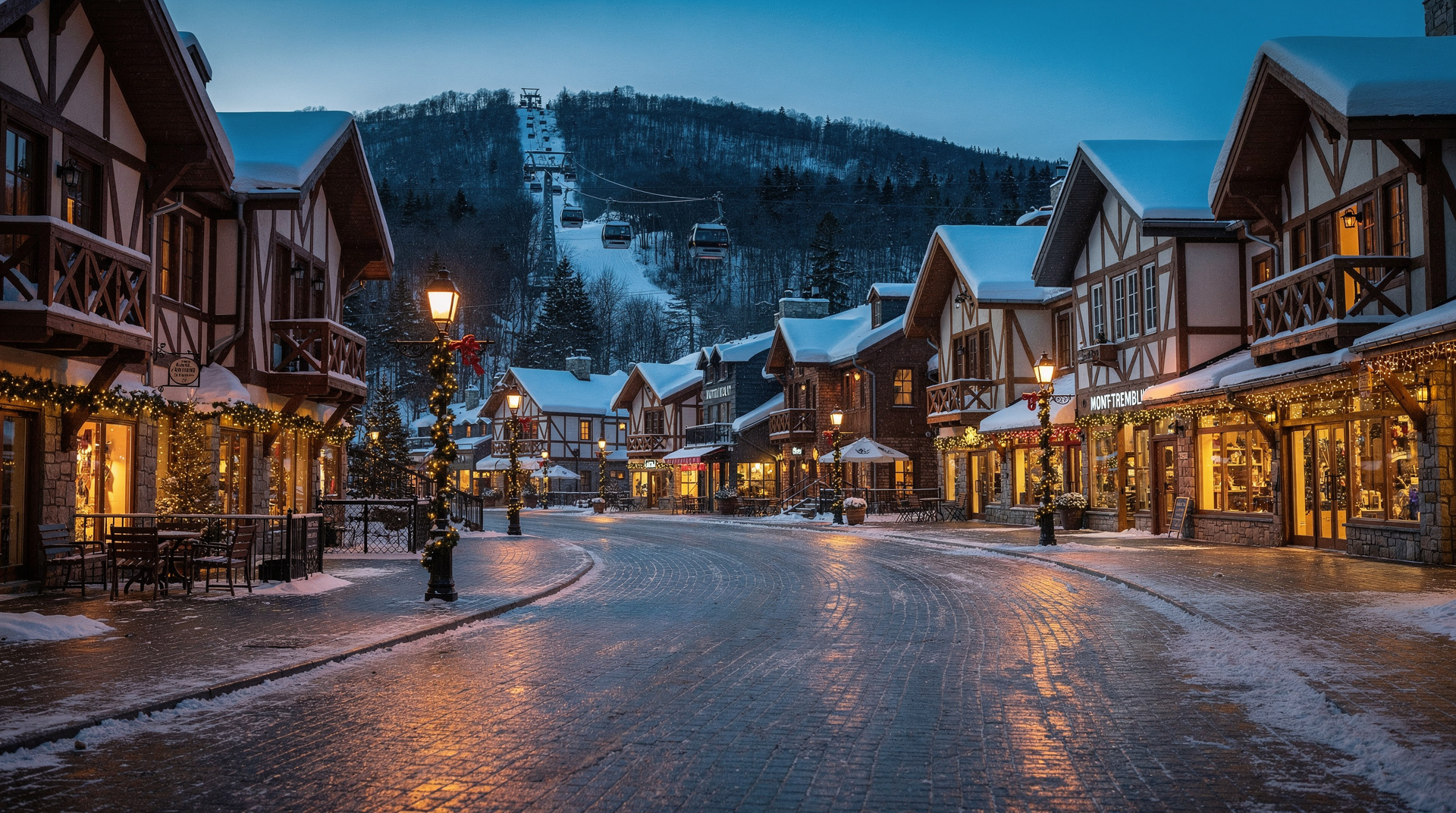
Mont-Tremblant is primarily known as a ski destination (see the ski guide), but the resort maintains a dedicated snowshoeing network separate from the ski trails. The Tremblant area’s terrain — rolling Laurentian hills, frozen lakes, spruce corridors — makes for excellent snowshoe routes ranging from easy village-adjacent loops to half-day wilderness routes.
Snowshoe Rental with Trail Maps (Mont-Tremblant) — rental of snowshoes with detailed trail maps for self-guided exploration around the resort area. No guide required; good for active travellers who prefer independence. Pricing varies by session length.
Snowshoeing at Tremblant also pairs well with the many other activities available at the resort: combine a morning on snowshoes with an afternoon on the ski runs or at the Nordic spa at the village.
Forillon National Park (Gaspésie) — wilderness snowshoeing
For travellers making the longer journey to the Gaspésie, Parc national Forillon at the tip of the Gaspé Peninsula offers some of the most dramatic winter snowshoeing in eastern Canada. The park’s coastal cliffs, frozen coves, and boreal forest combined with views of the Gulf of Saint-Laurent are extraordinary in winter.
Forillon is remote — approximately 900 km from Montréal, 600 km from Québec City — and requires a car and an overnight stay (or several). The park is managed by Parks Canada and operates a winter snowshoe program with groomed trails and occasional guided excursions.
Access: Parks Canada Discovery Pass covers entry (approximately 145 CAD/year per adult). The park’s facilities are reduced in winter — confirm what is open before visiting.
Other notable snowshoeing areas
Parc national des Hautes-Gorges-de-la-Rivière-Malbaie (Charlevoix) — spectacular gorge scenery, moderate trails. About 120 km from Québec City. Sépaq park.
Parc de la Gatineau (near Ottawa) — if you are visiting the Outaouais region, the Gatineau Hills offer excellent snowshoeing with views of the Ottawa River valley. Managed by the National Capital Commission; trail use is free, equipment rental available nearby.
Réserve naturelle des Montagnes-Vertes (Cantons-de-l’Est) — excellent snowshoeing in the Eastern Townships, accessible from both Montréal and Sherbrooke.
Guided vs self-guided snowshoeing
Self-guided
The majority of snowshoers in Québec’s parks go self-guided. Park maps are clear, trails are well-marked with coloured blazes, and distances are posted at intersections. This is the most flexible and economical option.
Required: park entry fee, equipment rental (if needed), map (available at park entrance or downloadable). Recommended: tell the park office which trail you are doing and your expected return time.
Guided
Guided snowshoeing excursions (like the Jacques-Cartier tours above) add interpretive value: a naturalist guide explains the boreal ecosystem, points out animal tracks, identifies trees, and provides context that self-guided hikers often miss. For first-time winter outdoor visitors, a guided experience can significantly deepen the experience.
Guides also provide safety oversight — important for those unfamiliar with winter wilderness protocols.
Wildlife you might see
Winter snowshoeing in Québec parks offers excellent wildlife observation opportunities. The animals are more visible in snow (dark animals against white ground) and their tracks tell stories.
Moose (orignal) — most commonly seen in the Laurentides and Parc Jacques-Cartier; tracks are unmistakable (large split hoof, deep sinkage in snow).
White-tailed deer — common throughout southern Québec parks; groups shelter in cedar swamps during deep cold.
Grey wolf — present in larger parks including Jacques-Cartier, Tremblant national park, and Forillon. Very rarely seen directly; tracks and territorial markings are visible.
Ruffed grouse (gélinotte huppée) — burrow into snow for warmth; you may startle one as it explodes from a snowbank beside the trail.
Coyote — tracks common in all parks; occasionally seen at dawn and dusk.
River otter — look for slides down riverbanks to frozen streams. Jacques-Cartier and other river-adjacent parks.
Season, conditions, and planning
The snowshoe season in Québec runs December to March, with the best conditions in January and February when snowpack is deep and stable.
Early season (December): snowpack may be thin at lower elevations; higher parks (Camp Mercier, Tremblant) are more reliable.
Peak season (January–February): deep snow, reliable grooming, all parks fully operational.
Late season (March): consolidating snowpack at lower elevations creates harder, icier trails. Traction devices become more useful. Higher parks (Jacques-Cartier, Camp Mercier) often still have excellent conditions.
Weather: Québec winter temperatures range from -5°C to -25°C depending on region and month. Wind chill can make exposed ridge trails significantly colder. Always check the forecast and dress for conditions 10°C colder than the base temperature if you are going on exposed terrain.
Combining snowshoeing with other activities
Snowshoeing is a natural companion to:
- Cross-country skiing — many parks maintain separate trails for both. See the cross-country skiing guide.
- Winter camping — advanced snowshoers can access backcountry yurt or tent sites in Parc Jacques-Cartier and Parc de la Mauricie.
- Dog sledding — a complementary experience, both slow and quiet winter activities. See the dog sledding guide.
- Hôtel de Glace + snowshoeing — a morning snowshoe session from Québec City makes an excellent complement to an Hôtel de Glace stay. See the Hôtel de Glace guide.
For a full overview of winter activities in Québec, visit our winter sports hub.
Frequently asked questions about Snowshoeing in Québec: from city parks to backcountry
Do I need experience for snowshoeing in Québec?
None at all. Snowshoeing is the most beginner-friendly winter activity in Québec. If you can walk, you can snowshoe. A 5-minute orientation covers attachment, stride, and basic technique. Most parks have a range from flat beginner loops to challenging backcountry routes.What is the difference between snowshoeing and hiking on packed snow?
Snowshoes distribute your body weight over a larger surface, preventing you from sinking into deep snow (postholing). On packed trails they are unnecessary but harmless. On fresh or unconsolidated snow they are essential — without them, each step could sink 40-60 cm, making progress exhausting and potentially unsafe in deep backcountry.Can I bring a dog snowshoeing in Québec parks?
Dogs are allowed on snowshoe trails in most Québec parks but must be kept on leash. Some wildlife protection zones prohibit dogs during winter (particularly wolf territory). Check individual park regulations before bringing your dog. Booties are recommended for dogs in very cold conditions with icy trails.What should I wear for snowshoeing?
Dress in layers: moisture-wicking base layer, fleece mid-layer, and a windproof outer shell. Snowshoeing is moderately aerobic — you will warm up quickly. Insulated waterproof boots are essential; your regular winter boots work if they are waterproof and warmly insulated. A toque, mittens, and neck gaiter complete the kit.Is snowshoeing free in Québec provincial parks?
Parks require an entry fee (around 9-12 CAD per adult per day for Sépaq parks). Trail use itself is included in the entry fee. Equipment rental is available at most major centres (15-25 CAD for snowshoes + poles for a day). Some parks allow self-guided snowshoeing without a guide; others offer guided interpretive walks at extra cost.
Top experiences
Bookable activities with verified prices and instant confirmation on GetYourGuide.