Québec City to Île d'Orléans: half-day or full day?
Île d'Orléans Guided E-Bike Tour with Tastings
Duration: 4-6.5 hours
How long do you need at Île d'Orléans?
A half-day (3-4 hours) is enough to cover the eastern loop — Saint-Jean to Sainte-Famille with stops at a ciderie, fromagerie, and maybe a strawberry farm. A full day (6-7 hours) lets you complete all six parishes and really soak in the island's pace. By e-bike, the full circuit takes 5-6 hours. By car, 3-4 hours is comfortable.
An island that earns its reputation
Île d’Orléans is the kind of place that Québec is quietly proud of: a working agricultural island in the middle of the St. Lawrence, connected to the mainland only by a single bridge, that has managed to stay genuinely productive while simultaneously becoming one of the province’s best culinary destinations. Thirty-four kilometres long, six parishes, and a dense map of farms, orchards, cideries, fromageries, and artisan shops — all within 30 minutes of Old Québec.
This guide answers the main practical question: how much time do you actually need?
| Where | 15-20 min / 15 km east of Old Québec |
| Cost | Free to drive; tastings and tours around 70–95 CAD |
| Time needed | Half-day (3-4h) for the eastern loop, full day (6-7h) for all six parishes |
| Getting there | Self-drive, guided e-bike tour, or the infrequent RTC route 16 |
| Best time | June–July (strawberries), September–October (harvest and cider) |
Half-day vs full day
Half-day (3-4 hours)
A half-day is enough if you focus on the eastern loop: cross the bridge, turn right (westward/counterclockwise is actually easier for orientation), stop in Saint-Pétronille for the view, continue through Saint-Jean for a ciderie stop, then to Sainte-Famille for cheese, and return via Sainte-Pierre. You’ll visit 3-4 producers and see the best of the island’s scenery.
Best if: you’re combining with Montmorency Falls in the same half-day, or arriving in the afternoon.
Full day (6-7 hours)
A full day allows the complete circuit of all six parishes (67 km loop), with multiple tastings, a proper lunch at one of the island restaurants, and time to wander Sainte-Pétronille village. By e-bike, this is the most enjoyable way to do it.
Best if: you’re a food or cycling enthusiast, it’s strawberry season (June-July) or harvest season (September-October), or you simply want to slow down after the intensity of Old Québec.
Getting to the island
By car
15-20 minutes from Old Québec via Autoroute Dufferin-Montmorency (A-440) east, then Route 368 to the bridge. Cross the Pont de l’Île-d’Orléans (no toll). Turn right for the classic counterclockwise circuit (Saint-Pétronille → Sainte-Pétronille → Saint-Laurent → Saint-Jean → Saint-François → Sainte-Famille → Sainte-Pierre → back to bridge).
Parking is informal — most farms and cideries have parking areas. No parking fees.
By e-bike tour (recommended)
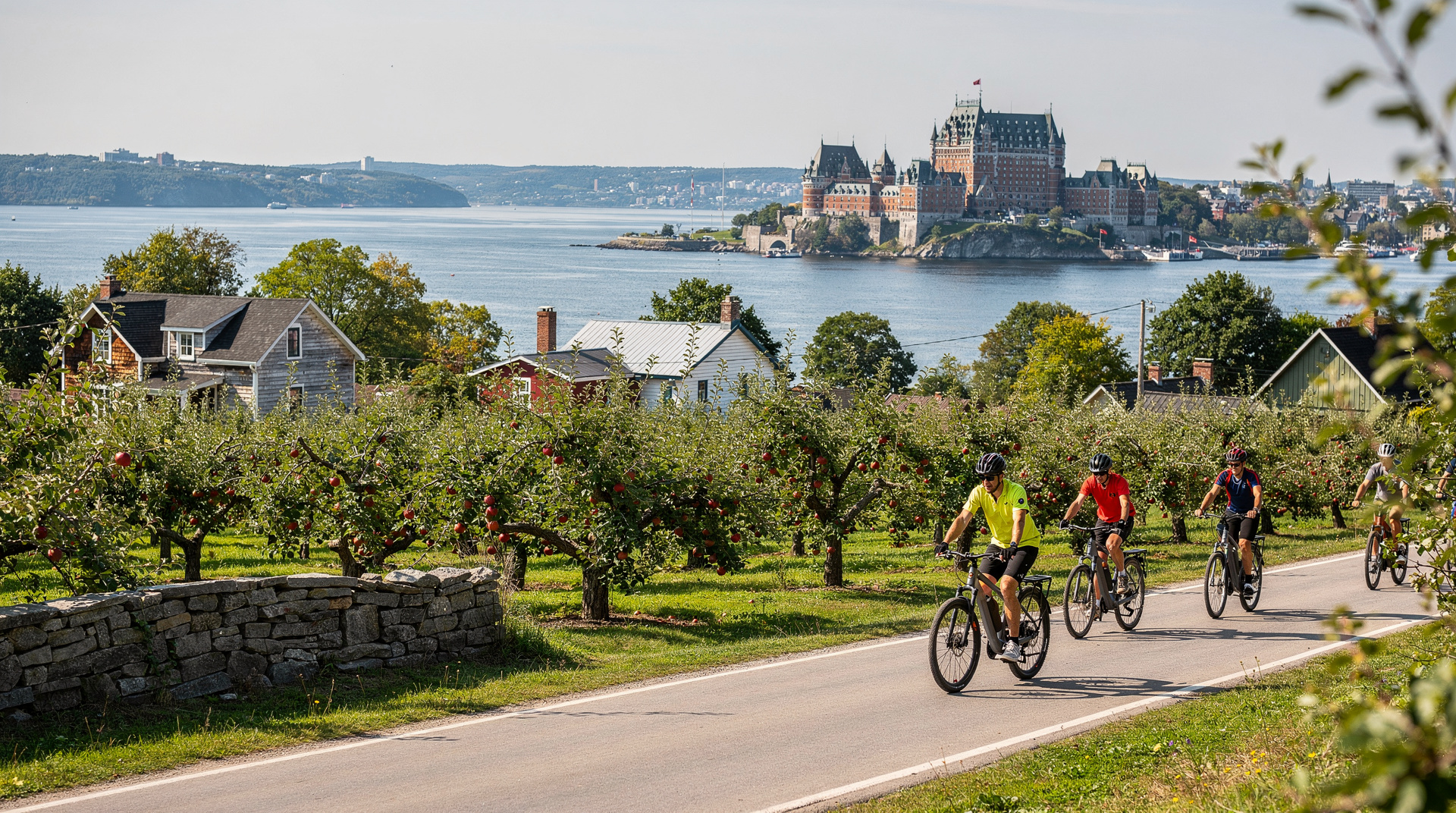
The guided e-bike tour with tastings is widely considered the best way to experience the island. The e-bikes handle the hills, the guide knows the best stops and can get you into some operations that don’t regularly receive walk-ins, and the tastings are built in:
Île d'Orléans Guided E-Bike Tour with TastingsBy bus (RTC route 16)
RTC route 16 connects the Beauport sector (reachable by metro and RTC from Québec City) to Saint-Pierre on Île d’Orléans. Service is infrequent (a few times a day) and not timed for tourists. Practical only if you’re very patient or combining with accommodation on the island.
Combined Montmorency + Île d’Orléans half-day tour
For the time-efficient visitor wanting both Montmorency Falls and a taste of Île d’Orléans in one organised morning:
Montmorency Falls & Île d'Orléans Half-DayThe six parishes: what to know
Sainte-Pétronille
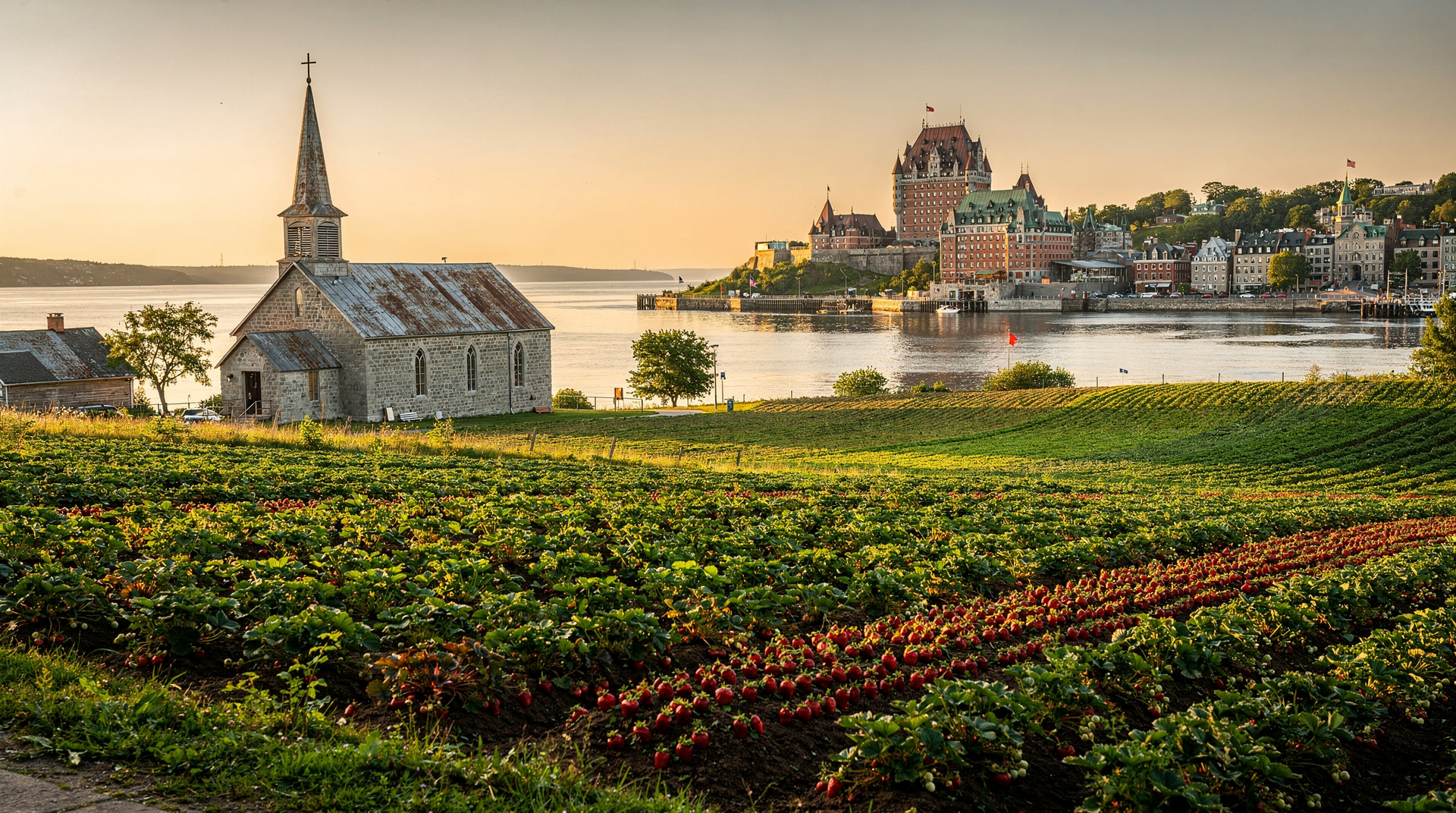
The first village past the bridge, on the southwest tip of the island. The Belley Farm and the elegant old houses here overlook the narrowing river towards Québec City — one of the best viewpoints. The Chocolaterie de l’Île d’Orléans is here (worth a stop for handmade chocolates and the view). Small marina in summer.
Saint-Laurent
The island’s historic maritime parish. Les Anciens Canadiens (the island restaurant) is here. The small museum in the old chapel tells the story of the island’s boat-building tradition. A few good strawberry farms in June-July.
Saint-Jean
Historically the home of the island’s upper class — the manoir seigneurial is still standing.
Saint-François
The most eastern and least visited parish. Simpler landscape, more open fields, less tourist infrastructure. The lookout point here has the best view of the widening St. Lawrence towards the Côte-de-Beaupré. A good stopping point if you want to feel like you’ve left the tourist circuit.
Sainte-Famille
The oldest parish (1661) and home to the oldest wooden church on the island (1749).
Sainte-Pierre
The last parish before returning to the bridge. Cassis Monna’s main outlet is here. The Espace Félix-Leclerc celebrates the legendary Québec singer-songwriter who lived on the island for decades. A pleasant stop even if you don’t know Leclerc’s music.
Best stops for food and tasting
| Producer | Parish | Product | Notes |
|---|---|---|---|
| Cassis Monna et Filles | Saint-Pierre | Black currant liqueur, cassis wine | Unique to the island |
| Laiterie de l’Île | Sainte-Famille | Artisan cheese (soft and aged) | Milk from island herds |
| Les Fromages de l’Isle | Saint-Pierre | Artisan cheese | Cheddar, fresh curds |
| Multiple strawberry farms | All parishes | Strawberries (June–July) | Pick-your-own or bought |
| La Chocolaterie de l’Île | Sainte-Pétronille | Artisan chocolate | Beautiful shop, great view |
Wine tour option
For a guided circuit including wine, cider, and cheese producers:
Island of Orleans Wine TourOr the self-guided Taste Trail that covers the artisan food highlights:
Island of Orléans Taste TrailPractical notes
Driving the island: the ring road is Route 368. It’s a single two-lane road around the entire perimeter. Traffic is one direction (or both, technically — it’s a public road). No GPS required; just follow the perimeter.
What to bring: a cooler bag is useful if you’re buying cheese and cider to take home. Ice cider must be refrigerated. A credit card is accepted at most farms; some small stands prefer cash.
Dogs: most farm operations welcome leashed dogs.
Children: the island is excellent for families — strawberry picking (June-July), farm animals visible at many properties, the beach at Saint-Laurent in summer.
Winter: the island is accessible year-round but most producers close from November to May. The icy St. Lawrence views and cross-country skiing (informal, on farm fields) are the winter draws.
If you only have time for a shorter visit
Not every trip allows a half-day. If you can only spare 90 minutes to two hours, cross the bridge, stop in Sainte-Pétronille for the view and a chocolate shop visit, then turn back — you’ll have seen the island’s most photogenic corner without committing to the full circuit. This works well tucked into a longer day that also includes Montmorency Falls or a Côte-de-Beaupré drive, rather than as the day’s sole focus.
How the island compares to other Québec City day trips
Île d’Orléans is the easiest day trip from Québec City to execute without a car — the e-bike tour handles logistics entirely — and the most food-focused. For comparison, a Charlevoix day trip demands a longer drive and rewards an overnight, while a Tadoussac day trip is built around whale-watching rather than tasting. If your time in the region is limited to one day trip, Île d’Orléans is the lowest-effort, highest-reward choice; save Charlevoix and Tadoussac for when you have at least one extra day.
Combining with Montmorency Falls
The practical combination for a half-day: Montmorency Falls (2 hours) in the morning, then cross to Île d’Orléans for a 3-hour afternoon circuit. Leave Québec City by 09h00, visit the falls by 09h30, drive to the island by 12h00, visit 2-3 producers, return to Québec City by 17h00. Very doable.
Pacing your day on the island
The biggest mistake on Île d’Orléans is treating it like a checklist. The island rewards a slower rhythm: one tasting, a walk, a view, then the next stop. If you plan too many producers, the afternoon turns into a blur of small plastic cups. Pick two or three stops that genuinely interest you and leave room for whatever you spot from the road, whether that is a farm stand, a roadside bench facing the river, or a church worth a quick look.
If you are unsure what to prioritise, think about what you want to bring home. Cider and cassis travel well and make good gifts; cheese and strawberries are better eaten the same day. Our Québec souvenirs guide has more ideas for what to carry back, and it is worth deciding before you start buying.
Choosing between the tour options
The guided options solve different problems. The e-bike outing suits people who want to be outdoors and cover ground without worrying about the hills. The wine tour suits visitors who would rather not think about driving at all, which matters when several stops involve alcohol. The combined Montmorency and island morning suits anyone short on time. If you are weighing guided against independent travel more generally, our comparison of Viator and GetYourGuide in Québec explains how the booking platforms differ.
For a day built around tasting, a guided circuit keeps the logistics simple, so nobody has to be the designated driver.
Eating well beyond the tasting rooms
Tasting portions are small, so plan a proper meal. The island has restaurants in several parishes, and the old-fashioned dining rooms and farm-linked kitchens are part of the experience. For ideas on what to order back in the city, see where to eat in Québec City and our guide to poutine and where to eat it. Lunch on the island and a lighter dinner in the city is a rhythm that works well for most visitors.
Reading the landscape
Part of the pleasure here is understanding what you are looking at. The long, narrow farm strips running down to the river come from the seigneurial system of New France, when land was divided so that each family had access to the water and the road. The island is one of the places where that pattern is still easy to read from the car window. If the history appeals, our New France history overview gives the wider story, and the churches of the island connect naturally to the themes in the religious heritage guide.
The views change with the season. In early summer the fields are bright green and the farm stands are busy. In autumn the orchards and the maples along the road turn, and the light over the river becomes softer. Even on an overcast day, the river views from the western end remain worth the drive.
Weather, clothing, and timing
The river creates its own microclimate, so the wind can be stronger at the water’s edge than in Old Québec. Bring a light layer even in summer, and comfortable shoes for stepping in and out of farm shops and orchards. If you are cycling, sunscreen and a refillable water bottle matter more than extra gear. For a longer view of what to expect through the year, check Québec weather month by month and the best time to visit Québec.
If your visit falls in the colder months, the island is still pleasant for a drive and a few views, but you should not plan around tastings. Our Québec City winter versus summer article gives a personal take on how differently the region feels between seasons.
Fitting the island into a longer stay
Île d’Orléans works best as one piece of a wider Québec City stay rather than the whole plan. A first-timer with limited days can pair it with the walking highlights of Old Québec and the Québec City destination guide, while the 3-day Québec City itinerary shows where a half-day on the island slots in comfortably. Families will find the island easy and relaxed; the Québec City with kids itinerary has more child-friendly ideas for the rest of the trip.
If you are arranging transport, two other guides help: how to rent a car in Québec covers the practicalities if you prefer to drive yourself, and driving in Québec from Europe is useful if road rules or signs are unfamiliar. For a broader food-focused plan, the 5-day foodie itinerary builds the island into a wider tasting route.
Related guides
- Day trips from Québec City
- Île d’Orléans destination guide
- Québec cider route guide
- Québec ferry guide
Frequently asked questions about Québec City to Île d'Orléans: half-day or full day?
How do you get to Île d'Orléans from Québec City?
The only road access is the Pont de l'Île-d'Orléans, about 15 km east of Old Québec (15-20 minutes by car). No bridge toll. RTC bus route 16 from the Beauport sector also connects to the island (infrequent service). There is no direct bus from Old Québec to the island — you need a car, taxi, or join a guided tour.Can I cycle around Île d'Orléans?
Yes. There are no dedicated cycle paths on the island: the full 67 km loop follows the shared road (with a cycling shoulder). By regular bike, allow 5-7 hours with stops. E-bikes complete it in 4-5 hours and make the hilly sections manageable. The terrain is rolling — some climbs on the eastern sections near Sainte-Famille. Bike rentals are available at the bridge end (Saint-Pétronille side).What are the best stops on Île d'Orléans?
Top stops: Laiterie de l'Île d'Orléans (organic cheese from island cows), Cassis Monna et Filles (black currant wine and liqueur, Saint-Pierre), Les Fromages de l'Isle (artisan cheese), and Les Chocolats Favoris for ice cream. Sainte-Pétronille village for the view back towards Québec City.What is the best season to visit Île d'Orléans?
June to October. Strawberry season (June–July) is particularly festive with farm stands everywhere. Apple and pear harvest (September–October) brings the cideries to life. Autumn foliage on the island is beautiful (mid-October). Winter is quiet — most farm operations close, but the icy St. Lawrence views can be spectacular.Is there a wine tour on Île d'Orléans?
Several operators offer guided wine and tasting tours of the island. The Island of Orleans Wine Tour visits multiple producers — wine, cider, cassis liqueur, and cheese — in one organised circuit. E-bike tours also include tastings at producer stops. Self-driving with a designated driver is the most flexible approach.Which parish should I prioritise if I only have time for one or two?
Sainte-Famille and Sainte-Pierre cover the most ground: Sainte-Famille has the oldest wooden church on the island, while Sainte-Pierre has Cassis Monna et Filles and the Espace Félix-Leclerc. Add Sainte-Pétronille if you want the classic river view back towards Québec City — it's the first stop past the bridge and easy to fit in even on a tight schedule.Is Île d'Orléans worth visiting outside strawberry and harvest season?
Yes, though the experience changes. Spring (May) has orchard bloom and a quieter island. Winter (November–April) closes most farm stands and cideries, but the icy St. Lawrence views and the option of informal cross-country skiing on farm fields have their own appeal for visitors already in Québec City for winter activities. If tasting and buying fresh produce is the priority, June through October is the reliable window.
Top experiences
Bookable activities with verified prices and instant confirmation on GetYourGuide.