Eastern Townships vineyards: a 2024 tasting weekend
The Cantons-de-l’Est wine region nobody tells you about
There is a small but serious wine region about 90 minutes southeast of Montréal that most international visitors walk past entirely on their way to Vermont or the ski hills of the Laurentides. The Cantons-de-l’Est — or the Eastern Townships, if you prefer the English name — is Québec’s main wine country, and it deserves considerably more attention than it gets.
I spent the second weekend of May 2024 driving the back roads around Dunham and Frelighsburg with a specific agenda: visit at least three vineyards, eat well, and find out whether Québec wine has genuinely improved or whether the entire industry is still surviving on local goodwill and ice wine.
Short answer: it has genuinely improved.
| Where | Dunham–Brigham–Frelighsburg triangle, ~90 min SE of Montréal |
| Best time | Late May–October; early May is quieter but colder terraces |
| Tasting cost | Around 15–20 CAD for a flight of five wines |
| Getting around | Rental car strongly recommended; roads are rural |
| Book ahead | Restaurant dinners, especially summer weekends |
Getting there and the lay of the land
From Montréal, take Autoroute 10 east toward Sherbrooke, then exit toward Autoroute 35 south in the direction of Saint-Jean-sur-Richelieu. From there, the wine country clusters around the towns of Dunham (l’Orpailleur’s home base), Brigham, and Frelighsburg, within a roughly 30-kilometre triangle. The roads are small, the countryside rolls gently, and in early May the apple orchards are just coming into blossom alongside the vineyards.
The Eastern Townships is also home to Lac Memphrémagog, one of the most beautiful lakes in Québec, and the town of Magog on its northern shore is worth an evening stop if you are staying the weekend.
L’Orpailleur: the original
L’Orpailleur, established in 1982, is the winery that essentially proved Québec could produce quality table wine. It is located in Dunham and operates as much as an educational institution as a winery — there is a permanent exhibition about viticulture in this cold climate, a restaurant, and a terrace that looks out over the vines.
I arrived on Saturday morning when the tasting room opened at 10:00. The 2023 white blends they were pouring — primarily based on Vidal and Seyval Blanc, cold-hardy hybrid varieties that survive the Québec winter — were genuinely impressive. Crisp, mineral, with a long finish. The Vendanges Tardives (late harvest) dessert wine was extraordinary: not cloying, not heavy, more like a very focused Vouvray demi-sec than the sticky ice wine style I had expected.
The tasting flight costs 15 to 20 CAD per person (five wines) and the staff are knowledgeable without being precious about it. I bought two bottles of the 2022 Blanc de Blanc, which is their flagship, for about 22 CAD each.
One caveat: L’Orpailleur is the most visited winery in the region and in summer and fall it can feel like a tourist attraction rather than a working estate. On a Saturday in early May, it was pleasant and unhurried. By late October (peak foliage season), the parking lot is reportedly a challenge.
Vignoble de la Bauge: the wild card
About 12 kilometres north of Dunham, Vignoble de la Bauge is smaller and less polished than L’Orpailleur, but it was the find of the weekend. The estate also raises deer and wild boar, which gives the whole experience a kind of rustic, unexpected quality. The wines are made in smaller quantities from a mix of hybrid varieties and some European crosses that they have been experimenting with for the past decade.
The Seyval reserve they poured was the most complex wine I tasted all weekend — barrel-aged, slightly oxidative in a deliberate way, with a nuttiness that reminded me of white Burgundy. Unusual for Québec. The winemaker, when I asked, explained that they have been selectively leaving grapes on the vine longer than their neighbours in order to develop phenolic maturity even at this latitude.
The farm shop also sells venison and boar products, which made the picnic I assembled on the tailgate of my car considerably better than planned.
Domaine du Ridge: the view
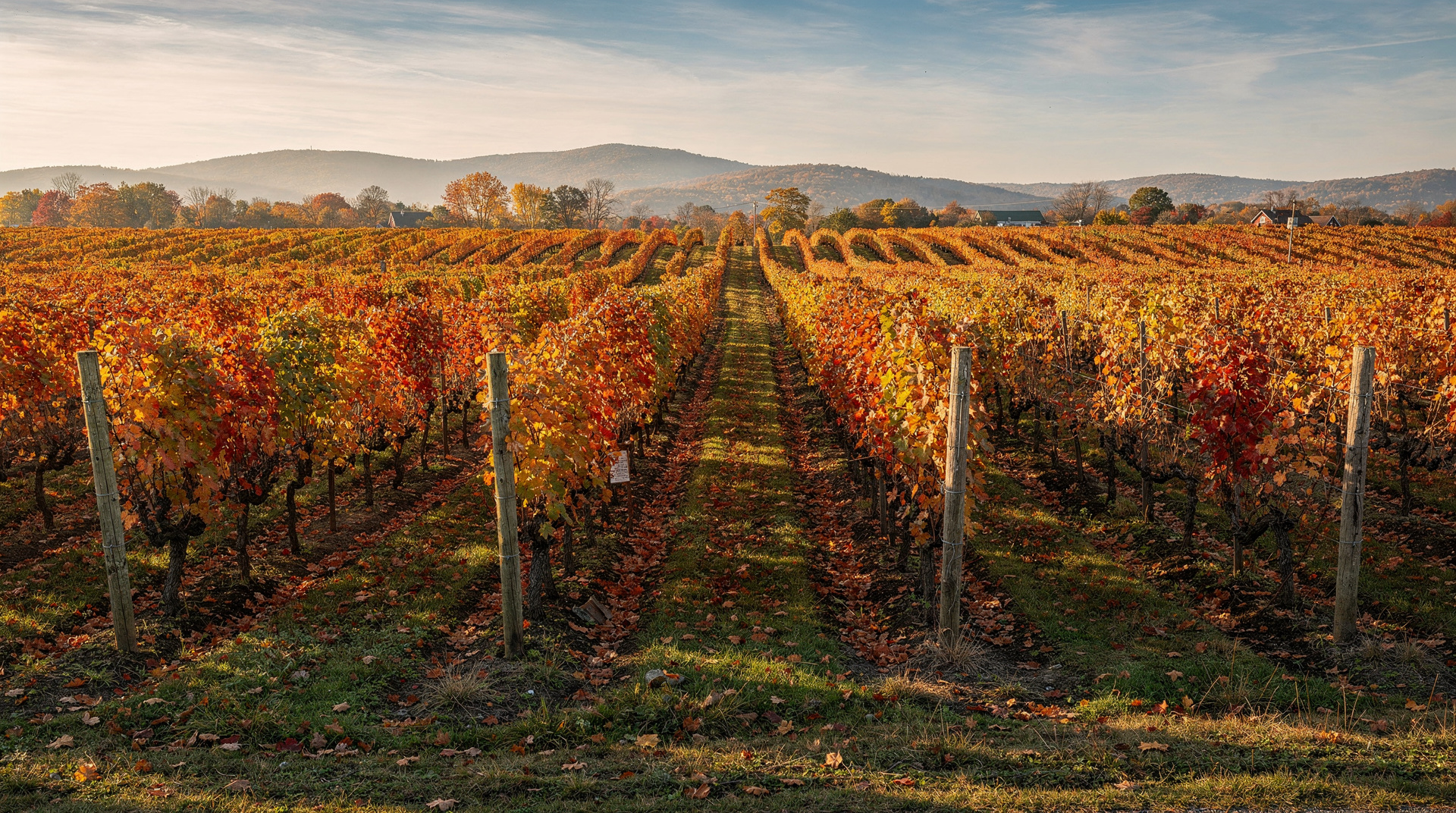
Domaine du Ridge is the most visually spectacular of the three estates I visited. It sits on a hillside above Saint-Armand with views that extend across the rolling farmland toward the Vermont border on clear days. In May, with the leaves just coming in, the light on the vineyard rows was genuinely painterly.
The wine quality here is consistent rather than exceptional — solidly made, correctly priced at 18 to 25 CAD per bottle, and well-suited to the kind of straightforward food-and-wine pairing that makes sense at a picnic or a dinner at a local auberge. Their Rosé de Glace (ice rosé) was the best thing they produce: semi-sweet, very Québécois, the kind of wine that does not exist anywhere else in the world.
The tasting room staff were enthusiastic and the terrace is worth sitting on for an hour. Book ahead if you are going on a summer weekend, because it fills up.
Where to eat: the honest version
The Eastern Townships has a genuine food scene that has developed considerably in the last five years, and not all of it is in the obvious places.
Auberge Riverend in Frelighsburg is where I stayed both nights. It is a restored 19th-century mill on the Rivière aux Brochets, 10 rooms, beautiful and calm. The restaurant is genuinely excellent — table d’hôte menus that change daily based on seasonal produce, with a wine list drawn exclusively from regional producers. A three-course dinner will run you 60 to 75 CAD per person without wine, which is correct for this level of cooking.
In Dunham itself, the Café-Boulangerie near the centre was where I started both mornings. Excellent croissants, proper coffee, and the kind of relaxed local atmosphere that is impossible to manufacture. Saturday morning it was full of people who had clearly just walked their dogs.
In Magog, Le Bouchon in the old town has been a reference point for local cuisine for several years. Book ahead — it is small and it fills up on weekend evenings. The duck confit and the wine list (regional and imported) are both better than the décor would suggest.
One thing worth avoiding: the tourist-oriented restaurants on the waterfront strip in Magog, which all charge similar prices for considerably less quality than the places the locals actually eat.
What I got wrong
I planned the weekend around the optimistic assumption that all three vineyards would have their terraces open. In early May, this is not guaranteed. L’Orpailleur’s terrace was open because they heat part of it; de la Bauge was fully outdoor and cold enough that we ate our picnic in the car; du Ridge was open but had a brisk wind.
Early May is before peak season in the Eastern Townships, which means fewer crowds and better value accommodation, but it also means you are gambling on the weather. The weekend I went had one gorgeous day and one grey, windy day. Bring layers.
The wine route is also longer than it looks on a map. Driving between vineyards with stops for tastings, lunch, and the actual enjoyment of the countryside, the 30-kilometre triangle takes a full day to cover properly. Do not try to rush it.
The broader picture
The Eastern Townships wine industry produces about 4 million litres annually — a tiny fraction of French or Californian production. The wines are expensive relative to comparable quality from warmer regions (a solid Dunham white costs as much as a decent Burgundy at a Québec SAQ), but they are genuinely distinctive: cold-climate, acid-driven, mineral, unlike anything from Bordeaux or the Rhône valley.
If you are coming from Europe, the prices will feel high. If you approach it as a regional experience rather than a value proposition — which is the right frame — the Eastern Townships is one of Québec’s more rewarding food-and-drink destinations.
The complete Eastern Townships wine route guide covers the full list of producers and the optimal circuit if you have more than a weekend. The destination page for Cantons-de-l’Est has the practical logistics for getting there and getting around without a rental car (though a car is strongly recommended — the vineyards are rural and the bus connections are limited).
For the coming season, Magog and Lac Memphrémagog deserve at least a day on the lake if the weather cooperates. The boat tours that operate from June onwards are a very different way of seeing the region than the wine road.
Doing it as a day trip versus a weekend
If a full weekend doesn’t fit your itinerary, the wine route can be compressed into a long day trip from Montréal — the Montréal to Eastern Townships day trip guide covers a realistic single-day version, though you’ll only comfortably manage two vineyards plus lunch rather than the three I visited. If you can spare three days, the 3-day Eastern Townships itinerary builds in Magog, the lake, and a slower pace through the vineyards without the tailgate-picnic-in-the-cold improvisation I ended up doing.
What to expect if you don’t drink much wine
Not every travelling companion wants five tasting-room stops. The good news is the region works as a food-and-scenery trip even if wine isn’t the point: the orchards, the covered bridges, Magog’s lakefront, and the farm-to-table restaurants (the Charlevoix farm-to-table guide covers a similar philosophy further north, for comparison) mean a non-drinker in the group still has plenty to do while you taste. Several estates, including L’Orpailleur, also sell non-alcoholic grape juice and food products in their boutiques.
Frequently asked questions about Eastern Townships vineyards: a 2024 tasting weekend
Do I need to book vineyard tastings ahead of time? Generally no for a standalone tasting — L’Orpailleur and du Ridge both take walk-ins during opening hours. Book ahead only for a vineyard restaurant meal or a guided tour with food pairing, and always in summer and fall when the region gets busy.
Is one day enough to see the Eastern Townships wine route properly? Not really. The 30-kilometre triangle between Dunham, Brigham, and Frelighsburg takes a full day just for driving, tasting, and lunch at a relaxed pace — trying to add Magog or Lac Memphrémagog on top makes for a rushed day. Two to three days lets you actually enjoy it.