Petit-Champlain & Lower Town
Explore Petit-Champlain and Lower Town in Quebec City: oldest commercial street, Place-Royale, food tips, best times to visit.
Old Quebec Classic Walking Tour with Funicular
Duration: 2.5 hours
Quick facts
- Age
- Oldest commercial district in North America, dating to the 1680s
- Access
- Funicular from Terrasse Dufferin (4.50 CAD) or Breakneck Stairs (free)
- Distance from Upper Town
- 5-minute walk via funicular or stairs
| Where | Basse-Ville, at the foot of Cap Diamant, Quebec City |
| Cost | Free to walk; funicular 4.50 CAD each way; interpretation centre small fee |
| Time needed | Half a day, ideally split between morning (quiet) and evening (locals) |
| Getting there | Funicular from Terrasse Dufferin or the free Escalier Casse-Cou (Breakneck Stairs) |
| Best time | Before 09:00 or after 17:00, to avoid the cruise-ship crowds |
Getting your bearings in Lower Town
Lower Town — the Basse-Ville — is the oldest part of Quebec City’s old city, and arguably its most photogenic. It sits at the foot of Cap Diamant, sandwiched between the cliff face and the Saint-Laurent River. Where Upper Town has the administrative weight — the Château Frontenac, the Citadelle, the government buildings — Lower Town has the merchant history.
Petit-Champlain is the neighbourhood’s centrepiece: a narrow street of stone buildings from the 17th and 18th centuries, tightly packed with galleries, boutiques selling Quebec-made crafts and food products, and restaurants that are, with a few exceptions, better value than their Upper Town counterparts. Fifty metres away, Place-Royale marks the exact site of Samuel de Champlain’s 1608 habitation and is the founding point of French Canada.
The appeal of Petit-Champlain is not complicated: it is genuinely old, genuinely beautiful, and compact enough to see thoroughly in a morning. The management challenge is the cruise ships.
The cruise ship problem — and how to navigate it
Quebec City is one of Canada’s most active cruise ports. Ships dock at the Louise Basin, five minutes from Lower Town, and passengers flow into Petit-Champlain from approximately 09:00 to 16:00. In peak summer (July–August), this can make rue du Petit-Champlain effectively impassable during those hours — a single narrow street carrying thousands of visitors.
The solution is straightforward: arrive before 09:00 or after 17:00. In the morning, you have soft light, empty cobblestones, and bakers opening their shutters. In the early evening, the cruise passengers have returned to their ships and the restaurant terraces fill with local diners.
The Port de Québec publishes ship arrival schedules online. If you are visiting Petit-Champlain specifically for photography or unhurried exploration, checking the schedule before you plan your day is worthwhile.
What to see and do
Rue du Petit-Champlain
The street itself is the attraction. The stone buildings date to the 1680s through the early 19th century, and the scale is human — two- and three-storey structures that feel proportionate rather than monumental. The mural at the bottom of the Escalier Casse-Cou (painted in the 1980s, depicting historic scenes) marks the unofficial entrance to the district.
The shops are a mixed bag. The best ones sell products with a genuine Quebec provenance: Alain Cyr chocolatier uses Quebec maple products and local fruit; Les Délices de l’Érable is heavy-handed on the tourist packaging but carries legitimate maple producers; several galleries sell Inuit and First Nations art of varying quality and authenticity.
The trap: the souvenir shops selling mass-produced “Quebec” merchandise are indistinguishable from those in any major tourist district. Look for the “fait au Québec” (made in Quebec) label.
Place-Royale
Place-Royale — the square 100 metres from Petit-Champlain — is the founding site of Quebec City. Samuel de Champlain built his first habitation here in 1608; the bronze bust in the centre of the square marks the approximate location. The Notre-Dame-des-Victoires church, which dates to 1688 and has been rebuilt twice after bombardment, still serves as a parish church. Interior visits are free.
The Maison Chevalier (free, open seasonally) and the Centre d’interprétation de Place-Royale (small charge) provide the historical context that the square itself does not explain. The interpretation centre is particularly useful — it explains the archaeology of the site and the layers of construction from 1608 to the present.
Note: Place-Royale is very crowded in July and August between 10:00 and 16:00. The morning and evening light are better for photography in any case.
The funicular
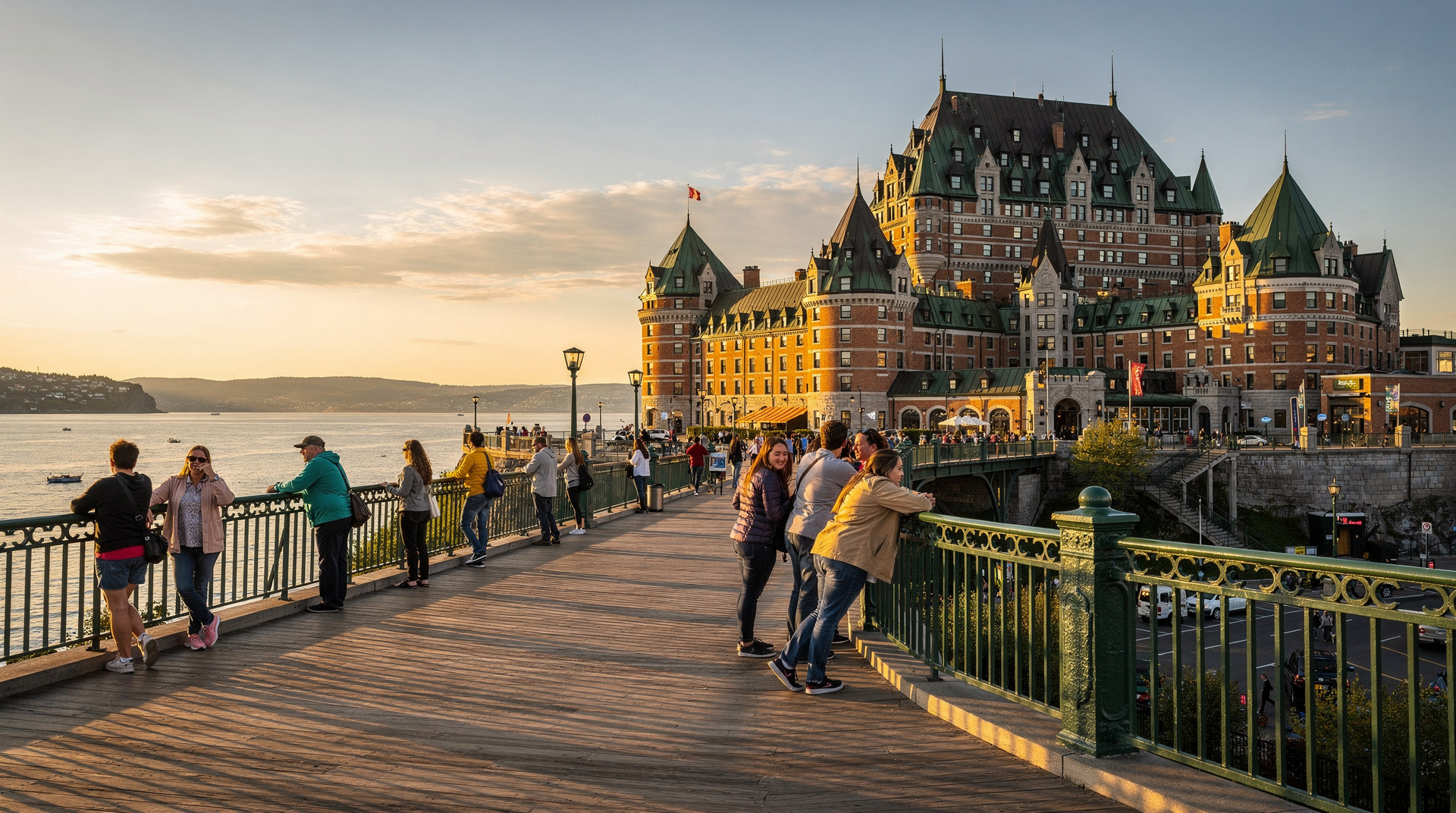
The funicular connecting Terrasse Dufferin (Upper Town) with rue du Petit-Champlain (Lower Town) has been running in various forms since 1879. The current version is glass-sided and takes 45 seconds to descend. At 4.50 CAD each way, it is a legitimate attraction in itself — the view of the Château Frontenac from the lower station, framed by the glass cabin, is the classic Lower Town photograph.
The Escalier Casse-Cou (Breakneck Stairs) beside the funicular is free, steeper than it looks, and often faster during peak hours when the funicular queue extends to 15 minutes.
The classic walking tour with funicular ride combines the Upper Town circuit with Lower Town and includes funicular passage — a good option if you want the context of how the two levels relate to each other historically and geographically.
The historic district walking tour
The three-hour historic district walking tour covers Petit-Champlain and Place-Royale with historical depth that is hard to replicate independently. The guide covers the development of the merchant class in New France, the relationship between the church and commerce in Lower Town, and the 1759 British bombardment that destroyed most of the original buildings in both Upper and Lower Town.
The historical walking and tasting tour
The historical walking and tasting tour pairs the Lower Town history circuit with food stops at specific producers — maple products, artisan cheese, local charcuterie — and is a good option if you want to understand the food culture alongside the built environment.
Cruise ship schedule: how to actually use it
The Port de Québec publishes advance ship arrival schedules online, and checking them before your visit is one of the highest-value five-minute tasks in planning a Lower Town day. On days with two or three ships in port, the street can carry several thousand extra visitors between roughly 09:00 and 16:00; on days with no ships, the same street is a completely different, quieter experience even at midday. If your dates are flexible, favour days with no scheduled arrivals or plan your visit strictly outside the window.
For the deeper Lower Town history that the square itself doesn’t explain, the Château Frontenac history guide and the UNESCO Old Quebec walking guide both cover how Place-Royale and the merchant district fit into the wider fortified city’s story.
Where to eat in Lower Town
Lower Town has the better restaurant value proposition in Old Quebec. Without the same level of cruise ship foot traffic as rue Saint-Louis in Upper Town, restaurants here can rely more on quality than location.
Café du Monde (on the Saint-Laurent waterfront, rue Dalhousie): reliable French bistro cooking — steak frites, moules-frites, credible wine list. Terrasse in summer with river views. Mid-range: 55–80 CAD per person with a glass of wine.
Le Lapin Sauté (rue du Petit-Champlain): the name is a genuine indicator of the menu direction. Rabbit appears in several preparations; the terrace on the cobbled street is agreeable. Slightly tourist-priced but the food is better than the location implies. 50–75 CAD per person.
Poutine wise: Avoid the poutine at Petit-Champlain tourist restaurants. Chez Ashton (multiple locations in Quebec City including one near Porte Saint-Jean in Upper Town) is the honest answer for poutine at 12–18 CAD with fresh cheese curds.
Breakfast and coffee: Café Krieghoff on rue Cartier in Upper Town is worth the short walk for coffee and pastries. In Lower Town itself, most cafés are tourist-priced; go early and you’ll find better options.
Practical tips for Petit-Champlain
Cobblestone warning: Rue du Petit-Champlain is heavily cobbled. Flat shoes or walking shoes with good grip are non-negotiable. This goes especially for the Escalier Casse-Cou, which is steep and uneven.
Photography light: East-facing streets in Lower Town get the best morning light. The Escalier Casse-Cou looking upward toward the Château Frontenac is best photographed in morning or golden hour. Rue du Petit-Champlain itself is narrow; overcast days work well for even light on the stone facades.
Strollers: The funicular accommodates strollers. The Escalier Casse-Cou does not. Several alternative routes between Upper and Lower Town have stroller-accessible inclines along Boulevard Champlain.
What’s actually made in Quebec: Look for products with the “made in Quebec” or “fait au Québec” label. Alain Cyr chocolatier, Les Délices de l’Érable, and the Sirop de l’Érable boutiques carry genuine local products. Many souvenir shops carry Chinese-manufactured items with Quebec branding.
Connecting Lower Town to the rest of your Quebec City visit
Petit-Champlain and Lower Town work best as a half-day, ideally paired with the Upper Town circuit. The natural sequence is:
Morning: Upper Town → Terrasse Dufferin → funicular down → Petit-Champlain → Place-Royale → walk back up via Escalier Casse-Cou or alternative route.
Afternoon: Plains of Abraham or the Citadelle, depending on interest.
Evening: dinner in Lower Town or, better value, in the Saint-Roch neighbourhood.
For the full Quebec City context, see the Quebec City guide. For the fortifications and Upper Town, see Upper Town & Citadelle.
Day trips from this base include Île d’Orléans (30 minutes by car) and Montmorency Falls (15 minutes by car), both accessible as half-day excursions.
For multi-day planning, the Quebec City 3-day itinerary builds a logical sequence around Lower Town, Upper Town, and the surrounding area. For poutine and other Lower Town food specifics beyond what’s covered here, the poutine guide and the Quebec City museums guide (for the Maison Chevalier and Place-Royale interpretation centre in wider context) are worth a look.
Frequently asked questions about Petit-Champlain & Lower Town
What time should I visit Petit-Champlain to avoid crowds?
Before 09:00 or after 17:00. Cruise ship passengers flow into Lower Town roughly 09:00-16:00 in peak summer, and the narrow rue du Petit-Champlain can feel genuinely crowded during those hours. Checking the Port de Québec’s published arrival schedule in advance is worth doing if your dates are flexible.
Is the funicular worth it, or should I just take the stairs?
The funicular (4.50 CAD, 45 seconds) is worth doing once for the view of the Château Frontenac framed by the glass cabin — a classic Lower Town photograph. The free Escalier Casse-Cou beside it is steeper than it looks but often faster during peak hours when the funicular queue extends to 15 minutes; most visitors end up using one going down and the other coming back up.
Top experiences
Bookable activities with verified prices and instant confirmation on GetYourGuide.