UNESCO Old Quebec: self-guided walking itinerary
Old Quebec City: Grand Walking Tour
Duration: 2 hours
How long does it take to walk UNESCO Old Quebec?
A thorough self-guided loop — Place d'Armes to Château Frontenac, Terrasse Dufferin, funicular down to Petit-Champlain, Rue du Trésor, Hôtel-de-Ville, and up to the Plains of Abraham — takes 3 to 4 hours at a comfortable pace. Pure sightseeing without museums can be done in 2 hours.
What makes Old Quebec unlike any other city in North America
Vieux-Québec is the only city north of Mexico to have preserved its 17th-century fortification walls essentially intact. When UNESCO listed it in 1985, the citation noted the exceptional quality of the ensemble: French colonial streets, British military engineering, Catholic churches, convents, and one of the most photographed hotels in the world — all compressed into a walkable area roughly 2 km across.
That compression is the point. You can cover the major highlights on foot in half a day without a car, a guide, or a tour bus. This guide gives you the most efficient self-guided loop, notes the photo points, flags the genuine tourist traps, and explains what you are actually looking at when you arrive.
The site divides naturally into two levels: Upper Town (Haute-Ville) on the promontory, behind and above the walls, and Lower Town (Basse-Ville), the original commercial district below the cliff. The funicular or the Escalier Casse-Cou connects them.
| Where | Vieux-Québec, Upper and Lower Town |
| Cost | Free to walk; funicular ~4 CAD, guided tours ~30–40 CAD |
| Time needed | 2 hours (sightseeing only) to 3–4 hours (full loop) |
| Getting there | 10–20 min walk from the station or cruise terminal |
| Best time | Early morning (8–9am) for quiet cobblestones and light |
Doing the walk with kids or limited mobility
The loop described above works reasonably well for families, though a few adjustments help. Children generally enjoy the funicular ride and the Escalier Casse-Cou stairs as an activity in themselves, and the Plains of Abraham gives room to run after the more static Upper Town sections. Budget extra time — the 3–4 hour adult pace stretches with young children, and the cobblestones on Rue du Petit-Champlain slow prams considerably.
For visitors with mobility limitations or using a wheelchair, several sections are genuinely difficult: the Escalier Casse-Cou has no alternative besides the funicular, and Rue du Petit-Champlain’s cobblestones are uneven. The funicular itself, Terrasse Dufferin, and the Plains of Abraham are all accessible. See our accessibility guide for Québec for a fuller route-by-route breakdown before you plan the day.
Choosing between winter and summer for this walk
The loop works year-round, but the experience differs meaningfully by season. Winter (December–March) transforms the fortifications and Plains of Abraham into a genuinely striking snow-covered scene, and the crowds thin dramatically — but cobblestones ice over, and several outdoor stops become brief rather than lingering.
Summer (June–August) is warm and reliably busy, with the tourist traps around Place Royale and Rue Saint-Louis at their most crowded and their most tempting to fall into out of convenience. Spring and early autumn split the difference: comfortable temperatures, meaningfully fewer crowds than peak summer, and the fortifications and river views still fully accessible. If photography or a quieter walk matters more to you than warm weather, shoulder season is the honest recommendation.
The self-guided walking itinerary: step by step
Allow 3 to 4 hours for the full loop. Distances are short but the terrain is hilly and the streets are cobblestoned — wear shoes with proper grip.
Stop 1 — Place d’Armes (start here, 10 minutes)
Place d’Armes is the natural starting point and the most photographed square in Québec City. It sits in front of Château Frontenac and has been a public gathering space since the 1600s. The bronze monument at the centre commemorates Samuel de Champlain, who founded the settlement in 1608, and the arrival of the Récollet Franciscans in 1615.
Take in the view of Château Frontenac from here before entering it — the full facade reads better from the square than from directly below. The terrasse behind the hotel (Terrasse Dufferin) is your next stop.
Photo point: Stand at the south edge of Place d’Armes, late afternoon light hits the copper roof of the Château from the west — ideal shot.
Stop 2 — Château Frontenac exterior and Terrasse Dufferin (20–30 minutes)
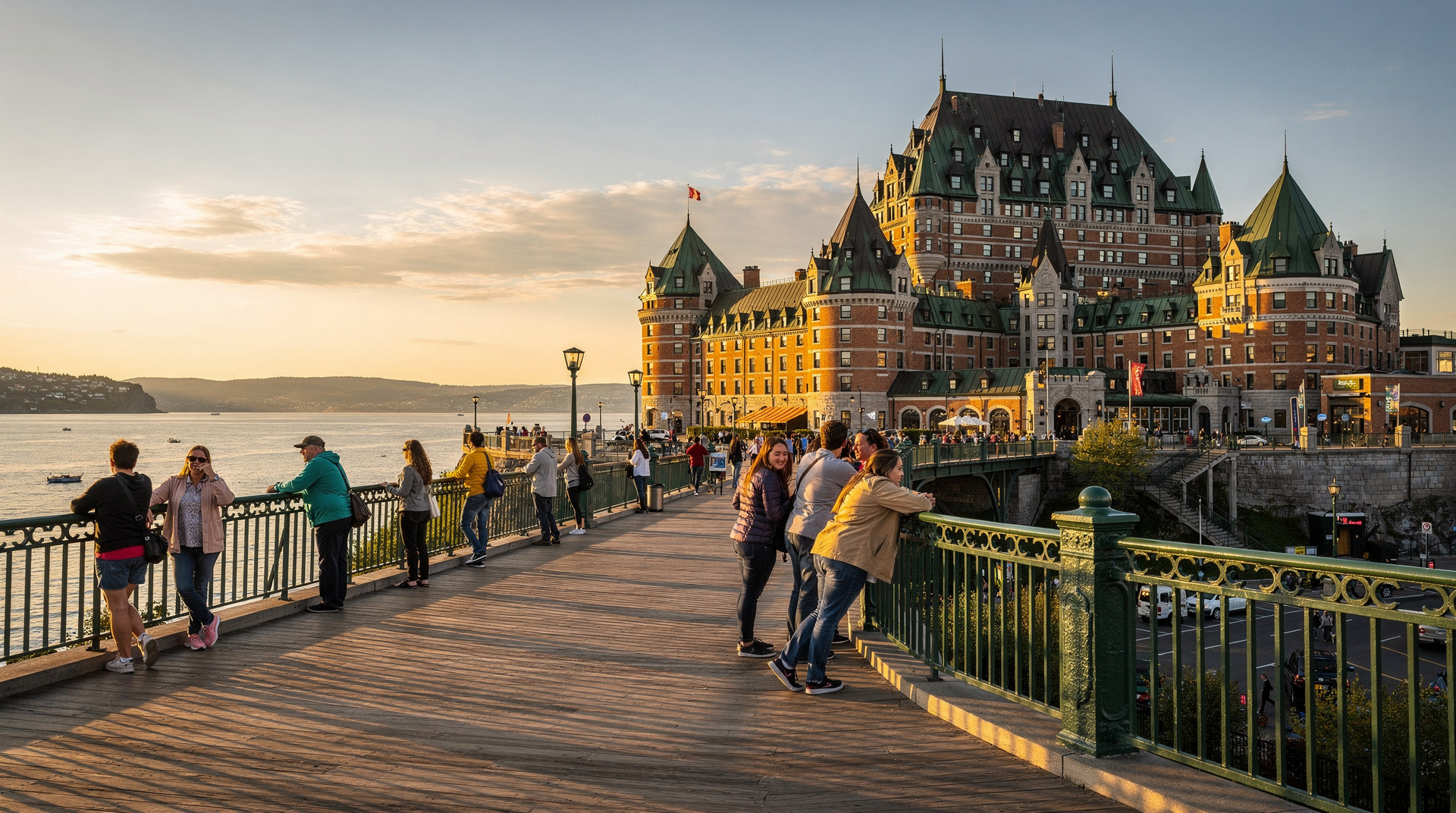
Walk through or around the hotel grounds to reach Terrasse Dufferin, the wide wooden boardwalk cantilevered over the cliff with views of the Saint-Laurent river and the south shore. On a clear day you can see the Pont de Québec bridge (the railway bridge completed in 1919) and the plains of Lévis across the water.
The Château itself was designed by architect Bruce Price and opened in 1893 as a luxury hotel for the Canadian Pacific Railway. The current structure is a result of multiple additions and the central tower (1924). It is worth walking through the lobby — the stained glass and carved stone interior is genuinely impressive. You do not need to book or pay anything to enter the lobby.
Honest assessment: The guided tour of the Château (~1 hour, around 19 CAD) covers history and access to normally closed spaces. Skip the afternoon high tea (80–120 CAD) — it is expensive, the setting is beautiful but the quality is not commensurate with the price. A coffee at the bar 1608 downstairs is a more enjoyable and affordable use of the space (cocktails from 18 CAD, but a proper experience of the building).
Old Quebec City: Grand Walking Tour (2 hours) — if you want context and stories with your walk rather than self-guiding, this guided option is one of the most consistently well-reviewed tours of the district. Around 30 CAD.
Stop 3 — Funiculaire du Vieux-Québec (5 minutes + ride)
At the north end of Terrasse Dufferin, the funicular descends 59 metres to Rue du Petit-Champlain. The ride takes about 1.5 minutes and costs approximately 4 CAD one way (cash or card). The glass-panelled car gives a clear view of the cliff face and the rooftops below.
Alternatively: take the Escalier Casse-Cou (Breakneck Stairs), directly adjacent. Free, good exercise, historically named because the original wooden stairs were genuinely dangerous in icy conditions.
Stop 4 — Rue du Petit-Champlain and Place Royale (30–45 minutes)
Rue du Petit-Champlain is the oldest commercial street in North America, dating to the early 1600s. It is narrow, cobblestoned, lined with artisan shops, cafés, and galleries. The tourist density here is high in summer — arrive before 10 am or after 5 pm for a calmer experience.
What to look for: the trompe-l’oeil mural on the side wall of an apartment building at the top of the street depicting historical Québec scenes — it is genuinely impressive close up.
Place Royale is a 3-minute walk from the bottom of Rue du Petit-Champlain. This small square was the commercial heart of New France in the 17th and 18th centuries. The Église Notre-Dame-des-Victoires (1688) on the square is the oldest stone church in North America. It is free to enter, small, and worth 10 minutes inside.
The Pointe-à-Callière museum is technically in Montréal rather than here, but the nearby Musée de la civilisation (a few minutes’ walk, on Rue Dalhousie) is one of the best museums in the province and worth a half-day visit on its own. See the museums of Québec City guide for details.
Honest food note: The restaurants closest to Place Royale apply heavy tourist markups. Walk one or two blocks north toward the Vieux-Port for better value, or save appetite for Saint-Roch or Limoilou, where locals actually eat.
Stop 5 — Rue du Trésor and Upper Town (20 minutes)
Back in Upper Town (take the funicular back up, or climb the Escalier Casse-Cou), Rue du Trésor is a short pedestrian alley where artists display and sell prints, watercolours, and etchings of Québec cityscapes. The prints are genuinely made locally — this is one of the more legitimate souvenir purchases you can make in the area.
Continue east along Rue Sainte-Anne to reach the Cathédrale Notre-Dame de Québec (1844, on the site of a chapel from 1647) and the Séminaire de Québec — the oldest educational institution in Canada, founded by Bishop Laval in 1663.
Stop 6 — Hôtel-de-Ville (City Hall) and the Plains of Abraham (30–40 minutes)
Walk along Rue Saint-Louis — lined with Victorian-era townhouses and former officers’ residences — to reach the Hôtel-de-Ville de Québec (City Hall, 1896) at the corner of Rue d’Auteuil. The building itself is a neo-Baroque pile worth a look from outside.
Continue through Porte Saint-Louis (one of the original city gates, rebuilt in 1878 in a picturesque Gothic Revival style) to reach the Plaines d’Abraham (Plains of Abraham).
The Plains are a 90-hectare urban park built on the site of the 1759 battle between the French forces of the Marquis de Montcalm and the British forces of General Wolfe. Both commanders were fatally wounded. The French lost the battle and — more consequentially — New France fell to the British within a year. This is arguably the most historically significant patch of ground in Canadian history.
The Musée des Plaines d’Abraham is located in the Martello Tower at the edge of the park. Even if you skip the museum, the park itself is free, expansive, and gives a strong sense of the scale of the original engagement. In winter it becomes a skating and skiing area.
Old Quebec Classic Walking Tour with Funicular — if you want a guided experience that covers both Upper and Lower Town including the funicular, this 2.5-hour option does exactly that and includes historical context on the 1759 battle. Around 40 CAD.
Stop 7 — Rue Saint-Jean (return, 20 minutes)
Return through Porte Saint-Jean into the walled city and walk along Rue Saint-Jean back toward the centre. This is the most local-facing street inside the walls: independent boutiques, decent cafés, and a few proper neighbourhood restaurants not aimed purely at tourists. It is also the main axis between the walled city and the Faubourg Saint-Jean-Baptiste neighbourhood outside the walls — worth knowing for dinner.
What to eat and drink on the walk
Inside the walls (acceptable choices):
- Café-Boulangerie Paillard (1097 Rue Saint-Jean) — bakery with proper coffee, sandwiches, pastries. Popular with locals. No tourist markup.
- Le Petit Coin Latin (8½ Rue Sainte-Ursule) — crêperie in a heritage building, reasonable prices, neighbourhood feel.
- Bar 1608 at Château Frontenac — for a drink in a beautiful space without paying high-tea prices.
Avoid for full meals: Restaurants on Rue Saint-Louis between Porte Saint-Louis and Place d’Armes, and the strip directly around Place Royale, carry significant tourist surcharges. Budget 30–40% more than you would pay for equivalent food in Saint-Roch.
Practical information
Getting to Vieux-Québec: From Québec City station or the cruise terminal, it is a 10–20 minute walk or a 5-minute taxi. Parking inside the walls is extremely limited and expensive (15–25 CAD/day). Use the parking outside the walls along Côte d’Abraham or at Parc de l’Amérique-Française and walk in.
Seasons: All year round. Summer (June–August) is warm and busy. Winter (December–March) is spectacular — snow on the fortifications, Carnaval de Québec in late January — but cold (-15°C and below). Spring (April–May) is the local’s season: no crowds, reasonable prices.
Cobblestones and mobility: The historic district is not ideal for wheelchairs or pushchairs in several sections (Escalier Casse-Cou, Rue du Petit-Champlain). The funicular is accessible. See the accessibility guide for Québec for details.
Historic District Walking Tour (3 hours) — a longer guided option that covers the Citadelle area and Quartier du Petit-Séminaire in addition to the standard walking tour circuit. Around 35 CAD.
The 1985 UNESCO inscription: what it actually means
UNESCO’s recognition of Old Quebec as a World Heritage Site was based on three criteria: it is an outstanding example of European colonial town planning in North America; the fortification system is an exceptional surviving example of a military defensive ensemble; and the urban landscape demonstrates the layers of 400 years of history in an unusually legible way.
What this means practically is that major new construction inside the walls is tightly controlled. The skyline of Upper Town has looked broadly the same since the late 19th century. The Citadelle, the ramparts, and the major ecclesiastical buildings are protected from demolition. The cobblestone streets and building heights are regulated.
It also means the site is subject to the competing pressures every popular UNESCO destination faces: the tension between preservation and the commercial reality of mass tourism. Vieux-Québec manages this more carefully than many comparable sites — the fake-rustic souvenir shops are contained, the building fabric is genuine — but the tourist-trap restaurants are real and you should plan around them.
Combining this walk with other sites
Old Quebec pairs naturally with:
- Île d’Orléans — a half-day drive or guided tour from the city, completely different character (farms, orchards, artisan producers). See the Île d’Orléans guide.
- Montmorency Falls — 12 km east of the walled city, spectacular 83-metre waterfall higher than Niagara. Easy half-day addition. See the Montmorency Falls destination page.
- Wendake — the Huron-Wendat reserve 20 km north of Quebec City, a genuinely different cultural experience. See the Wendake guide.
- Citadelle de Québec — the British-built star fort at the southern end of the plains, with changing of the guard in summer. See the Upper Town guide.
For planning a full Quebec City itinerary, the 3-day Quebec City itinerary covers how to sequence all of these efficiently.
Frequently asked questions about UNESCO Old Quebec: self-guided walking itinerary
When was Old Quebec designated a UNESCO World Heritage Site?
Old Quebec (Vieux-Québec) was inscribed on the UNESCO World Heritage List in 1985, recognised as the only walled city north of Mexico — a unique blend of 17th-century French colonial urban planning and British military fortifications overlaid on each other over 400 years.Is the funicular in Old Quebec worth the price?
The funicular costs around 4 CAD one way and saves you the steep staircase between Upper Town and Petit-Champlain. The glass-walled car gives a good photo angle of the rooftops. Worth it once for the view; you can take the free stairs (Escalier Casse-Cou) back up.What are the tourist traps in Old Quebec I should avoid?
The main traps are the restaurants on Rue Saint-Louis and Rue du Trésor (tourist markup of 40–60%), horse-drawn calèche rides (overpriced for what they are), and the souvenir shops near Place d'Armes selling foam moose and plastic key chains. Eat in Saint-Roch or Limoilou instead.Can I walk the Old Quebec ramparts for free?
Yes. The 4.6 km of fortification walls encircling Upper Town are free to walk at any time. You can climb the ramparts at several points including near Porte Saint-Louis and Porte Saint-Jean. The Citadelle itself (inside the walls) requires a paid ticket.What is the best time of day to visit Old Quebec on foot?
Early morning (8–9 am) gives you quiet cobblestones and perfect light on Château Frontenac. Evenings in summer are atmospheric but crowded. Avoid arriving mid-morning in July and August — the walking tour buses arrive from around 10 am and the narrow streets become very congested.How do I get from Lower Town back to Upper Town without the funicular?
The Escalier Casse-Cou (Breakneck Stairs) connects Rue du Trésor / Rue de la Montagne in Upper Town directly to the Petit-Champlain area. It is steep — 59 steps — but free, and gives a better ground-level experience than the funicular on the way up.
Top experiences
Bookable activities with verified prices and instant confirmation on GetYourGuide.