Virtual Québec: armchair travel during the pandemic
The trip that didn’t happen
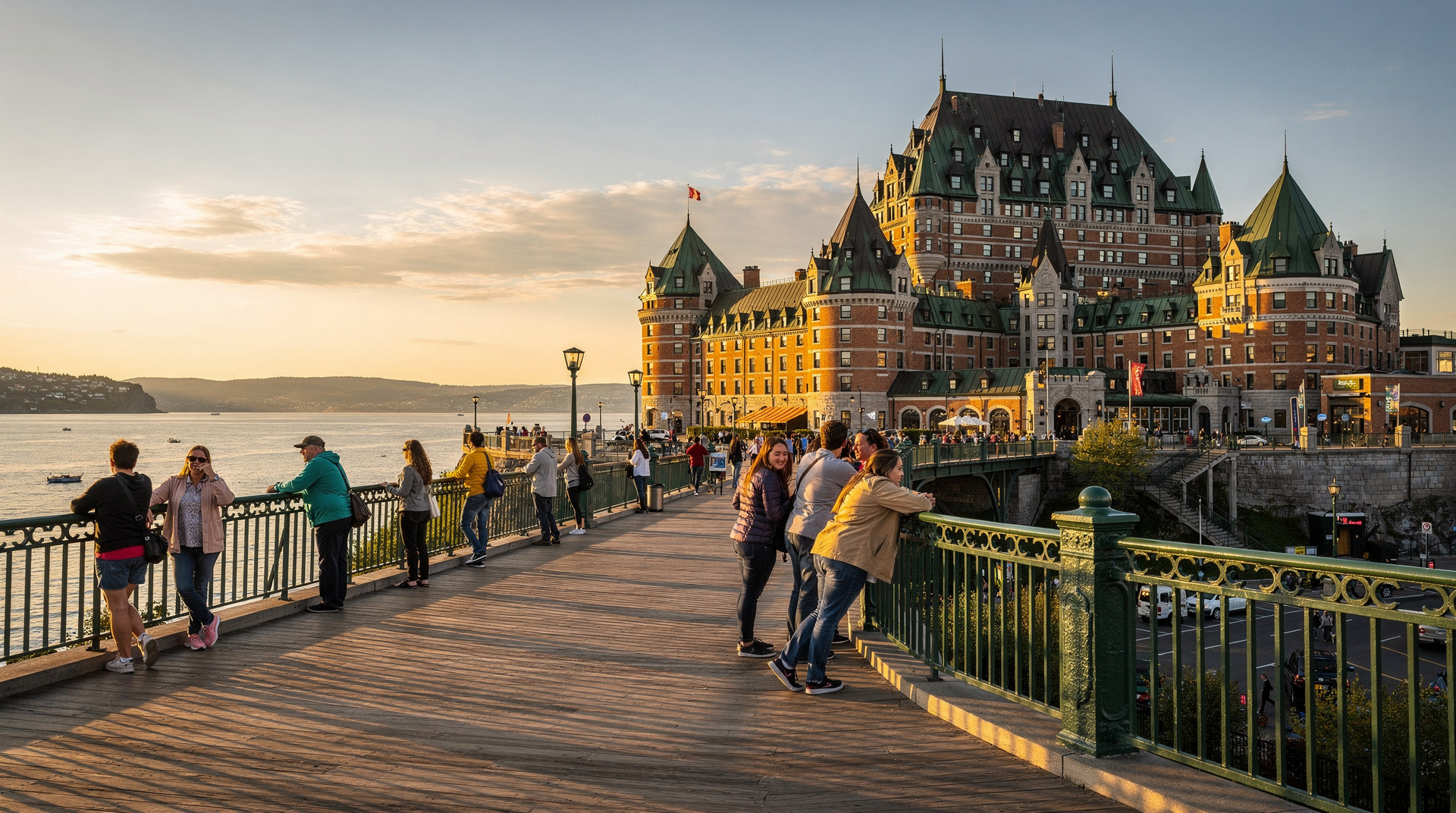
In March 2020, I had a trip booked to Québec City and Charlevoix for late April. I was going to stay at Hôtel Le Germain Charlevoix in Baie-Saint-Paul for three nights, then drive to Tadoussac for the first whale sightings of the season. The reservation was made, the flights were confirmed, the rental car was sorted.
| What was cancelled | Québec City, Charlevoix and Tadoussac, April 2020 |
| What replaced it | Video, maple imports, French lessons, Québécois literature |
| Duration of the gap | March 2020 to April 2021 |
| Cost | Modest — mostly shipping fees and an online course |
| What came of it | A sharper, more specific sense of the province on return |
Then the borders closed, and the trip became a collection of booking confirmation emails that sat in my inbox, un-cancelled for longer than was rational, because cancelling felt like giving something up definitively rather than just postponing it.
Everyone who travelled regularly had a version of this story in spring 2020. What I want to write about is what happened after the cancellations — how a group of friends and I, all of whom had varying levels of Québec obsession, dealt with the sudden absence of a place we had been going to regularly for years.
The itinerary I had planned was, in hindsight, a fairly standard first-timer’s route: a few days in Québec City, a loop through Charlevoix, then onward to Tadoussac for the start of the whale season. Losing it meant losing not just a holiday but a specific, already-imagined version of spring — one I ended up reconstructing, imperfectly, from a flat in Europe.
The YouTube rabbit hole
It started with a YouTube channel called Les Aventures de Sébastien — a French-Canadian traveller who does long documentary-style videos about remote parts of Québec that most visitors never reach: the Côte-Nord north of Tadoussac, the James Bay road, Anticosti Island. The videos are in Québécois French, which requires concentration from me, but the landscapes are extraordinary and the commentary unpretentious. I watched maybe thirty hours of this content between March and June.
From there I found the Télé-Québec archives, which are partially available online: old documentaries about the fisheries of the Gaspésie, about the construction of the Manicouagan dam system on the Côte-Nord, about the Huron-Wendat community at Wendake. There is a series from the 1980s about traditional trades in rural Québec — blacksmithing, woodworking, maple syrup production — that is visually slow and almost hypnotic. I watched six episodes in one evening.
Then I found the drone footage, which is its own genre. Québec from above, particularly the Saint-Laurent estuary and the Charlevoix coast and the autumn Laurentides, is the kind of visual that makes you either immediately book a flight or sit in profound frustration because you cannot book a flight. In 2020 it was the latter.
Maple syrup by post
A friend who had been to Montréal frequently told me about an online shop run by a small producer in the Eastern Townships — Érablière du Chemin Perdu, near Compton — that shipped maple products internationally. This led to an extended experiment in maple-based cooking that my household still talks about.
The amber maple syrup is the everyday variety, the one you put on pancakes. But there is also dark maple syrup, which has a more intense, almost smoky flavour and is better for cooking savoury dishes — roasted carrots, glazed duck breast, a reduction for venison. There is maple butter, which is maple syrup whipped until it crystallises into a spreadable paste and which is so good on toast that I had to ration myself. And there is maple sugar, which can replace regular sugar in baking and gives an almost caramel quality to anything it touches.
I made tourtière from a recipe I found on the website of a Montréal food journalist — the Lac-Saint-Jean style, which uses cubed meat rather than minced, a denser and more satisfying pie that takes four hours to make properly and fills the kitchen with a smell of game and juniper. We made it twice during lockdown and ate it with pickled beets and a simple salad, which felt like the right thing.
I also ordered from a Québécois cidery that ships — Les Vergers de la Colline, on Île d’Orléans — whose ice cider (cidre de glace) is made from apples left on the trees until after the first frost and then fermented. The result is sweet and intense and not like any other cider I’ve drunk, and it is genuinely Québec in a bottle: a product that exists because of the specific climate of the province.
None of this replaced the real thing, but it meant that when travel resumed, I already understood dishes I would otherwise have discovered cold. The poutine guide and the sugar shack guide cover the two food traditions I found myself most homesick for during lockdown, and both were near the top of my list once I could travel again.
Francophone Québec, at home
I enrolled in an online French conversation group run by a Montréal language school — École de langue, operating online during the pandemic. The group met weekly by video call for ninety minutes, with six to eight participants at various levels of French, most of whom had some connection to Québec or francophone Canada. The teacher, a woman from Saguenay named Marie-Claude, was excellent and mercilessly corrected my tendency to apply European French phonology to Québécois vocabulary.
This turned out to be one of the more useful things I did in 2020. My comprehension of Québécois French improved significantly — not just in accent recognition, but in vocabulary. I learned dépanneur (corner shop), char (car), bec (kiss), pogner (to get, to catch), être game (to be up for something), ostie and its variants (the Québécois profanity system, which is based entirely on sacred objects rather than bodily functions, is a fascinating linguistic rabbit hole I will leave for the reader to explore). By the time I was able to visit again, conversations in Québec felt distinctly easier.
The books
I had read some Québécois literature before the pandemic — Michel Tremblay’s Les Belles-Soeurs plays, some Réjean Ducharme — but I used the lockdown to go deeper. The novelist Marie-Claire Blais, who died in 2021, wrote about Québec society in a way that is both specific and universal; Une saison dans la vie d’Emmanuel is the place to start. Gabrielle Roy’s Bonheur d’occasion, set in Saint-Henri in Montréal during World War II, is one of the canonical Québécois novels and available in English translation as The Tin Flute.
I also read a history of New France by historian Gilles Havard that gave me more context for the places I’d visited — why Old Québec looks the way it does, why the relationship between French and English in the province carries the specific weight it does. The New France history overview covers the same ground in more concise form, if a full history is more than you want before a trip.
What it was actually for
Armchair travel is not travel. This is its limitation and also its specific quality. What I found, working through Québec from a distance during a year when I couldn’t go, was that the place became more specific to me — not more generalised, not a postcard, but more detailed and more mine in some way that I don’t quite know how to articulate.
When I finally did get back — April 2021, as soon as the rules permitted — I arrived at Québec City’s airport with a stronger sense of what I wanted to do and where I wanted to eat and who I wanted to talk to than on any previous visit. The absence had clarified something.
For planning your own trip whenever you’re able to go: the best time to visit guide covers the seasonal logic in detail. And if you want to start with the Québec French experience, the language and culture guide covers what to expect linguistically in each city. Montréal is the natural pairing with Québec City if you have not decided your route yet.