Abitibi-Témiscamingue
Quebec's gold rush country: mining heritage in Rouyn-Noranda and Val-d'Or, Refuge Pageau wildlife sanctuary, and Anishinabe Algonquin culture.
Quick facts
- Distance from Montreal
- 530 km northwest, ~5h by car via Route 117
- Regional capital
- Rouyn-Noranda
- Mining history
- Gold rush began 1920s; Malartic mine still active (world's largest open-pit gold mine in Canada)
- Indigenous nation
- Algonquin Anishinabe (9 communities)
| Where | Rouyn-Noranda / Val-d’Or / Amos, 530 km northwest of Montréal |
| Cost | Budget 120–180 CAD/night lodging; Cité de l’Or tour ~35 CAD; Refuge Pageau ~15–20 CAD |
| Time needed | 2–3 days minimum, more if combining with Nord-du-Québec |
| Getting there | Route 117 by car (5.5–6h from Montréal) or Air Canada/Air Creebec to YUY/YVO |
| Best time | June–September for outdoor sites; winter only for snowmobiling/occasional aurora |
A note on GetYourGuide coverage
Abitibi-Témiscamingue has no GetYourGuide listings. This page is entirely editorial and covers what the region genuinely offers. No affiliate links appear here.
An honest framing
Abitibi-Témiscamingue is not a destination you stumble into. It requires deliberate choice: you drive 5 hours northwest from Montréal through boreal forest, cross into a landscape that feels like a separate country, and arrive in a region defined not by scenic tourism infrastructure but by the specific drama of its 20th-century history — the gold rush, the company towns, the mining industry that still employs a significant portion of the population.
This is not a region for visitors who want polished tourism experiences. The towns are functional, the restaurants are serviceable rather than destination-worthy, and the main attraction — the open-pit mines, the wildlife refuge, the Anishinabe cultural sites — demands genuine curiosity. For that traveller, Abitibi-Témiscamingue is one of the most interesting under-visited regions in Quebec.
The gold rush and mining heritage
The gold rush that began in the 1920s transformed what had been remote agricultural territory into one of Canada’s most important mining regions almost overnight. The discovery of gold near Rouyn (1920) and Noranda (1926) drew prospectors and capital from across North America during the Great Depression — one of the rare regions in Quebec where economic boom and the Depression coincided.
Rouyn-Noranda was literally built by the mining companies. The Noranda Copper Smelter (now Glencore’s Horne Smelter) has operated continuously since 1927, visible from most parts of the city as a skyline-defining industrial complex. The Maison Dumulon (191 Avenue du Lac) is a 1924 general store and post office preserved as a museum that documents the first-generation mining era. Entry is modest; the social history inside is genuine.
Val-d’Or (literal translation: Valley of Gold) was founded in 1934 and remains centred on its mining past. The Cité de l’Or complex offers underground mine tours in a real former gold mine (the Lamaque mine, which produced over 3 million ounces of gold from 1935 to 1985). Guided tours descend 90 metres underground; booking recommended in summer. It is the best single attraction in the region and worth the drive from Rouyn-Noranda (about 100 km east).
Malartic, between Rouyn-Noranda and Val-d’Or, is home to the Canadian Malartic Mine — the largest open-pit gold mine in Canada, operated by Agnico Eagle. The mine is so large (roughly 2 km × 1 km × 220m deep) that it has effectively consumed the southern half of the town; a neighbourhood of homes was relocated to make way for its expansion. The Agnico Eagle visitor centre offers lookout access to the pit, and the sheer scale is genuinely astonishing. Tours (free, seasonal) must be booked in advance.
Refuge Pageau
The Refuge Pageau in Amos (120 km east of Rouyn-Noranda) is one of Quebec’s most unusual wildlife sanctuaries. Founded by trapper and wildlife keeper Michel Pageau in 1986, it takes in injured and orphaned wild animals from across Québec — wolves, bears, lynx, foxes, caribou, moose, owls, and eagles — and rehabilitates them for release when possible, or provides lifetime sanctuary for those that cannot survive in the wild.
What distinguishes Refuge Pageau from a conventional zoo is context. These are wild animals from Quebec’s boreal forest, brought here because of injury or human conflict, cared for by people with direct knowledge of that ecosystem. The refuge is small and genuinely moving in a way that large commercial wildlife parks are not. Open year-round (seasonal hours vary); entry around 15-20 CAD for adults.
Michel Pageau’s relationship with the animals — documented in his books and a National Film Board documentary — is remarkable. Some of the wolves in residence have lived at the refuge for years; the interactions between the keepers and the animals are not performances.
Amos itself is a functional regional town with a few good cafés and the Cathédrale Sainte-Thérèse-d’Avila (1930, art deco / Byzantine hybrid — genuinely architectural interesting). It makes a good overnight base between Val-d’Or and Rouyn-Noranda.
Anishinabe Algonquin Nation
Abitibi-Témiscamingue is the traditional territory of the Algonquin Anishinabe people, whose nine communities span the region and extend into Ontario. Unlike the Huron-Wendat Nation at Wendake (near Québec City, with an established tourism infrastructure), Algonquin cultural tourism in Abitibi-Témiscamingue is largely community-managed and requires advance contact.
Pikogan (adjacent to Amos) is the largest Anishinabe community in the region and occasionally organises cultural programming for visitors — traditional land practices, cultural demonstrations, and guided territory access. Contact the Conseil de la Nation Anishinabe du Lac Simon or the Abitibi-Témiscamingue tourism board (tourisme-abitibi-temiscamingue.org) for current offerings.
The relationship between the mining industry and the Anishinabe communities is complex and ongoing. Land rights, contamination from historical mining operations, and resource revenue sharing remain active political issues. Visitors approaching Anishinabe cultural programming with awareness of this context will get more from the experience.
Lac Abitibi and the natural landscape
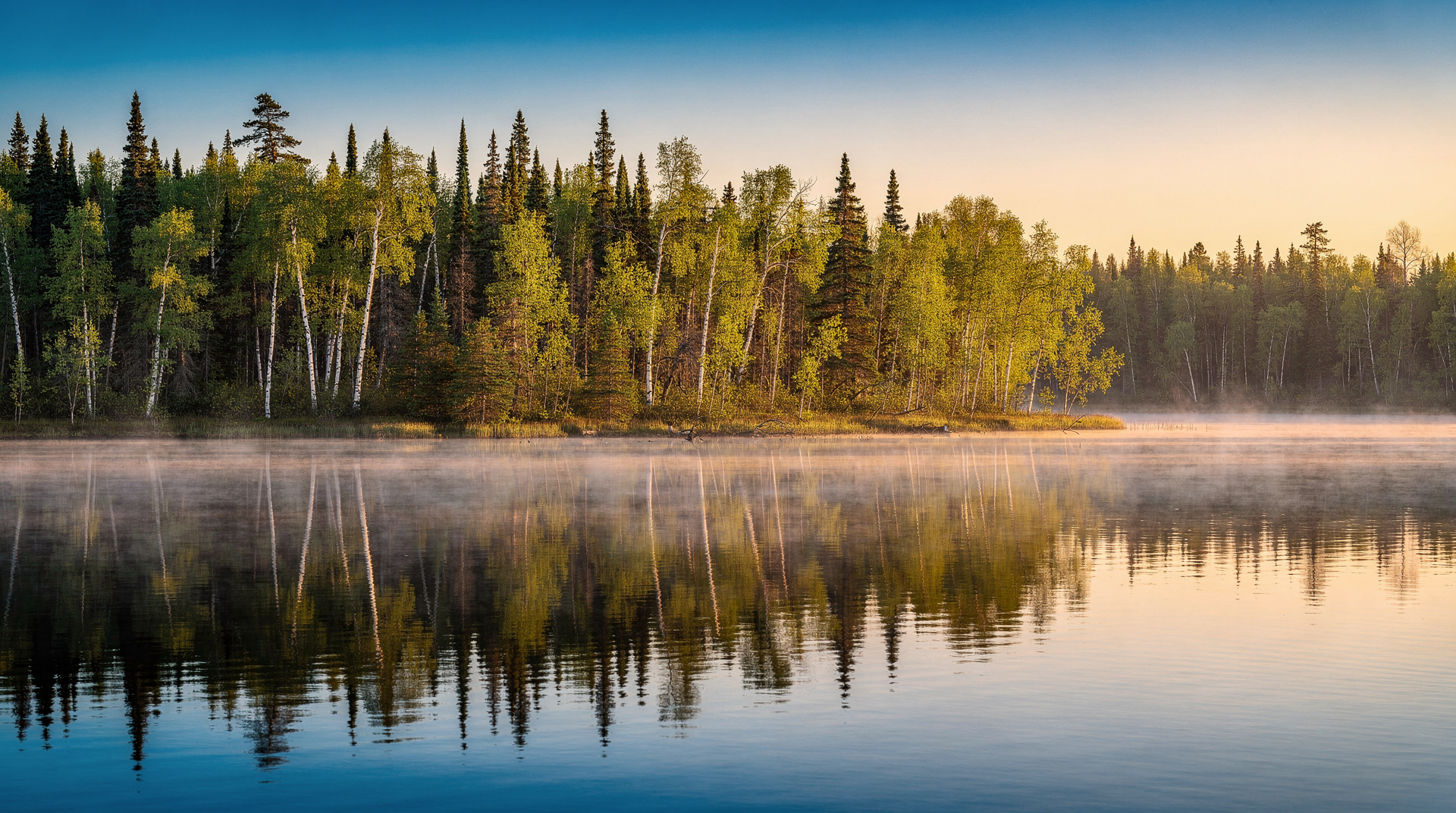
The natural landscape of Abitibi-Témiscamingue is defined by the Clay Belt — an enormous flat plain deposited by a glacial lake approximately 8 000 years ago. This produces a landscape unlike the rolling Canadian Shield of the Laurentides or the dramatic topography of Charlevoix: endless boreal forest punctuated by lakes, wetlands, and rivers, with a flatness that creates extraordinary skies.
Lac Abitibi straddles the Ontario-Quebec border and is one of the largest lakes in the Clay Belt. Fishing (walleye, pike, yellow perch) is a significant draw for visitors from Ontario and Quebec alike; outfitter lodges operate on the lake’s perimeter. The lake’s east shore is accessible from Rivière-Ojima.
Parc national d’Aiguebelle (near Rouyn-Noranda) is a relatively small but geologically exceptional provincial park: precambrian rock formations, a fault valley, and suspension bridges over deep water-filled chasms. Hiking is the main activity. Entry ~9.50 CAD/day; camping available.
Aurora borealis
Unlike the far north (see Nord-du-Québec), Abitibi-Témiscamingue sits at a latitude (~48-49°N) where aurora viewing requires strong geomagnetic activity (Kp index 4+). This occurs perhaps 15-30 nights per year, unpredictably. The region’s advantages over southern Quebec are its very low light pollution and flat horizon. If you are already here and the forecast shows Kp 4+, the skies west of Amos or around Lac Abitibi are excellent. Do not plan a trip specifically for aurora from this latitude.
Planning a route through the Laurentides
Because Route 117 to Abitibi-Témiscamingue runs directly through the Laurentides, most visitors treat the drive north as two trips rather than one. Breaking the journey with a night in Mont-Tremblant or Val-David turns a long single push into a more comfortable two-day approach, and gives you a comparison point: the manicured resort landscape of the Laurentides against the raw, working-industry character of Abitibi-Témiscamingue further north.
Travellers doing a genuine cross-province loop sometimes continue from Abitibi-Témiscamingue east toward the Saguenay region rather than backtracking through Montréal, though this adds a full extra day of driving on secondary roads.
Comparing the region’s three towns
| Town | Best for | Time needed | Signature site |
|---|---|---|---|
| Rouyn-Noranda | Base with most services, smelter skyline | 1 night | Maison Dumulon, Horne Smelter view |
| Val-d’Or | Underground mine tour | 1 day | Cité de l’Or (Lamaque mine, -90m) |
| Amos | Wildlife sanctuary, quieter overnight | 1 night | Refuge Pageau |
| Malartic | Half-day detour between Rouyn-Noranda and Val-d’Or | 2–3 hours | Canadian Malartic open-pit mine |
Most itineraries run Rouyn-Noranda → Malartic → Val-d’Or → Amos in a loose loop, since the towns sit in a rough line along Route 117/111 with Malartic roughly midway.
Getting there
By car: Route 117 from Montréal northwest through Saint-Jérôme and the Laurentides to Val-d’Or; alternatively, continue on 117 to Rouyn-Noranda (another ~100 km). The drive from Montréal to Rouyn-Noranda is approximately 5.5-6 hours. The road is good quality; fuel at regular intervals once past Val-d’Or becomes less frequent.
By air: Air Canada and Air Creebec operate scheduled flights between Montréal (YUL) and Rouyn-Noranda (YUY) and Val-d’Or (YVO). Flights take ~1 hour; prices vary significantly between booking windows.
Via Rail: The Transcontinental train (Montréal-Halifax) stops at Senneterre, but service frequency is limited (approximately twice weekly). Not practical for short visits.
Where to stay
Rouyn-Noranda has the best accommodation selection in the region — a mix of business hotels (Holiday Inn Express, Comfort Inn level) and a few independent options. Budget 120-180 CAD per night for decent rooms. Val-d’Or has similar options. Amos is smaller with fewer choices.
For a more atmospheric option: the Auberge Harricana in Amos has been renovated and offers comfortable rooms at the gateway to the wildlife refuge. During winter, some outfitter lodges on Lac Abitibi accept guests (book directly; no central booking platform).
Is it worth the trip from Montréal?
Directly: only if you have a specific reason. The Cité de l’Or mine tour is genuinely excellent and justifies a Val-d’Or detour for anyone interested in Canadian industrial history. Refuge Pageau is one of the most affecting wildlife experiences in Quebec. The open-pit mine at Malartic is a spectacle of industrial scale.
For most visitors doing a Quebec tour, the time investment (5h each way from Montréal, minimum 2 nights) is better spent in destinations with more diverse appeal — Charlevoix, the Gaspé Peninsula, or Tadoussac. Abitibi-Témiscamingue rewards the curious off-the-beaten-path traveller who has already seen the standard Quebec circuit.
Frequently asked questions about Abitibi-Témiscamingue
Is Abitibi-Témiscamingue worth visiting if I only have one week in Quebec?
Generally no. With a single week, destinations like Charlevoix or the Gaspé Peninsula offer far more variety per hour of driving. Abitibi-Témiscamingue makes sense on a second or third Quebec trip, or as a dedicated long weekend focused specifically on the mining heritage and Refuge Pageau.
Can I visit Abitibi-Témiscamingue without a car?
Not practically. Air Canada and Air Creebec fly into Rouyn-Noranda and Val-d’Or, and Via Rail’s Transcontinental stops at Senneterre twice weekly, but moving between the towns, the mine tours, and Refuge Pageau requires a rental car. There is no local public transit built for tourism.