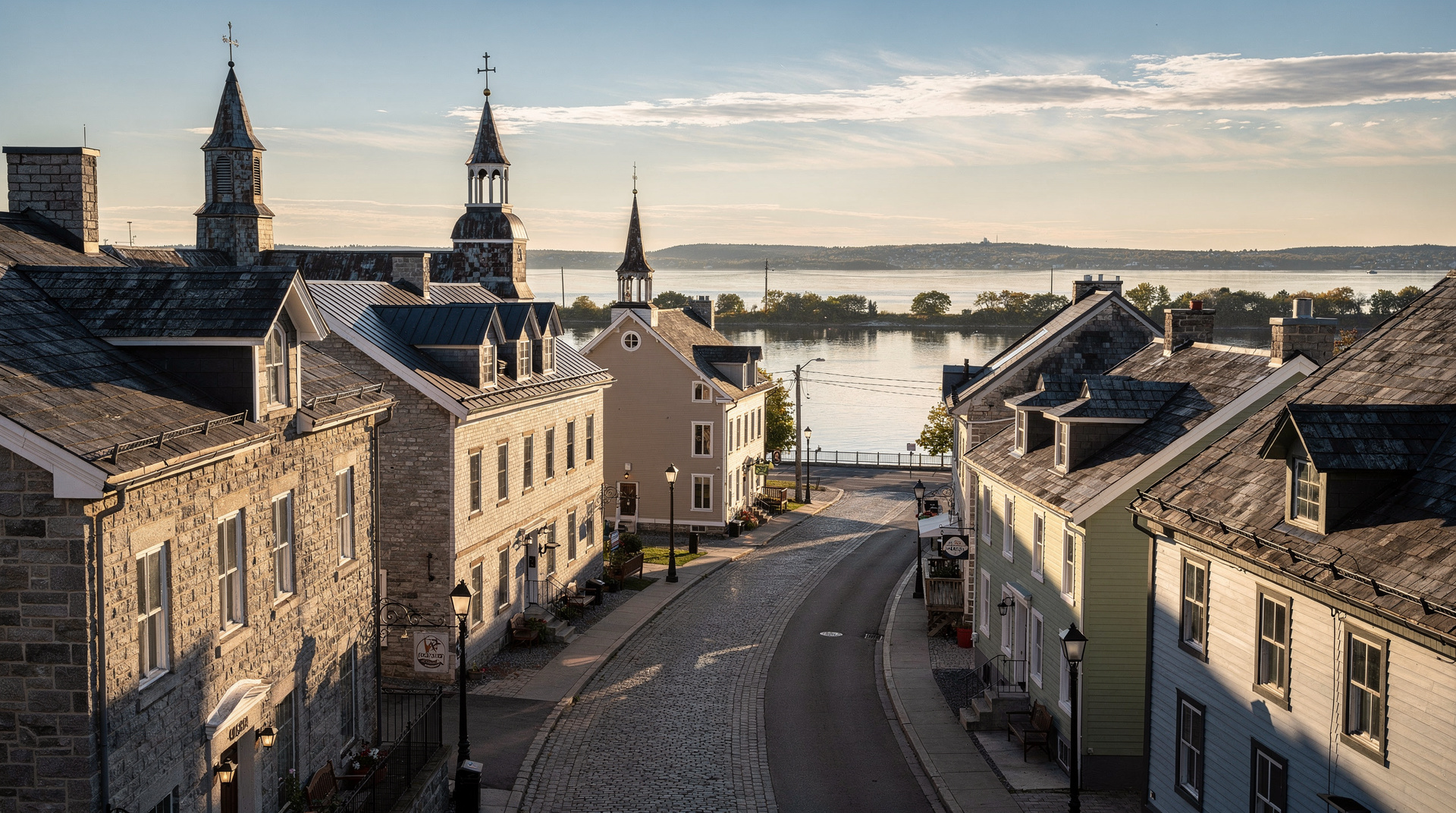
Trois-Rivières
Quebec's second-oldest city: a walkable Old Town, a thriving arts scene, and a gateway to the Mauricie wilderness.
Old Quebec City: Grand Walking Tour
Duration: 2 hours
Quick facts
- Distance from Montreal
- 140 km (1h40 by car)
- Distance from Quebec City
- 145 km (1h40 by car)
- Founded
- 1634 (second-oldest city in Quebec)
- Population
- ~150 000 (metro area)
The city that gets skipped
Trois-Rivières sits precisely halfway between Montreal and Quebec City on the south bank of the St-Lawrence, and precisely for that reason most travellers pass through at highway speed. This is the general misunderstanding: Quebec’s second-oldest city (founded 1634, only Québec precedes it) has a compact, walkable Old Town, a riverfront boulevard, a significant industrial art museum, and a restaurant scene that has matured considerably in the past decade.
A full day here — arriving for lunch, walking the Old Town in the afternoon, and eating well before continuing — converts a highway passing into a genuine stop. For travellers doing the Montreal-Quebec City-Mauricie loop, Trois-Rivières serves as both a destination and a gateway to Parc national de la Mauricie.
| Where | South bank of the St-Lawrence, exactly halfway between Montreal and Quebec City |
| Cost | museum entries 5–18 CAD each |
| Time needed | 1 full day; add an overnight to pair with Mauricie |
| Getting there | Autoroute 40 (1h40 from either city), Via Rail, or Orléans Express bus |
| Best time | Year-round; June–September for terraces and Festivoix |
How to shape your day
The simplest way to enjoy Trois-Rivières is to resist the urge to tick off every address and to let the day follow the river. Start with a coffee in the Old Town, walk the pedestrian streets while they are still quiet, and save the museums for the hours when the weather or your energy turns against walking outdoors. Lunch is the natural midpoint, and the long summer evenings suit a slow dinner on a terrace before you get back on the highway.
Travellers coming from the south often arrive tired from the road, so it helps to treat the first hour as a reset rather than a sightseeing sprint. Park once, leave the car, and do the rest on foot. If you are arriving from the Montreal side, the Montreal to Quebec City travel guide explains how the stopover fits with the train, bus and driving options, and the Via Rail guide helps if you would rather leave the car behind altogether.
Trois-Rivières also rewards people who like places that are lived in rather than staged. Much of what you will see is the everyday city: locals on the terraces, cyclists on the riverfront, families at the market. That is exactly the contrast with the heavily visited heritage districts, and it is the best reason to choose a stop here over another hour of motorway.
What to see
Vieux-Trois-Rivières (Old Town)
The historic core clusters around the Rue des Forges pedestrian street and the Rue du Bonaventure riverfront. The cityscape mixes 17th and 18th-century heritage buildings with 1960s reconstruction (a devastating fire in 1908 destroyed most of the original built fabric; only the religious institutions survived intact).
Points of intérêt:
- Cathédrale de l’Assomption: the neo-Gothic cathedral on Rue Bonaventure, completed in 1858, with fine stained glass.
- Ursulines Museum (Musée des Ursulines): the 1703 Ursuline convent and attached museum document the religious history of the city and hold important religious art. One of Quebec’s oldest institutions. See the official museum website for current hours and admission.
- Old Jail (Vieux-Pénitencier, 1822): a heritage prison building converted to tourism use with guided ghost tours.
Guided visit 24 CAD (ages 8 and over, about one hour, booking strongly recommended); open daily in summer, weekends only from autumn to spring. Dramatically good if you’re into that format.
- St-Maurice Iron Forges (Forges du Saint-Maurice): 15 km north of the Old Town — the first industrial enterprise in New France, operating 1730-1883. Now a national historic site with excellent reconstructed smelting facilities and interpreters. Worth the detour (20-30 min drive). Open to the public daily, 10h-17h, in summer (20 June to 7 September in 2026; closed for the rest of 2026 and reopening in spring 2027); admission 5 CAD.
Musée POP (Musée québécois de culture populaire)
The museum of popular culture is one of the best small museums in Quebec — unexpected for a mid-sized city. The permanent collection covers Québécois popular culture from the 18th century to the present with genuine humour and rigorous scholarship. Attached is the historical prison, accessible by guided tour. Open Wednesday to Friday 10h-16h and Saturday-Sunday 10h-17h until 23 June 2027 (closed Monday and Tuesday), then daily 10h-17h in summer. Admission 18 CAD for adults.
Reading the city’s history
Three threads run through Trois-Rivières, and the sights above map neatly onto them. The religious thread is the cathedral and the Ursuline convent, which survived when the rest of the old town did not. The industrial thread is the Iron Forges, a reminder that New France was not only furs and farms but also early manufacturing. The popular-culture thread is Musée POP, which treats everyday Québécois life as worthy of serious attention. Seen together, they give a more rounded picture of the province than a single headline monument could.
If you are travelling with someone who is not a museum person, pick one of the three threads and skip the others. The Forges suit curious families and anyone who likes seeing how things were made, the Ursulines suit quiet, reflective visitors, and Musée POP is the easiest sell for a mixed group because its subject is familiar and often funny. For wider context on how this fits the story of the colony, the overview of Quebec history and New France is a good companion read, and the Quebec religious heritage guide goes deeper on the churches and convents that shaped the province.
Cogeco Amphitheatre and riverfront
The riverfront amphitheatre hosts major concerts and festivals throughout the summer (Festivoix, various national touring acts). The waterfront promenade along Boulevard des Forges gives the best views of the St-Lawrence at its widest — the river is 13 km wide here, making it impossible to see the north shore from the ground.
Food and drink
Trois-Rivières’ restaurant scene has evolved significantly. The Rue des Forges and the blocks north of the Old Town have the highest concentration of independent restaurants.
Le Poivre Noir (Trois-Rivières): the city’s reference fine-dining address, with a menu focused on local seasonal ingredients. Reservations recommended on weekends.
Café-Boulangerie Le Temps d’une Pinte (Old Town): excellent coffee, good croissants and local pastries. The spot for breakfast before a morning of sightseeing.
Brasserie La Forge (near the waterfront): craft brewery with standard pub fare and a solid tap list. Casual and lively on summer evenings.
Restaurant L’Authentique (Vieux-Trois-Rivières): solid Quebec comfort food (poutine, tourtière, duck confit). Good choice for an introduction to la cuisine québécoise traditionnelle.
Marché Décarie: the city’s public market (open Thursday-Sunday, May-November) has local produce, artisan cheeses, and prepared foods. The Saturday morning market draws a good crowd.
Eating well without over-planning
A good rule here is to decide the main meal first and let everything else orbit it. If you want the fine-dining experience, book ahead and build the afternoon around it. If you would rather eat casually, the independent addresses near the Old Town are easy to drop into, and the public market is the right place to assemble a picnic for the road or for the park. For a primer on what to order, the poutine guide and the Quebec City restaurant guide will help you compare what you find here with the better-known food cities, and tipping in Quebec covers the etiquette at the table.
Getting around
The Old Town is entirely walkable — Rue des Forges to the cathedral to the Ursulines museum covers about 1.5 km. The St-Maurice Forges (15 km north) require a car or taxi.
Bike sharing (BIXI): the city has a modest BIXI network for summer cycling, useful for longer distances.
Parking: free parking exists 5-10 minutes walk from the Old Town core on Rue St-Georges and Boulevard du Carmel.
Where to stay
Hôtel Delta Trois-Rivières (Marriott): the city’s largest and most business-oriented hotel, central.
Auberge Gouverneur Trois-Rivières: reliable 3-star in the centre.
Hôtel des Gouverneurs: classic mid-range, convenient for transit and the Old Town.
Le Flambard (B&B, Vieux-Trois-Rivières): small, well-kept, genuinely hospitable. Breakfast included.
Getting there
By car from Montreal: Autoroute 40 Est, 140 km, 1h40 minimum (Quebec City-Montreal highway is often congested around Laval; use A-30 bypass).
By car from Quebec City: Autoroute 40 Ouest, 145 km, 1h40.
By train (Via Rail): the Montreal-Quebec City corridor stops at Trois-Rivières. Frequency has been improving; check the official Via Rail website. Journey from Montreal approximately 1h50, from Quebec City approximately 1h30. The station is 10 minutes walk from the Old Town.
By bus (Orléans Express): Montreal-Quebec City buses stop at Trois-Rivières. Check the official Orléans Express website for schedules. Journey from Montreal approximately 2h.
Combining with other destinations
Trois-Rivières pairs naturally with Parc national de la Mauricie (1h north) for an overnight loop: arrive in Trois-Rivières, explore the city, stay overnight, day-trip to the park the following day. See the Mauricie region overview for the bigger picture.
For the Montreal-to-Quebec-City road trip, the Quebec road trip 10 days itinerary includes Trois-Rivières as a midpoint stop. The Quebec Old Towns guide compares Trois-Rivières, Old Quebec, and Vieux-Montréal. It also works as a day trip in either direction: see day trips from Montreal and day trips from Quebec City for the logistics of a there-and-back visit versus stopping over.
Trois-Rivières vs Old Quebec: honest comparison
Travellers deciding how to split limited time between Old Towns often ask whether Trois-Rivières is worth it if you have already booked time in Old Quebec. The honest answer: it is a different, smaller experience, not a substitute.
| Trois-Rivières | Old Quebec | |
|---|---|---|
| Size | Compact, walkable in an afternoon | Much larger, needs 2+ days |
| Character | Quiet, arts-and-industry, few tourists | UNESCO site, busy, polished |
| Best for | A highway stopover, a change of pace | A primary destination in itself |
| Time needed | 1 day | 2–3 days minimum |
If you only have time for one Old Town on a Montreal-Quebec City trip, Old Quebec wins on sheer density of things to see — the UNESCO Old Quebec walking guide and the 3-day Quebec City itinerary cover it well. Trois-Rivières makes sense as an added stop on the drive between Montreal and Quebec City, not as a replacement for either. For the broader question of which city deserves more of your trip, the Montreal vs Quebec City guide is a useful read before you plan the split.
If Trois-Rivières makes you want a bigger Old Town
A short visit here often leaves people curious about how the larger heritage districts compare. If that happens, give Old Quebec the time it deserves rather than squeezing it in. A guided outing is the most efficient way to understand the layers of the place, whether that is a guided walking tour of the old walled cityGYG ↗ for the main sights, or an evening storytelling walk about crime and legend in New FranceGYG ↗ if you enjoyed the ghost-tour angle of the Old Jail here. Both pair well with the Old Quebec destination page, the Upper Town guide and the Petit-Champlain lower town page.
For a wider look at the region you are driving through, the Quebec City overview, Montreal and the Quebec City to Charlevoix day trip show how a Trois-Rivières stop can sit inside a longer journey, and the five-day Montreal and Quebec City itinerary is a natural frame for it. If your timing falls in the warm months, Quebec in July and Quebec in August describe what the season feels like across the province.
Frequently asked questions about Trois-Rivières
Is Trois-Rivières worth stopping at between Montreal and Quebec City?
Yes, for most travellers with a flexible schedule. A few hours in the Old Town — the Ursulines Museum, Musée POP, and a proper lunch — genuinely breaks up the drive and adds a layer of Quebec’s industrial and religious history that neither Montreal nor Quebec City covers in the same way. If your schedule is tight and non-negotiable, it is skippable; nothing here is a must-see on the scale of Old Quebec.
Can I visit Trois-Rivières without a car?
Yes. Via Rail and Orléans Express buses both stop in Trois-Rivières on the Montreal-Quebec City corridor, and the station is a 10-minute walk from the Old Town. The St-Maurice Iron Forges, 15 km north, do require a car or taxi, so a car-free visit means focusing on the walkable Old Town core.