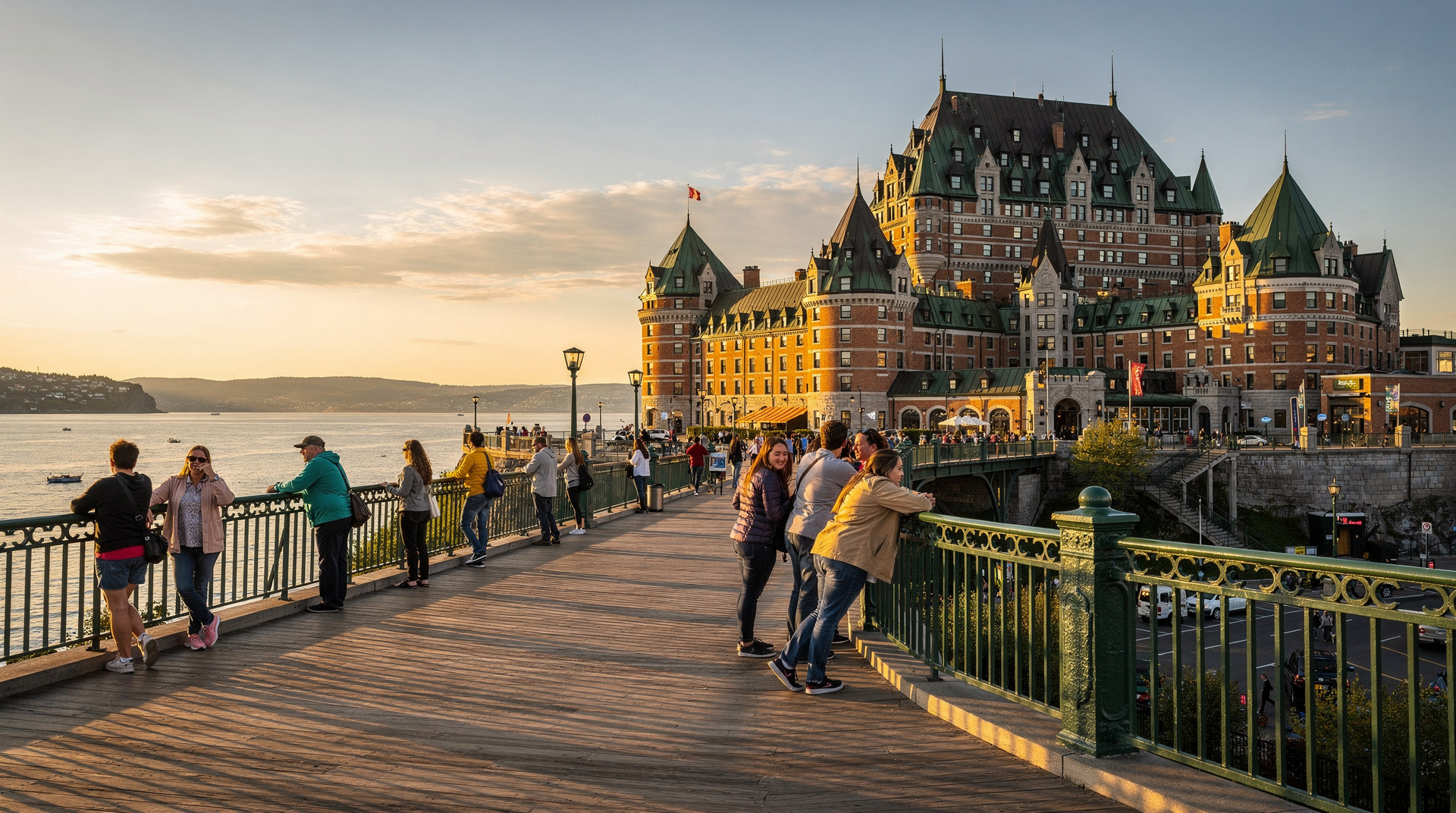
Château Frontenac: history, tour and what's worth doing
Guided Tour of Fairmont Le Château Frontenac
Duration: 1 hour
Is a visit to Château Frontenac worth it?
Photographing the exterior from Place d'Armes and having a drink at bar 1608 — absolutely worth it, essentially free. The 1-hour guided tour (around 19 CAD) is good value for history enthusiasts. The high tea (80–120 CAD) is expensive for average quality — skip it and spend that money on dinner in Saint-Roch instead.
The most photographed building in Canada
There is a reason Château Frontenac appears on more Canadian travel photographs than almost any other structure: it works. The copper-green turrets, the red-brick facade, the central tower looming over the cliff above the Saint-Laurent — it is exactly what a romantic 19th-century architect imagined when asked to build a landmark that would make European travellers think of Loire Valley châteaux transplanted to the New World.
It is also, practically speaking, a fully functioning luxury hotel operated by Fairmont, with 611 rooms, several restaurants, a spa, and a history that includes hosting Allied war conferences that helped determine the shape of post-war Europe.
This guide covers everything you need to know: the history, what the guided tour includes, an honest assessment of every food and drink option, and the best alternatives if the tourist-facing prices are not for you.
| Where | Rue Saint-Louis, Upper Town, Vieux-Québec |
| Cost | Free (lobby, photos) to ~19 CAD (guided tour) |
| Time needed | 15 min (lobby/photos) to 1 hour (tour) |
| Getting there | 20-min walk or 5-min taxi from the bus/train station |
| Best time | Late afternoon for photography |
History: from railway hotel to wartime command centre
The Canadian Pacific Railway’s master plan (1893)
The Château was not built as a private luxury hotel in the modern sense — it was conceived as infrastructure for the Canadian Pacific Railway. The CPR had completed its transcontinental railway in 1885 and was aggressively building a chain of grand hotels to fill its trains: the Banff Springs Hotel (1888) in Alberta, Château Lake Louise (1890), Château Frontenac (1893), and later the Empress in Victoria and several others.
The theory was straightforward: build hotels spectacular enough that people would travel across the continent specifically to stay in them. It worked. The CPR model effectively invented Canadian leisure tourism.
Bruce Price (father of etiquette writer Emily Post) was the chosen architect. He took the Château de Pierrefonds in France as his rough reference point and designed a building that looked ancient and medieval while incorporating modern conveniences. The original 1893 building had 170 rooms. The Saint-Louis wing was added in 1897, the Citadel wing in 1899, the Mont-Carmel wing in 1908, and the central tower — the defining element of the current silhouette — in 1924, designed by Edward Maxwell.
The building was named after Louis de Buade, Count of Frontenac, governor of New France from 1672 to 1698, who built the original fort on this cliff. The hotel sits roughly where his residence stood.
The Quebec Conferences, 1943 and 1944
The Château’s most historically consequential moment came during the Second World War. The US and UK were planning the largest military operation in history — the cross-Channel invasion of Europe — and needed a secure, neutral-adjacent location for high-level Allied strategy sessions. The Château Frontenac was chosen.
First Quebec Conference (Quadrant), August 1943: Winston Churchill, Franklin D. Roosevelt, and their combined chiefs of staff spent ten days in Québec City. The conference finalized Operation Overlord — the D-Day invasion planned for spring 1944 — and discussed operations in Italy and the Pacific. Churchill stayed at Citadelle (the official residence of the Governor General), but much of the conference work happened at the Château.
Second Quebec Conference (Octagon), September 1944: Churchill and Roosevelt returned to Québec City. The main topic was the Morgenthau Plan — a controversial proposal to deindustrialize post-war Germany — and the continuing Pacific strategy. Roosevelt rejected the more extreme elements of the Morgenthau Plan; the conference produced a modified agreement. This second conference was notable for a degree of tension between the British and American delegations over the direction of the war.
The choice of Québec was deliberate: the fortification walls of Vieux-Québec made security manageable, the city was politically neutral in the context of the Allied relationship with France (Free France vs Vichy), and Canada’s Prime Minister Mackenzie King was eager to demonstrate Canada’s role in the Allied effort.
Post-war to present
The Château was purchased by the Canadian Pacific Hotels chain and later acquired by Fairmont Hotels and Resorts in 1999. Major renovations were completed in 1993 (centenary) and 2014. The spa and pool were added in a basement extension. The hotel holds 611 rooms and suites, several food and drink venues, and remains one of the highest-occupancy luxury hotels in Canada year-round.
The guided tour: what you actually see
Guided Tour of Fairmont Le Château Frontenac — approximately 1 hour, guided by Fairmont staff or licensed guides, around 19 CAD per adult.
The tour covers:
- The history of the building’s construction and CPR context
- The main lobby and its architectural details (the decorative plasterwork, period furniture, historical photographs)
- Access to the Sir Wilfrid Laurier rooms and other historical spaces not normally accessible to non-guests
- The WWII conference history, with photographs and documents
- The 1924 central tower addition and the architectural changes over time
- Views from upper levels (depending on current configuration)
Verdict: Worth it if you are interested in the history. The guides are knowledgeable and the access to the upper spaces is genuinely interesting. If you are a casual visitor who just wants to say you have been inside the Château, the lobby tour on your own (free) is sufficient.
Book in advance in peak season (July–August): The guided tours are popular and often sell out for morning slots. Afternoons tend to have more availability.
Honest food and drink assessment
Bar 1608 (strongly recommended)
Bar 1608 occupies the ground floor off the main lobby and serves cocktails, wine, and light food. The name references the year Champlain founded Québec City.
The prices are hotel-bar prices — cocktails from 18–22 CAD, wines from 12–16 CAD per glass — but not egregiously inflated by Château standards. More importantly, the space is beautiful: exposed stone walls, low lighting, and the sense of drinking in a building with genuine history. This is the best value use of the Château as a non-guest visitor.
Restaurant Champlain (fine dining)
The signature restaurant with formal service, French-influenced Québécois cuisine, tablecloths, and the view. Dinner menus run 90–130 CAD per person before wine. The food is genuinely good — this is not a tourist-trap restaurant — but it is expensive. Comparable quality meals can be found in Saint-Roch for 60–80 CAD per person.
When to use it: A special-occasion dinner or anniversary where the setting is part of the experience. Not for a casual meal or if you are watching budget.
Restaurant Sam (casual option)
A more casual brasserie-style option in the Château, with a broader menu and prices in the 25–45 CAD per main range. Better value than Champlain for an everyday meal inside the hotel. The setting is less dramatic but still pleasant.
The afternoon high tea — the honest verdict
The Château Frontenac high tea (served in the Salon Frontenac or adjacent spaces, depending on season) costs 80–120 CAD per person and is one of the most consistently cited tourist traps in Québec City.
The setup is beautiful: three-tier stands, bone china, proper loose-leaf tea service, staff in traditional uniforms. The food — finger sandwiches, scones with clotted cream and jam, miniature pastries — is competent but not exceptional. It is Fairmount’s standard high-tea package.
At 100 CAD per person, you are paying mostly for the room and the name. For comparison, an excellent dinner at a proper Québec City restaurant (Au 48, Le Chambertin, Toast, Laurie Raphaël) costs the same and delivers considerably more interesting food.
Alternative: Coffee and excellent pastries at Café-Boulangerie Paillard (1097 Rue Saint-Jean, 5 minutes from the Château) costs 8–12 CAD. Use the saved 70–90 CAD for something that justifies the price.
Photographing the Château Frontenac
The building photographs well from multiple angles:
- Place d’Armes (directly in front) — the classic shot. Late afternoon gives warm light on the facade. Morning gives clean light but flatter shadows.
- Terrasse Dufferin (behind the hotel) — looking back at the tower from the boardwalk gives the dramatic cliff-face angle.
- Lévis ferry terminal — crossing the Saint-Laurent on the ferry to Lévis (5 CAD, 10 minutes) gives the full-profile shot of the Château with the cliff and fortifications behind it. Worth the trip for the photograph alone.
- Escalier Casse-Cou (looking up from Petit-Champlain) — the tower appears above the roofline in a way that is hard to achieve otherwise.
- Aerial — from the helicopter tours or the Observatoire de la Capitale (15 CAD, highest point in the city), the full hotel-plus-fortifications-plus-river composition is spectacular.
Getting to the Château Frontenac
The hotel sits at the top of Rue du Fort, adjacent to Place d’Armes and Terrasse Dufferin in Upper Town (Haute-Ville) of Vieux-Québec. From the Québec City bus station or Via Rail station, it is roughly a 20-minute walk or a 5-minute taxi. The UNESCO Old Quebec walking itinerary in our walking guide passes directly in front of it.
Parking: the Château has limited underground parking (40–50 CAD/day) but you are generally better served parking at a city facility and walking. See the Québec City planning guide for parking logistics.
Combining the Château visit with nearby sites
The Château Frontenac is at the heart of the walkable historic district:
- Citadelle de Québec — 10 minutes on foot, British star fort with changing of the guard in summer. See the Upper Town guide.
- Terrasse Dufferin and Plains of Abraham — directly adjacent. See the UNESCO Old Quebec walking guide.
- Petit-Champlain — via the funicular or the Escalier Casse-Cou, 5 minutes.
- Musée de la civilisation — 15 minutes on foot, excellent family-friendly history museum. See the museums of Québec City guide.
For a 3-day Quebec City itinerary that positions the Château as one stop among many, see the 3-day Quebec City itinerary.
Staying at the Château: is it worth the room rate?
Beyond visiting, some travellers want to know whether an overnight stay justifies the premium. The honest answer depends on the room category. Standard rooms (300–400 CAD in summer) are comfortable but modest in size by luxury-hotel standards — you are largely paying for the building and the address, not oversized square footage.
The Fairmont Gold floor (an additional 100–150 CAD) is a better value proposition: it includes a private lounge with breakfast, afternoon snacks, and evening canapés, which can offset a meaningful chunk of the premium if you’d otherwise be paying for those meals separately. For most visitors, one night at the Château to say you’ve stayed there — paired with several nights at a more moderately priced Old Québec hotel — captures the experience without the full week-long cost.
Seasonal price swings to plan around
Rates at the Château move more dramatically with the calendar than most Québec City hotels. Carnaval (late January–mid-February) and the Christmas–New Year period both see premiums of 30-50% over shoulder-season rates, driven by genuine demand rather than artificial scarcity — book 3-6 months ahead for either window if a Château stay matters to you. November and early May, by contrast, can see rates drop 30-40% below summer prices, making them the best-value time for a splurge stay if your schedule is flexible. See our best time to visit Québec guide for how this fits the wider seasonal picture.
Frequently asked questions about Château Frontenac: history, tour and what's worth doing
Who designed Château Frontenac and when was it built?
The Château Frontenac was designed by American architect Bruce Price and opened in December 1893. Price was commissioned by the Canadian Pacific Railway (CPR) to create a landmark hotel that would anchor the CPR's chain of grand railway hotels across Canada. The current silhouette — including the massive central tower — was completed in 1924 with an addition by architect Edward Maxwell.Is the high tea at Château Frontenac worth the price?
Honest answer: no. At 80–120 CAD per person, the afternoon tea at the Château is expensive for what is delivered — standard finger sandwiches, scones, and pastries in a beautiful room. The room is genuinely lovely, but the food quality does not justify the price compared to what you could eat at a proper Québec City restaurant for the same amount. Good alternative: a coffee and pastry at Paillard (Rue Saint-Jean) and use the saved 70–100 CAD for dinner.What happened at the Quebec Conferences in 1943 and 1944?
The Château Frontenac hosted two major Allied conferences during World War II. The First Quebec Conference (August 1943) saw Churchill and Roosevelt plan the cross-Channel invasion of Europe (Operation Overlord). The Second Quebec Conference (September 1944) addressed the Morgenthau Plan for post-war Germany. The hotel was chosen for its security — surrounded by the fortification walls of Old Quebec — and for the political symbolism of holding Allied planning in French Canada.Can I visit the Château Frontenac without staying there?
Yes. The lobby is open to the public at all times — walk in through the main entrance on Rue Saint-Louis. The hotel does not charge for lobby access. The guided tour (around 19 CAD) takes you to spaces not normally open to non-guests, including historical rooms and the upper levels. Bar 1608 and the Champlain restaurant are open to non-guests for drinks and dining.How much does it cost to stay at Château Frontenac?
Rates vary widely by season. In peak summer (July–August), standard rooms start around 300–400 CAD per night. For Carnaval de Québec (late January–mid February), expect 400–600 CAD. Off-season (November, early May) rooms can drop to 200–280 CAD. A Fairmont Gold floor upgrade adds 100–150 CAD but includes a private lounge with breakfast and evening canapés, which changes the value calculation significantly.Can you go inside Château Frontenac for free?
Yes — the lobby is open to the public at no charge, any time the hotel is operating, through the main entrance on Rue Saint-Louis. You can see the grand lobby, period architectural details, and access Bar 1608 and the restaurants without paying anything beyond what you choose to order. Only the guided tour (around 19 CAD) and staying overnight require payment.How does Château Frontenac compare to other CPR grand railway hotels?
Château Frontenac is generally considered the most architecturally striking of the Canadian Pacific Railway's chain of grand hotels, thanks to its dramatic clifftop setting above the Saint-Laurent — a more theatrical site than the Banff Springs Hotel or Château Lake Louise, both set among mountains rather than a fortified old city. Its central tower (added 1924) also makes it more visually iconic and recognisable in photographs than its Rocky Mountain siblings.
Top experiences
Bookable activities with verified prices and instant confirmation on GetYourGuide.