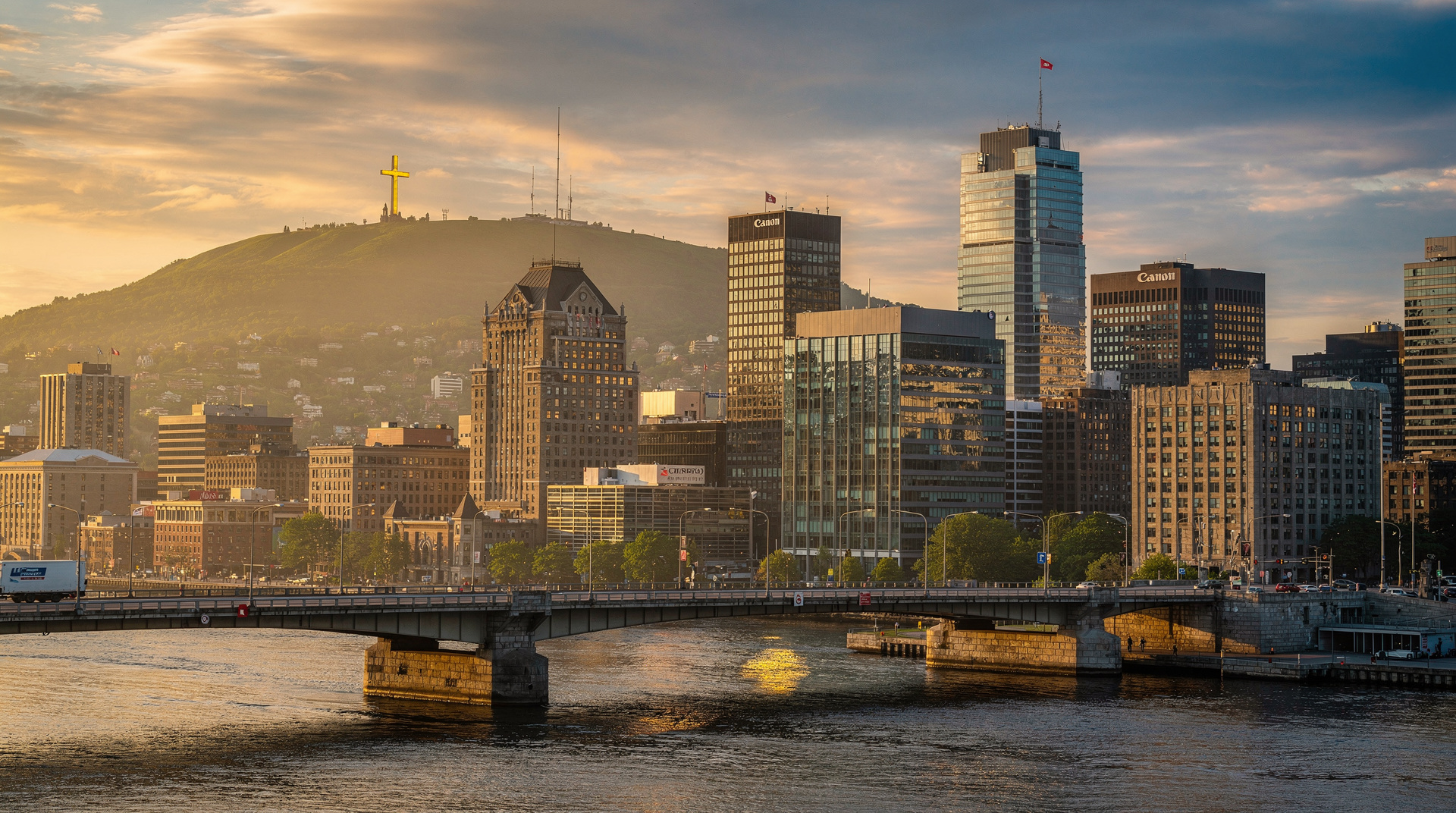
Old Montreal (Vieux-Montréal)
Explore Old Montreal: Notre-Dame Basilica, cobblestone streets, Old Port. What's worth it, tourist traps, best restaurants. Verified tips.
The Original Old Montréal Walking Tour
Duration: 2 hours
Quick facts
- Founded
- 1642 (Ville-Marie — founding of Montreal)
- Area
- Approximately 1.6 km²
- Notre-Dame Basilica
- Built 1824–1829, Gothic Revival, seats 2,772
- Old Port
- 2.5 km promenade along Saint-Laurent waterfront
First impressions of Old Montreal
Vieux-Montréal sits at the southern edge of the island, between downtown and the Saint-Laurent River. The cobblestone streets and stone buildings — not reconstructed, but continuously occupied since the 17th century — give the district a physical weight that the rest of the city’s neighbourhoods lack.
The comparison to Old Quebec is inevitable and worth making honestly: Old Quebec is more dramatic (the cliffs, the fortification walls, the Château Frontenac), but Old Montreal is larger, more architecturally varied (the shift from French colonial to British Victorian to 19th-century bank architecture is compressed into a few blocks), and less overwhelmed by cruise ship tourism.
One day covers the essential circuit: Notre-Dame Basilica, the main streets (Saint-Paul, de la Commune, Saint-Jacques), the Old Port waterfront, and a guided walking tour for context. Two days allows you to also visit the Pointe-à-Callière Museum, take an evening ghost tour, and spend a morning at the Old Port without rushing.
| Where | Southern edge of Montreal island, along the Saint-Laurent |
| Cost | Notre-Dame ~6 CAD; Pointe-à-Callière ~26 CAD; walking tours 25–35 CAD |
| Time needed | 1–2 days |
| Getting there | Metro Square-Victoria-OACI or Champ-de-Mars (Orange Line) |
| Best time | May–October; evenings for fewer crowds |
Understanding Old Montreal’s layout
Old Montreal covers roughly 1.6 km² and is bounded by the Vieux-Port waterfront to the south, McGill Street to the west, Berri Street to the east, and the elevated highway (Autoroute Ville-Marie) to the north.
The main east-west arteries are:
- Rue de la Commune: the waterfront street running parallel to the Old Port
- Rue Saint-Paul: the most historic commercial street, running parallel one block north
- Rue Notre-Dame: the main administrative and civic axis (the basilica is here)
- Rue Saint-Jacques: the banking district, with the former headquarters of the major Canadian banks
The main north-south connections cross these streets and include Place d’Armes (the main square in front of Notre-Dame), Place Jacques-Cartier (the public square near the Old Port, usually with outdoor restaurant terraces in summer), and the streets connecting them.
What to see and do
Notre-Dame Basilica
Notre-Dame is the most architecturally significant building in Old Montreal — a Gothic Revival structure built between 1824 and 1829 with an interior that disproportionately affects visitors who were not expecting to be moved by a Canadian church. The interior combines pointed arches, a deep blue-gold colour scheme, hand-carved woodwork, and scale (it seats 2,772) in a combination that stops conversation.
Entry: 6 CAD for interior access (free exterior). The guided tour is included in the entry ticket and provides the architectural and historical context. Allow 45–60 minutes for the interior.
The AURA light show (evenings, separate ticket 20–35 CAD) is a contemporary light-and-music experience that uses the interior as a canvas. The quality of the production is high; whether the AURA adds to or detracts from the experience of the church is a matter of personal response.
The AURA at Notre-Dame Basilica + Cruise combines the evening light show with a Saint-Laurent River cruise — a full evening activity at approximately 60 CAD that covers both the architectural experience and the waterfront.
Old Montreal walking tour
The Original Old Montréal Walking Tour is the standard-setter for walking tours in the district. Two hours, covers the key buildings and their histories — the founding of Ville-Marie, the fur trade era, the banking district’s 19th-century dominance, and the 20th-century decline and revival of Old Montreal. The guide format makes the architectural layers legible in a way that independent exploration rarely does.
The Old Montreal walking tour with a guide is an alternative format at 25 CAD — slightly shorter, with more emphasis on the cobblestone streets and neighbourhood character rather than the banking history.
For a smaller-group experience: the Explore Old Montreal small-group walking tour limits group size to 12 people, which gives more space for questions.
The Old Port (Vieux-Port)
The 2.5-km promenade along the Saint-Laurent waterfront is one of Montreal’s best outdoor spaces. The Science Centre (Centre des sciences de Montréal, 20–24 CAD) is the best family attraction on the promenade. The Clock Tower (Tour de l’Horloge, free entry) has a rooftop lookout. The IMAX theatre is attached to the Science Centre.
In summer, the Old Port has cycling paths, inline skating, and temporary event installations. In winter, the outdoor skating rink (Voie Maritime du Port) is one of the most pleasant skating venues in Montreal — free entry, skate rental available.
The intimate electric boat tour of the Old Port is a quieter alternative to the standard sightseeing cruise — a small-group format on an electric boat with close views of the clock tower, the waterfront architecture, and the islands downstream. At 45 CAD, it is priced fairly for the intimacy.
What to skip at the Old Port: La Grande Roue (the Ferris wheel, 27 CAD). The view is not meaningfully better than what you can see for free from the promenade, and certainly not better than the free Kondiaronk Belvedere lookout on Mont-Royal. The marketing is more impressive than the experience.
Ghost tour of Old Montreal
The Traditional Ghost Walk of Haunted Montreal is an evening walking tour that covers 1.5–2 hours of the darker history of the colonial period — executions, scandals, epidemics, and the specific buildings where these events occurred. Better researched and more historically honest than the theatrical framing suggests; genuinely a useful history tour presented in an accessible format.
Evening (20:30 start) is optimal. Not suitable for young children.
Pointe-à-Callière Museum
The Pointe-à-Callière Museum (Musée d’archéologie et d’histoire de Montréal) sits directly on the site of Ville-Marie’s founding in 1642, and its most remarkable feature is that you can walk through the archaeological excavations of the original settlement underground. The museum was built specifically to display the archaeology in situ rather than in vitrines.
Entry: 26 CAD (adult). Allow 2 hours. The permanent exhibition “Ici est né Montréal” is the best single historical overview of how the city developed from the founding through the 20th century. The underground gallery is the specific draw — the experience of walking through 17th-century foundation walls is not replicable elsewhere in Montreal.
Architecture worth slowing down for
Beyond the marquee sights, Old Montreal rewards a slower architectural eye. The Rue Saint-Jacques banking district compresses a full century of financial-institution architecture into a few blocks — the former Bank of Montreal head office, the Royal Bank tower, and a run of Beaux-Arts and neoclassical facades that once made this Canada’s Wall Street. Most are now repurposed as hotels, condos, or event spaces, but the exteriors are intact and the street is quiet enough for genuinely unhurried photography.
The Marché Bonsecours dome, visible from much of the Old Port, is one of the most photographed silhouettes in the district and a good orientation landmark if you’re navigating on foot without constantly checking a map. Nearby, the Château Ramezay (rue Notre-Dame) — a 1705 residence that later served as the seat of the British and American occupying forces at different points in the 18th century — offers a small, easily-missed museum that covers the colonial period with less crowding than the bigger-name sights.
Where to eat in Old Montreal
Old Montreal has good restaurants alongside tourist traps. The distinction is important.
Honest options:
Olive & Gourmando (rue Saint-Paul): the best casual lunch in Old Montreal — sandwiches, salads, excellent coffee. Popular with locals, reasonable prices (15–25 CAD). Lineup at peak lunch.
Icehouse (rue William): Texas-style BBQ and Southern cooking, entirely at odds with the heritage district. The pulled pork sandwich is excellent and the prices are reasonable.
Marché des Saveurs (rue Saint-Paul): not a restaurant but a food shop with Quebec-made products — artisan cheeses, charcuterie, ice cider, maple products. Good for provisions and gifts.
Mid-range (50–90 CAD per person):
Garde-Manger (rue Saint-François-Xavier): Chuck Hughes’ seafood-focused restaurant in a former bank vault. Good raw bar, strong cocktail program. The tourist-to-local ratio is better than most of the restaurant row.
Boris Bistro (rue McGill): reliable French bistro with a large terrace, predictable menu, consistent quality. The least adventurous option on this list but reliable.
Special occasion:
Toqué! (Place Jean-Paul-Riopelle): the most important restaurant in Montreal’s modern food history. Seasonal Quebec ingredients, serious wine list, impeccable service. 140–180 CAD per person. The standard by which the rest of the city’s fine dining is judged.
What to avoid: The tourist restaurants on rue Saint-Paul that feature signs in three languages and photos of their food outside. Not specific enough to be useful? Walk along Saint-Paul and notice which restaurants have outdoor promotional menus visible from 10 metres — those are the ones to pass.
When to visit Old Montreal
May–June: Quiet by Montreal standards, all attractions open. The cobblestones are at their most photogenic in the spring light without the summer crowds.
July–August: Maximum crowd density, especially on weekends when Place Jacques-Cartier becomes a mass of restaurant terraces and street performers. The Jazz Festival (late June to early July) brings a different kind of crowd to Old Montreal — more cosmopolitan, fewer tour groups.
September–October: The best balance of weather, crowd levels, and open terraces. Foliage in nearby parks. The ghost tours are particularly atmospheric in October.
November–April: Old Montreal in winter is genuinely quiet. Some restaurants close for reduced hours; the Science Centre and Pointe-à-Callière are open year-round. The outdoor skating rink on the Old Port is a seasonal highlight (December–March).
Practical tips
Parking: Driving into Old Montreal on a summer weekend is not recommended — traffic, expensive parking (25–35 CAD for central lots). Metro (Square-Victoria–OACI station, Orange Line) is 2 minutes’ walk from the western edge of Old Montreal. The Old Port metro (Champ-de-Mars, Orange Line) serves the eastern edge.
Photography: Rue Saint-Paul west of Place Jacques-Cartier at golden hour has the best ambient light. Notre-Dame at night (AURA or otherwise) benefits from a tripod. The Clock Tower on the Old Port has good early morning light.
Cruise ships: Montreal does receive cruise ships (Saint-Laurent cruise ships), and the Old Port area becomes busier when they arrive. Less significant than in Quebec City, but worth noting on a summer weekend.
Connecting Old Montreal to the rest of your visit
Old Montreal sits at the southern edge of the island. The natural progression is: Old Montreal morning → Plateau and Mile End afternoon → Mont-Royal evening, or the reverse. Old Montreal and the Old Port is a full half-day activity; Pointe-à-Callière adds another 2 hours.
For the full Montreal picture, see the Montreal guide.
For the Plateau and Mile End, which provide the cultural counterbalance to Old Montreal’s historical weight, see Plateau Mont-Royal & Mile End.
Day trips from Old Montreal: Île d’Orléans and Montmorency Falls are 3 hours by car (better as a Quebec City base). The Eastern Townships and Mont-Tremblant are 1.5 hours and good for a Montreal-based day trip.
For multi-day planning, see the 4 days in Montreal itinerary.
Frequently asked questions about Old Montreal
Is Old Montreal or the Plateau better for a first visit?
They serve different purposes rather than competing — Old Montreal delivers the history and architecture, the Plateau delivers the food and nightlife culture. A first Montreal visit should include both; if forced to choose one for a single afternoon, Old Montreal gives the more immediately legible sense of place for a first-time visitor.
How does Old Montreal compare to Old Quebec?
Old Quebec is more dramatic — cliffs, fortification walls, the Château Frontenac — and more compact. Old Montreal is larger, more architecturally varied across three centuries of building styles, and considerably less overwhelmed by cruise ship crowds. Neither replaces the other; see the honest comparison on the Old Quebec guide for the fuller picture.
Top experiences
Bookable activities with verified prices and instant confirmation on GetYourGuide.