Mont-Tremblant in summer vs winter: which season suits you?
Winter Day Trip with Gondola Ride
Duration: 8-10 hours
Is Mont-Tremblant better in summer or winter?
Both seasons are genuinely excellent but for different reasons. Winter (December to March) is for skiing, snow tubing, dog sledding, and the most atmospheric village experience. Summer (June to October) is for hiking, gondola rides, lake swimming, festivals, golf, and fall foliage. If you can only visit once, summer is more accessible and cheaper; winter is more iconic.
Mont-Tremblant, both versions
Mont-Tremblant is one of those destinations that genuinely works across two completely different seasons, which is unusual. Most ski resorts in summer are vaguely sad — empty chairlifts, closed restaurants, and the lingering feeling that you have arrived at the wrong time. Tremblant avoids this by being a proper four-season resort with infrastructure and programming for every month it is open.
The question is not whether to come in summer or winter — both are good. The question is what you want to do.
| Where | Mont-Tremblant, Laurentides, ~130 km / 1h30 from Montréal |
| Winter cost | Lift ticket 120–160 CAD/day; hotel 350–550 CAD/night peak |
| Summer cost | Gondola + activities from ~40 CAD; hotel 200–350 CAD/night |
| Getting there | Car via Highway 15/Route 117; limited bus/shuttle |
| Best time | Jan–Feb for skiing; late Sept for foliage and thinner crowds |
Winter at Mont-Tremblant: December to March
The skiing
Mont-Tremblant is the largest ski resort in Eastern Canada by vertical drop — 645 metres, a number that sounds modest to anyone who has skied the Rockies or the Alps but is very real in the Laurentian context. The mountain has 102 trails spread across four faces, including black diamonds and double blacks that surprise intermediate skiers who expect a gentle Eastern Canadian hill.
The snow situation is honest: Tremblant makes significant use of snowmaking (as do all Eastern Canadian resorts — natural snow alone is unreliable). Conditions from January to mid-February are usually excellent, with a good mix of natural snow and packed powder. March can be variable; the shoulder months of November-early December and late March are for committed skiers who don’t mind imperfect conditions.
Lift tickets: 120–160 CAD/day adult in peak season. Multi-day packages and advance online purchase are meaningfully cheaper. The Montréal operators offer guided day trips with bus transport included if you don’t want to drive:
Winter Day Trip with Gondola Ride — Mont-TremblantBeyond skiing: winter activities for non-skiers
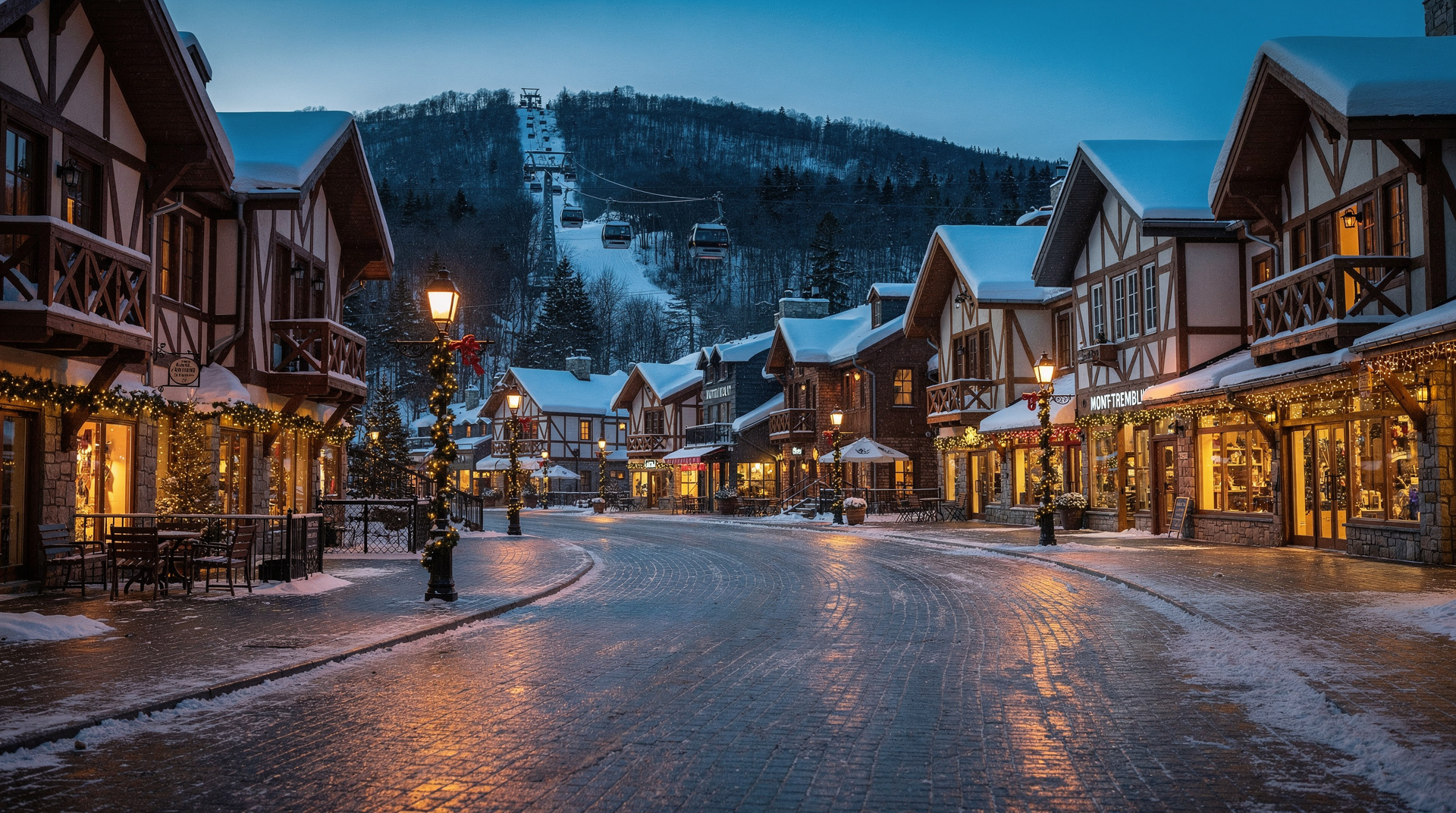
The village at Tremblant functions as a pedestrian-only cobblestoned space in winter, a deliberate design choice that creates an atmosphere unlike most North American resorts. Restaurants, boutiques, and bars line the main square, and in January-February the place has genuine energy.
Non-ski options in winter:
Snow tubing: A popular family activity that requires zero skill — you sit in an inflatable tube and slide down a groomed run, returned to the top by a mechanical lift.
Snow Tubing with Mechanical Lift — Mont-TremblantPrice: approximately 50 CAD per person. Duration: 2–3 hours.
Dog sledding: Several operators run guided mushing tours from the resort area. See our detailed dog sledding guide.
Ice climbing: Frozen cascade sites within 20 minutes of the village — see ice climbing guide.
Snowshoeing: Trail networks around the national park are excellent in winter; rental shops in the village provide equipment.
Spa and wellness: The various spas in and around the resort area (Spa Scandinave Tremblant, among others) are genuinely good — necessary after a day on cold slopes.
Winter pricing and accommodation
Mont-Tremblant accommodation peaks in January-February (ski high season). Expect:
- Budget: from 180–250 CAD/night (limited options, book early)
- Mid-range hotels/condos: 300–500 CAD/night
- Premium slope-side accommodation: 600–1,200 CAD/night
New Year’s Eve at Tremblant is one of the best outdoor countdown celebrations in Québec — fireworks, outdoor concerts, skating, and a village packed with revellers. It is also the most expensive night of the year to stay.
Summer at Mont-Tremblant: June to October
The gondola and the summit
The scenic gondola (télécabine des Versants) runs in summer from late May to mid-October, carrying passengers to the 875m summit for views over the lake, the village, and the Laurentian hills stretching to the horizon. On a clear day — which most July and August days are — this is the most effortless mountain view in the Laurentides.
The Sentier des Cimes treetop observatory walk at the summit offers an elevated canopy walkway through old-growth forest:
Sentier des Cimes Treetop Observatory — Mont-TremblantPrice: approximately 40 CAD. Combined gondola + Sentier packages available.
The lake and the beach
Lac Tremblant, directly adjacent to the resort village, has a public beach with rentals for paddleboards, kayaks, canoes, and pedal boats. This is the most family-friendly element of Tremblant in summer and the activity that most surprised visitors mention — they didn’t expect a mountain resort to have a swimming lake at its foot.
Water temperature in July: 22–24°C. The beach is free to access; equipment rental is extra.
Hiking
The Parc national du Mont-Tremblant surrounds the resort area. The park has over 100 km of marked trails, including the famous La Corniche ridge trail and the longer circuit around Lac Monroe. Day hiking in the park costs around 10 CAD/person for entry; trails range from easy lake loops to demanding summit ridges.
See our hiking in Mont-Tremblant National Park guide.
Golf
Three championship golf courses operate in the immediate resort area (Le Diable, Le Géant, and the La Bête course). Golf at Tremblant is genuinely excellent and slightly cheaper than at comparable Ontario or Atlantic Canada resorts. Green fees range from 90–180 CAD depending on course and season.
Summer festivals and events
Tremblant runs an aggressive summer events calendar:
- Tremblant International Blues Festival: usually late July
- Festival des Couleurs (fall foliage): last two weekends of September
- Free outdoor concerts every weekend from late June to mid-September in the pedestrian village
- Ironman 70.3 Mont-Tremblant: August (the race generates a particular energy in the village)
The fall festival in late September is arguably the best time to visit Tremblant in any season — the foliage, the outdoor concerts, the cooling weather, and the fact that summer crowds have partially thinned make for a near-perfect experience.
Summer pricing
Summer accommodation is approximately 30–40% cheaper than peak winter. Mid-range hotels run 200–350 CAD/night in July-August, dropping to 150–250 in September-October.
Side-by-side comparison
| Factor | Winter | Summer |
|---|---|---|
| Best months | Jan–Feb | July–Aug, late Sept (foliage) |
| Skiing | Yes (102 trails) | No |
| Gondola | Yes (ski) | Yes (scenic) |
| Lake swimming | No | Yes |
| Hiking | Snowshoes | Full trail network |
| Average hotel | 350–550 CAD/night | 200–350 CAD/night |
| Crowds | High (Jan-Feb) | Moderate (Jul-Aug peak) |
| Atmosphere | Most dramatic | Most versatile |
| Best for | Skiers, winter lovers | Everyone |
Getting to Mont-Tremblant
From Montréal: Highway 15 North to Saint-Jérôme, then Route 117 North to Mont-Tremblant. Total: 130 km, approximately 1 hour 30 minutes in normal traffic. Allow 2 hours on winter weekends when road conditions and resort traffic slow things considerably.
By bus: Galland/Autocar (summer) and shuttles from the resort run limited service from Montréal. A car is much more convenient, especially in winter.
See our Montréal to Mont-Tremblant day trip guide for getting there without a car.
The shoulder seasons: what you’re actually giving up
Spring (April–May) and late fall (November) are genuinely the weak points of the Tremblant calendar, and it is worth being honest about why. In spring, the ski lifts have closed but the hiking trails are still muddy and often patchy with snow at elevation, the lake is too cold to swim, and much of the village’s restaurant and activity programming has not yet switched into summer mode. In November, the reverse happens — summer activities have wound down but the ski lifts have not yet opened reliably. If your dates are flexible, avoid these windows; if they are not, treat a shoulder-season visit as a village-and-spa trip rather than an activity-heavy one, since the spas and several restaurants run year-round regardless of season.
Choosing based on group composition
A family with young children who don’t ski often does better in summer — the beach, the gondola, and the treetop walk require no skill and no rental logistics, whereas a winter trip built around skiing needs lessons, rentals, and realistic expectations for how much beginners can manage in a few days. A group of committed skiers should lean hard into January–February despite the cost, since that’s genuinely when the mountain performs best. Couples or groups without children often find the late-September foliage window the most rewarding overall: fewer crowds, lower prices than peak summer or winter, and arguably the most photogenic version of the resort.
Related guides
- Skiing at Mont-Tremblant: full ski guide
- Dog sledding in Québec
- Rafting the Rouge River
- Zip-lining in Québec
- Via ferrata in Québec
- Mont-Tremblant vs Mont-Sainte-Anne
Frequently asked questions about Mont-Tremblant in summer vs winter: which season suits you?
When is the best time to visit Mont-Tremblant?
For skiing: December to March, with January and February as the most reliable for snow. For summer activities: late June to August for warm weather. For fall foliage: mid to late September in the Tremblant area — some of the best colour in Québec. Spring (April-May) is the least rewarding: slopes are closed, trails are muddy, the village is quiet.How much does a ski day at Mont-Tremblant cost?
Lift tickets at Mont-Tremblant are among the highest in Eastern Canada. Full-day adult lift tickets typically run 120–160 CAD in peak season (January-February); multi-day passes and advance purchase reduce this. Equipment rental is extra (skis, boots, poles: 60–80 CAD/day). Ski school adds cost. A family of four skiing for a day including rental can expect 700–900 CAD total.Is Mont-Tremblant worth visiting without skiing?
Absolutely. The pedestrian village at the base of the mountain is active year-round with restaurants, bars, boutiques, and spa options. In summer: gondola rides, hiking, lake and beach access, golf, cycling, concerts. In winter even for non-skiers: snow tubing, dog sledding, skating, horse-drawn sleigh rides, and the dramatic snow-covered village atmosphere. Many visitors come specifically for the ambiance and spa, not the slopes.What is the gondola situation at Mont-Tremblant in summer?
The scenic gondola (télécabine) operates in summer from late May to mid-October, giving non-skiers access to the summit at 875m. Views over Lac Tremblant and the Laurentian hills are excellent. The Sentier des Cimes (treetop observatory walk) at the summit is a separate ticketed attraction. GYG sells winter gondola day trip packages; summer gondola tickets are available directly at the resort.What is the fall foliage like at Mont-Tremblant?
Fall foliage in the Tremblant area peaks approximately 20–30 September, making it one of the earlier foliage peaks in Québec (the higher elevation means faster colour change than the Montréal plains). The combination of the coloured hillsides, the gondola, and the now-quiet village is genuinely beautiful. This is arguably the most photogenic time to visit Mont-Tremblant — and prices are lower than peak winter or summer.
Top experiences
Bookable activities with verified prices and instant confirmation on GetYourGuide.