Gaspésie circle tour in 7 days: a road trip story
The drive from Montréal: managing expectations
Nobody tells you how long Gaspésie is. I’ve looked at maps of the peninsula many times, and the scale still surprised me when I started driving. From Montréal to Percé — the easternmost point of the loop, at the tip of the peninsula — is about 950 kilometres. By car, with no stops, that is approximately ten hours. With the stops you inevitably make (the first time you see the Saint-Laurent from the coast road, you stop; the first time you see a moose, you stop; the bakery in Sainte-Flavie, you stop), it is twelve to thirteen hours.
| Distance | ~950 km one-way Montréal–Percé; loop back is similar |
| Best time | June–September; August for warmest swimming at Carleton |
| Minimum time | 7 days for the full loop without rushing |
| Book ahead | Accommodation in remote sections, especially August |
| Getting there | Drive, or fly to Gaspé and rent a car locally |
We drove this in two days, stopping overnight in Rimouski after about six hours. This is the sensible approach: Rimouski is a pleasant mid-sized city with good restaurants, and it allows you to arrive in Gaspésie proper rested rather than exhausted. The alternative is to fly to Gaspé (Air Canada has seasonal service from Montréal, about an hour’s flight), pick up a rental car at the small Gaspé airport, and drive the loop from there. Both approaches work; we drove because we wanted the full coastal experience.
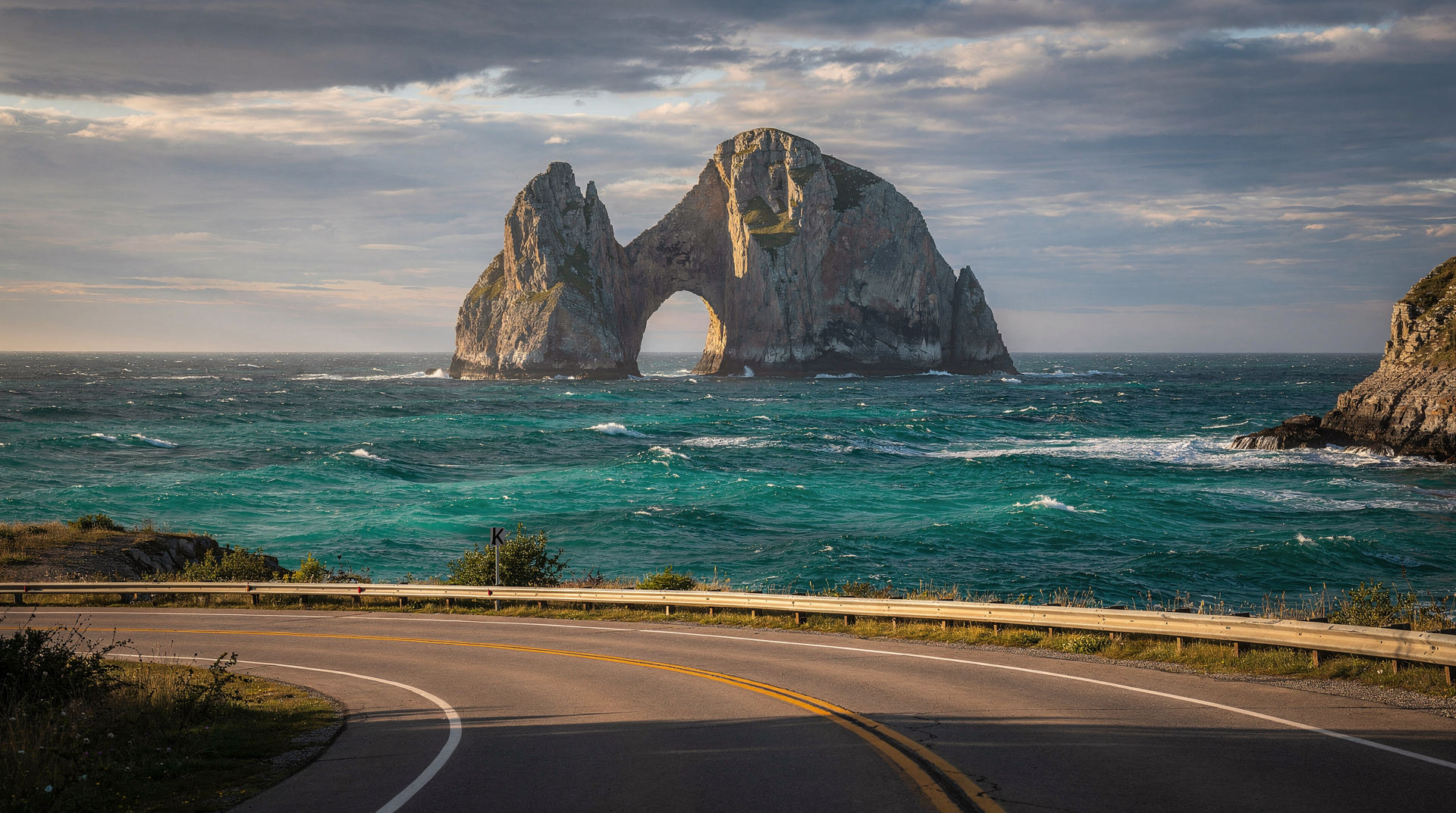
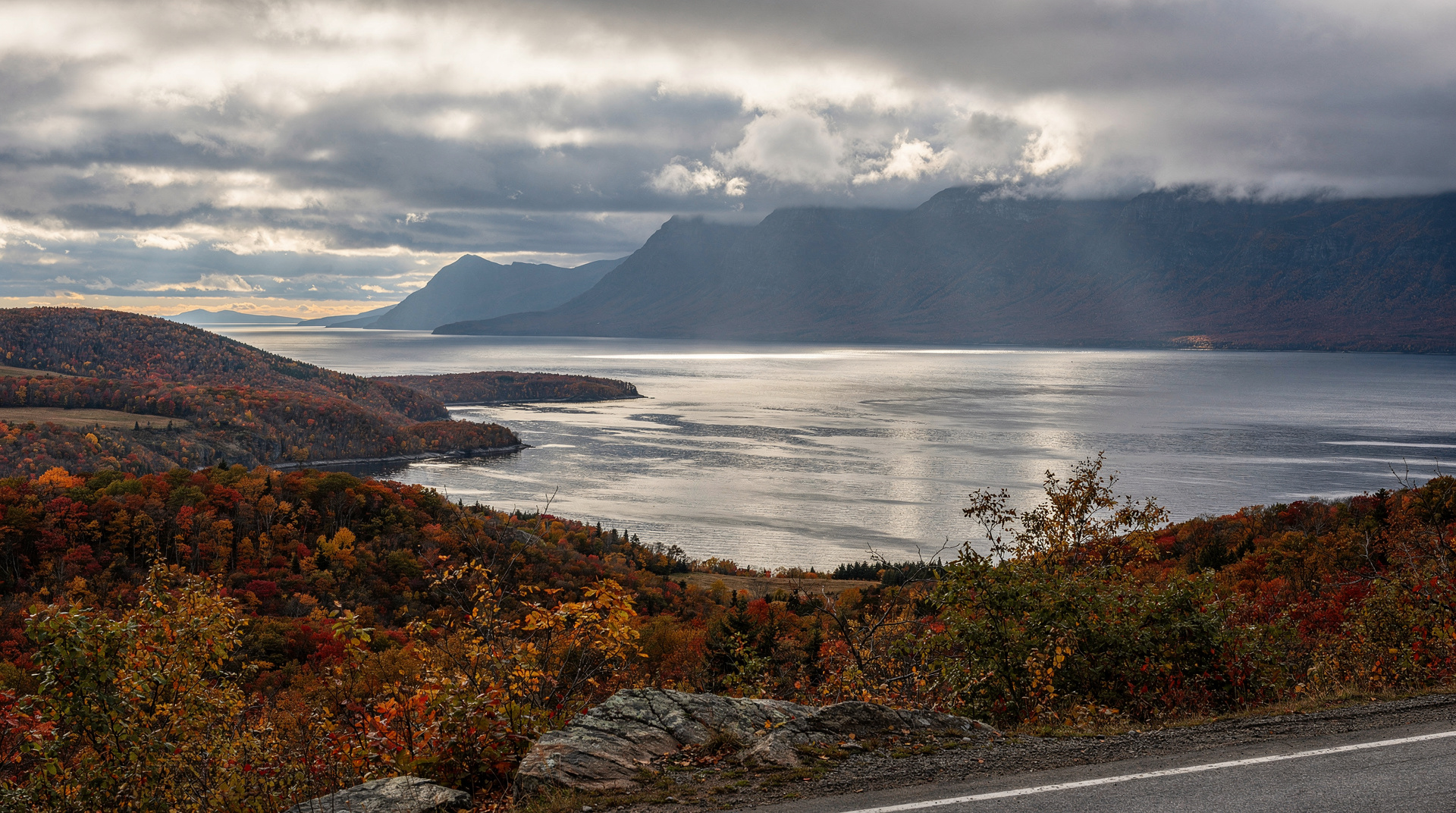
The coastal road is Route 132, which follows the south shore of the Saint-Laurent estuary and then wraps around the entire Gaspésie peninsula. From Rimouski onwards, the scenery begins in earnest: the river is wide enough here that the opposite shore (the Bas-Saint-Laurent) is just visible as a dark line, and the Appalachian hills inland are already impressive. By the time you pass Sainte-Flavie and turn onto the official Gaspésie road, you understand why people make this trip specifically.
Percé and the rock
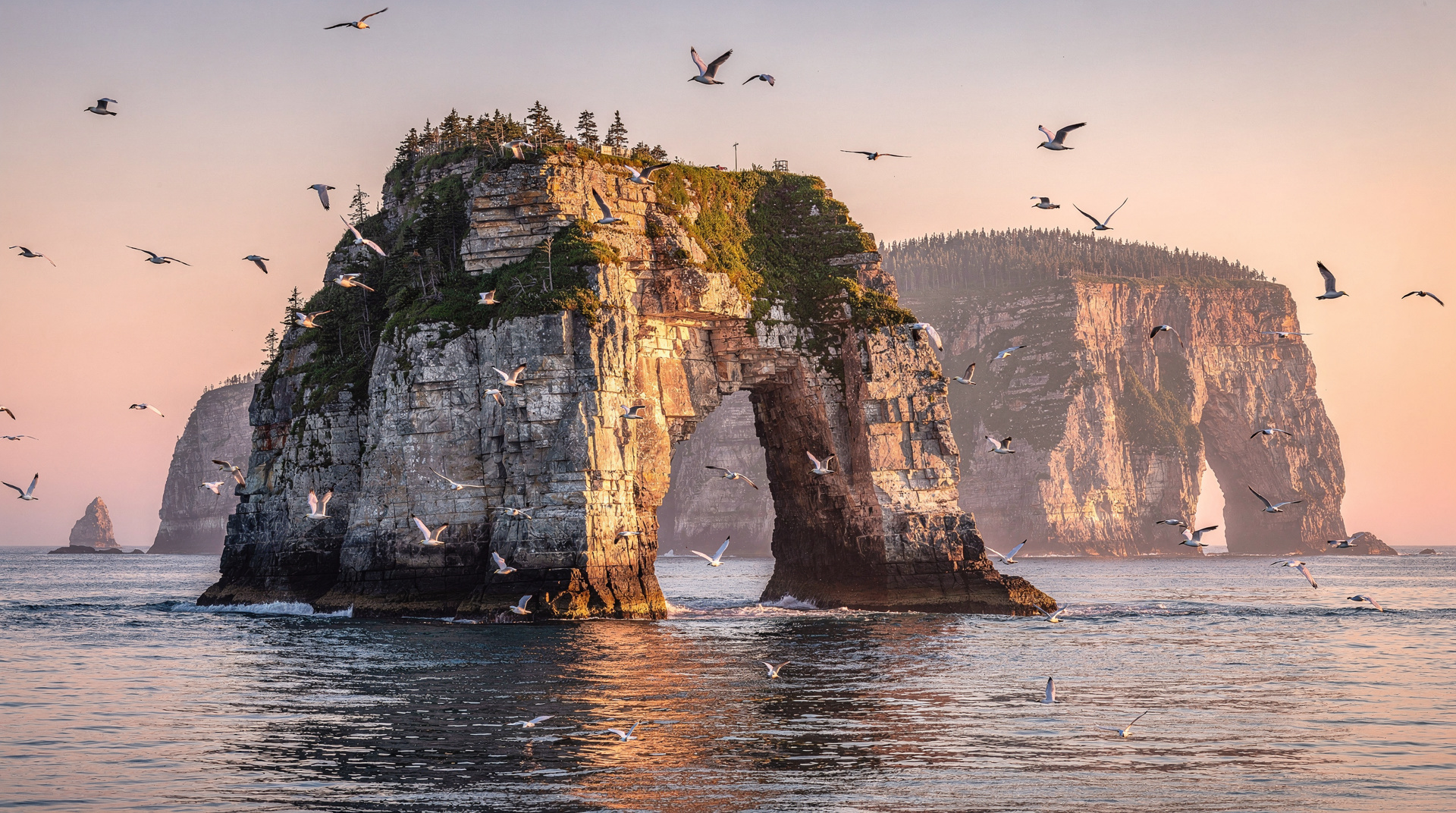
We arrived in Percé on day three, mid-morning, having driven the length of the south coast. Percé is a small town of about 3,000 permanent residents that exists almost entirely because of the Rocher Percé — the 438-metre-long rock with the famous natural arch that stands in the sea just offshore. The rock is the most photographed object in Gaspésie and possibly the most photographed geological feature in all of Québec.
It is also genuinely impressive in person, which is not always the case with heavily photographed landscapes. The rock changes appearance completely depending on the light and the angle: in early morning, it catches the pink of sunrise on its pale limestone face; in afternoon sun it turns amber; in overcast conditions it looks like a stage set for something dramatic. We were there for two nights and the light was different every time I looked at it.
The town itself is tourist-oriented in a straightforward way — restaurants with terrasses all facing the rock, hotels positioned for the view, souvenir shops selling miniature rochers. But this felt less cynical than it could have, perhaps because the rock justifies the attention. We ate dinner at La Maison du Pêcheur, a restaurant perched literally on the cliff above the harbour, where the freshly caught crab and the view competed for your attention. The crab won.
Île Bonaventure: the gannet colony
A short boat from Percé’s dock takes you to Île Bonaventure, a small island that is home to the largest northern gannet colony in North America — approximately 120,000 birds. The numbers make the experience overwhelming in the most positive sense. You approach the colony on foot via a marked trail through the island, and the noise begins before you see the birds: a vast, continuous churning sound that is the sum of 120,000 gannets calling simultaneously. Then you climb the last hill and the colony appears, and it is one of those moments of encountering wildlife at scale that recalibrates your sense of what nature actually contains.
The gannets are spectacular birds: large (about 90 cm beak-to-tail), brilliant white with black wing-tips and a golden wash on the head and neck, with extraordinary dive-bombing behaviour when fishing. At the colony, they are in constant motion — arriving, departing, arguing over nest sites, feeding chicks, performing the elaborate mutual-preening greeting rituals that pairs use when one partner returns from sea. The smell is considerable (90,000 birds; do the maths). The sound is extraordinary. The visual impact is genuinely overwhelming.
We spent three hours on the island and came back to Percé slightly dazed.
Forillon National Park
From Percé we drove north along the coast to Forillon National Park, which occupies the extreme tip of the Gaspésie peninsula. Forillon is one of those Parks Canada properties that seems undervisited relative to its quality — perhaps because it requires commitment to reach — and it has hiking trails that rival anything in the province.
We did the Les Graves trail along the Cap-Bon-Ami coast, which is a moderate 6-kilometre walk on clifftop paths above 60-metre limestone cliffs dropping into the sea. The trail ends at a point where, on a clear day, you can see both the north and south coasts of the Gaspésie peninsula simultaneously. We had a clear day.
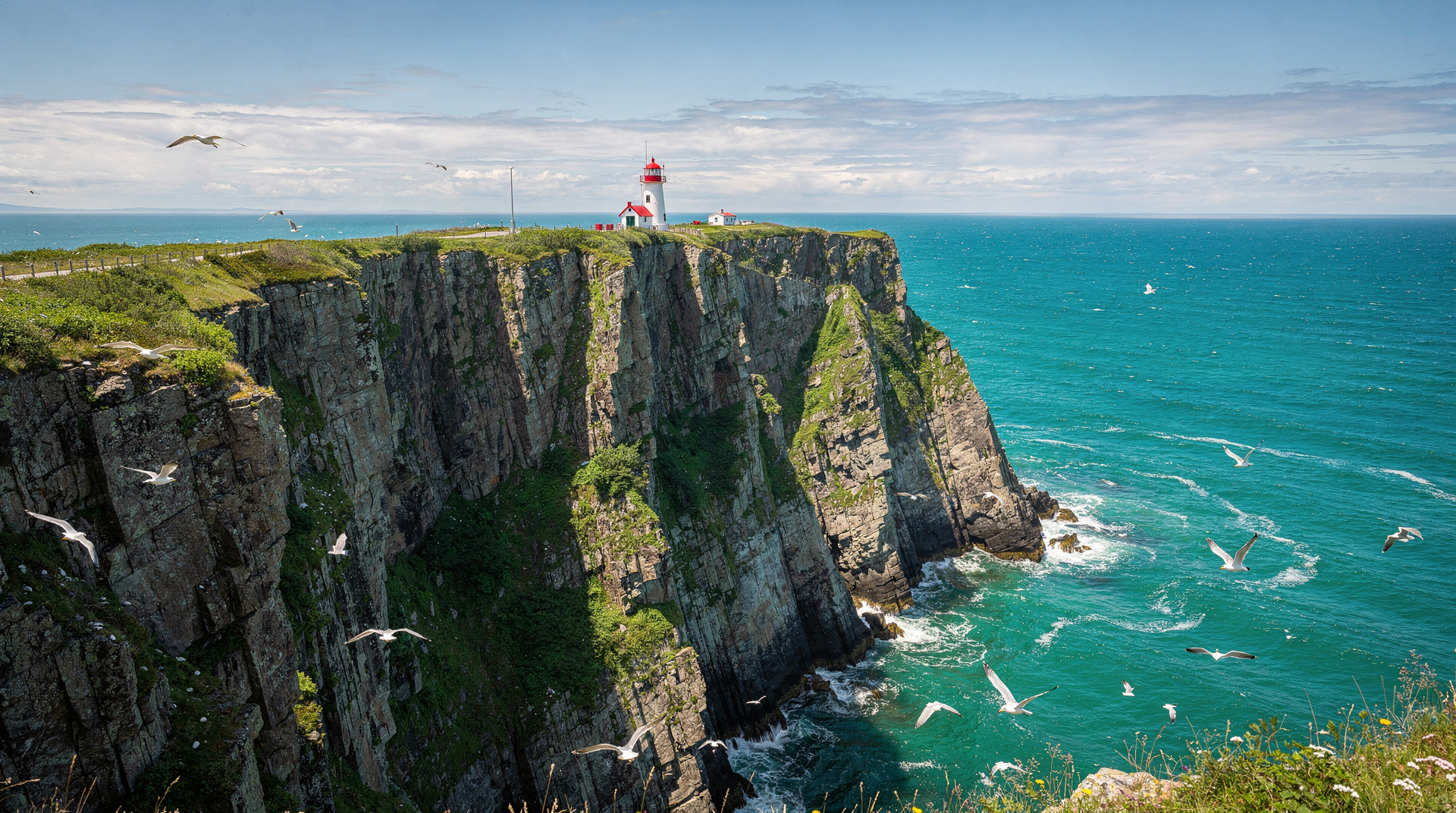
The seal colony at Cap-des-Rosiers is worth a stop: harbour seals haul out on the rocks below the famous lighthouse, and you can watch them from the viewing platform without disturbing them. Parks Canada naturalists are on site in August to answer questions.
The Chic-Chocs and Carleton-sur-Mer
The return leg of the loop goes up the north coast (the Haute-Gaspésie) through the Chic-Choc Mountains — the Québec extension of the Appalachian range — before coming back down to the Gulf coast at Carleton-sur-Mer.
The Chic-Chocs are different from anything else in the province: true mountains with above-treeline terrain, significant vertical, and a wilderness character that the rest of Québec largely lacks. The highest peak, Mont Jacques-Cartier at 1,268 metres, is accessible by a well-maintained Parks Canada trail from the Gîte du Mont-Albert. We hiked up on a morning when low cloud was flowing over the summit ridge, which created an atmosphere of complete isolation. We saw three caribou, which are the only remaining wild woodland caribou population in southern Canada.
The descent to Carleton-sur-Mer brought us back to the Baie-des-Chaleurs, which is sheltered by Île Bonaventure’s geography and is noticeably warmer than the open Gulf coast — beach swimming is viable here in August in a way it isn’t at Percé. We stopped at the beach in Carleton for an hour before driving the last stretch back toward the highway.
What the road trip taught me about Québec
The Gaspésie loop is one of the best long drives in North America. I say this with knowledge of the Pacific Coast Highway, the Icefields Parkway, the Cape Breton Cabot Trail, and the Ring of Kerry. The Gaspésie has something those routes don’t quite have: a sense of arriving somewhere genuinely remote and specific, a place with a distinct culture (Acadian, Madelinot, Micmac, Irish immigrant) and a landscape that rewards sustained attention rather than quick scenic drives.
It is also genuinely challenging. The distances are real, the accommodation in the more remote sections requires advance booking (I booked in May for an August trip and had limited choices at some stops), and the weather on the north coast of the peninsula can be severe even in summer — we had one day of horizontal rain and 15-km/h wind that made hiking feel inadvisable and took our car to the edge of what a 2020 Subaru is rated for in cross-wind.
But the gannet colony on Île Bonaventure, the dawn light on the Rocher Percé, the caribou on the Mont Jacques-Cartier ridge — these are the kinds of things you drive ten hours to see.
Practicalities we’d flag for anyone planning this now
Renting a car. If you’re flying to Gaspé rather than driving from Montréal, book the rental well ahead — the small airport has limited stock, and the loop covers rural sections where a breakdown means a genuinely long wait for help. The how to rent a car in Québec guide covers the practical details, including winter-tire requirements that don’t apply in August but matter if you’re extending the season.
Hiking gear for the Chic-Chocs. The above-treeline sections of the Chic-Choc Mountains get genuine mountain weather even in August — we had horizontal rain on the north coast the same week we had clear skies on the Mont Jacques-Cartier ridge. The Chic-Chocs mountains guide and the broader best hikes in Québec guide both cover trail conditions and what to pack in more detail than we have room for here.
Forillon specifically. If Forillon is the one park you prioritise on a shorter version of this trip, the hiking Forillon National Park guide has trail-by-trail detail beyond the Les Graves route we describe above.
Frequently asked questions about Gaspésie circle tour in 7 days: a road trip story
Can the Gaspésie loop be done in less than 7 days? It can, but something has to give. Five days is workable if you fly into Gaspé and skip either the full Chic-Chocs detour or a night in Percé, but you’ll be moving faster than we’d recommend for a place this rewarding of slow travel.
Is the Gaspésie loop doable without a car? Not really. Public transport along Route 132 is minimal and the best stops — Forillon’s trailheads, the Chic-Chocs summit trails, the smaller coastal villages — are not realistically reachable without your own vehicle.
The Gaspésie loop itinerary covers the practical route in detail. The Gaspé Peninsula destination page has regional context. And the Percé and Forillon pages cover those specific areas.