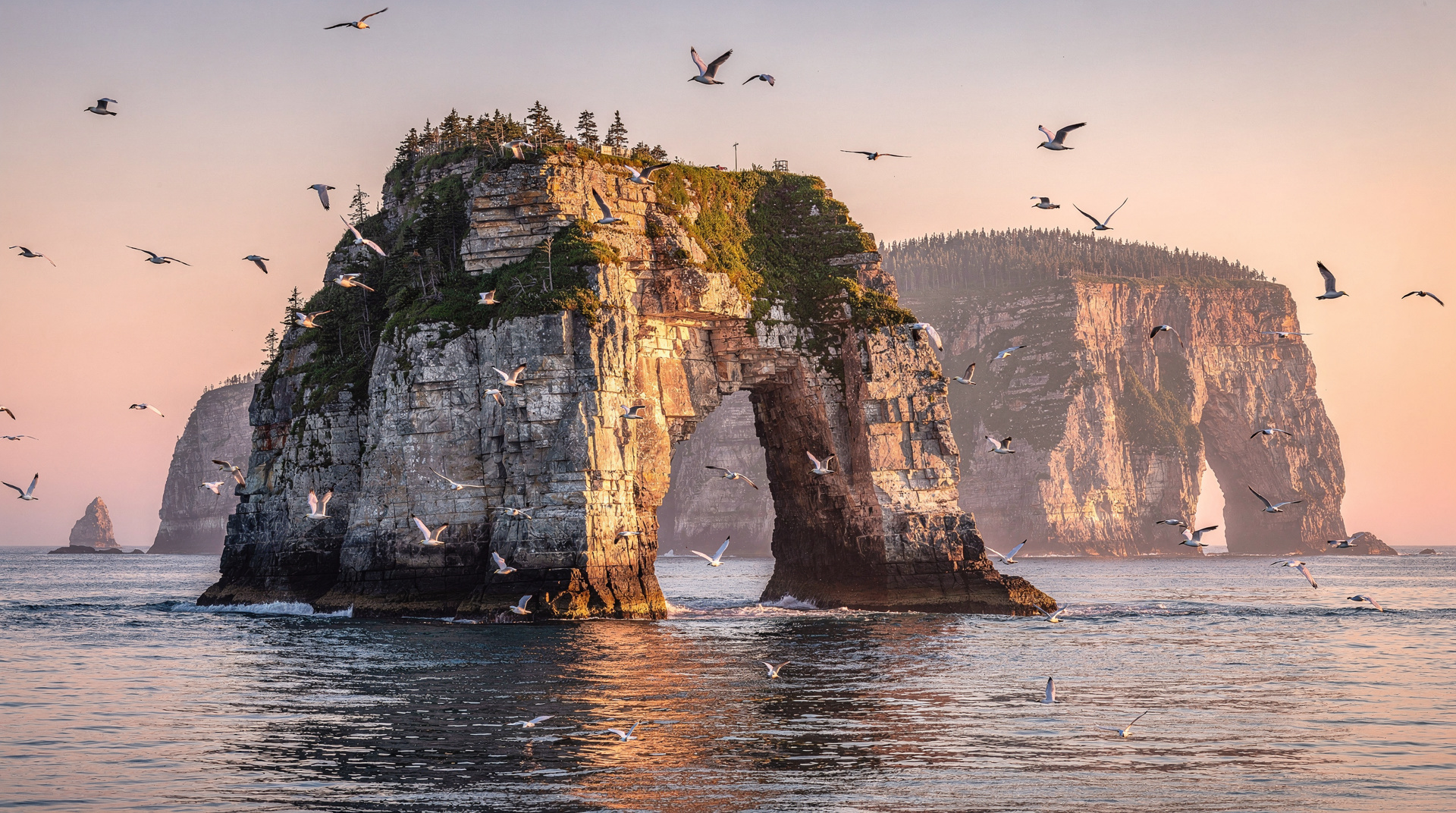
Percé (Rocher Percé & Île Bonaventure)
Iconic limestone arch rising from the sea plus the world's largest accessible gannet colony — 2 essential days on the Gaspé Peninsula.
Quick facts
- Distance from Quebec City
- 700 km (7-8h by car)
- Distance from Gaspé town
- 75 km (1h by car)
- Rocher Percé dimensions
- 438 m long, 88 m high, 1 natural arch
- Gannet colony (Île Bonaventure)
- ~120 000 northern gannets — world's largest accessible colony
- Season
- June to October (services); May and November limited
| Where | Gaspé Peninsula, 700 km from Québec City (7–8h by car) |
| Cost | Rock boat tour ~35–45 CAD; Île Bonaventure boat + entry ~40–50 CAD combined |
| Time needed | 2 days minimum — one for the rock, one for Île Bonaventure |
| Getting there | Car via Route 132 (7–8h from Québec City); seasonal flights to Gaspé (YGP), 75 km away |
| Best time | June–October; peak gannet activity July–August, best light and fewer crowds in June/September |
Two icons in one small village
Percé is where people go to see the Rocher Percé — the massive limestone stack rising 88 metres from the Gulf of St-Lawrence, pierced by a natural arch that the sea carved over 375 million years of geological time. They come for one day and stay for two, because Île Bonaventure — a 4-km island offshore — holds one of the most extraordinary wildlife spectacles in North America.
The village of Percé (population approximately 3 500) has all the hallmarks of a small destination that knows exactly what it offers: a waterfront strip of restaurants, a few hotels with direct views of the rock, and boat operators who run to Île Bonaventure and around the arch from mid-June to mid-October. The crowds peak in late July and early August; June and September are significantly quieter and, for wildlife purposes, often better.
The Rocher Percé
The rock is visible from the village waterfront and from the highway above — there is no single viewpoint, the whole southern skyline of the village is framed by it. At low tide from June to September, a gravel bar emerges between the village beach and the rock’s base, allowing visitors to walk partway out (wading shoes required; the crossing involves knee-deep water in some years depending on the sandbar). Parks Canada regulates access: the rock is a geological monument and climbing is prohibited.
Getting close: the sandbar walk gives a ground-level impression of the rock’s scale — 438 m long, 88 m high. The arch measures 15 m high and 9 m wide; a second arch collapsed in 1845 (there is historical evidence of three arches at various points in history). Tide times are posted at the village dock and at the Parks Canada interpretive centre.
From above: the panoramic viewpoint at the peak of Mont-Joli (accessible by a 30-minute trail from the village) gives the classic overhead perspective. A paid gondola lift also reaches a mid-mountain viewpoint — convenient but not essential given the trail option.
Boat tours: local operators (Les Bateliers de Percé, Croisières Julien Cloutier) run 90-minute circuits around the rock, with narration and stops for photography. The view of the arch from the water differs completely from the land-based experience; this is worth doing. Cost approximately 35-45 CAD per adult.
Île Bonaventure and the gannets
Île Bonaventure is an 8 km² island 3.5 km offshore, designated a national wildlife area and one of the most important seabird breeding sites in the western North Atlantic. The island holds approximately 120 000 northern gannets (fou de Bassan in French) — the largest accessible gannet colony in the world — plus black-legged kittiwakes, common murres, razorbills, and Atlantic puffins in smaller numbers.
The gannet colony occupies the northern cliffs and is reached by a 3 km trail from the landing wharf. Walking through the colony — birds landing a metre away, the noise deafening, the smell oceanic and intense — is one of the genuinely memorable wildlife experiences available in Quebec.
Access: boat departures from Percé wharf with several operators (Les Bateliers de Percé coordinates access). The crossing takes approximately 20 minutes. Boats depart 8h-14h (earlier departures recommended to beat afternoon crowds). Round trip including island time: approximately 4-5 hours. Cost: approximately 30-40 CAD (boat passage only); Parks Canada charges a separate entry fee to the wildlife area (approximately 10 CAD).
Best season: gannets are present from late April to mid-October. The colony is at maximum activity in July-August when chicks are growing. June is excellent and significantly less crowded. The birds begin departing in September; by mid-October most have left for the open Atlantic.
Trail on the island: the 3 km trail to the colony is moderately hilly, unpaved, and takes 45-60 minutes one-way. Wear sturdy shoes. The trail also passes through the old village of Bonaventure (abandoned 1971), with several heritage buildings still standing. Two shorter circular trails cover the island’s forest and coastal sections.
Photography: a 70-200mm lens is sufficient for close portraits — birds are genuinely close. Wide angle is useful for scale. Bring a lens cloth; sea spray is constant. The light is best in morning from June to August.
Three ways to see the Rocher Percé — which to choose
| Method | Cost | What you get | Best for |
|---|---|---|---|
| Sandbar walk (low tide) | Free | Ground-level scale, up close, wading required | Budget travellers, good weather, checking tide times first |
| Boat tour around the rock | ~35–45 CAD | The arch from the water, the only full-circumference view | First-timers, photographers wanting the classic shot |
| Mont-Joli viewpoint/trail | Free (gondola paid) | Overhead panorama of rock, village, and Île Bonaventure | Those wanting the postcard wide shot without a boat |
Most visitors do at least two of the three — the sandbar walk for scale and the boat tour or Mont-Joli viewpoint for the fuller picture. None of the three is strictly essential on its own, but skipping all three means missing what Percé is actually for.
Month-by-month: when to go
| Month | Gannets | Crowds | Notes |
|---|---|---|---|
| June | Present, less crowded | Low-moderate | Excellent for photography, cooler water |
| July | Peak chick-rearing activity | High | Book boats and rooms 6-8 weeks ahead |
| August | Peak activity continues | High | Same booking pressure as July |
| September | Numbers thinning, still active | Low | Best combination of activity and quiet |
| October | Most gannets departed | Very low | Services reduced; check operator schedules before travelling |
Geopark and geology
The broader area around Percé is part of the Geoparc mondial UNESCO de Percé, one of a global network of protected geological sites. The visitor centre at the village explains the 500-million-year geological history of the Gaspé Peninsula. Entry is free and worth 45 minutes even if geology is not your primary interest — the stratigraphy of the Rocher Percé is explained in terms anyone can follow.
Hiking around Percé
Beyond the Mont-Joli trail and the Île Bonaventure circuit, the village offers the Sentier de la Grotte (2.5 km, easy) toward a coastal cave, and access to the Parc national de l’Île-Bonaventure-et-du-Rocher-Percé trails on the mainland above the village. The park’s park office has trail maps and daily conditions.
Where to eat in Percé
La Maison du Pêcheur: the village institution — good seafood, right on the waterfront with the rock in view. Expect queues in July-August; open from lunch. Budget 40-60 CAD per person.
Resto-Bar L’Heure Bleue: casual option with a patio, good for moules-frites (mussels and fries) and local beer, 25-40 CAD per person.
Casse-Croûte du Rocher: take-away fish and chips a few steps from the water, 15-20 CAD.
For self-catering, there is a basic grocery store in the village. Larger provisioning is better done in Gaspé (75 km) before arriving.
Where to stay in Percé
Hôtel la Normandie: the best position in the village — ocean view rooms face the rock directly. Book months ahead for July-August. Rooms 160-280 CAD in season.
Auberge Le Coin du Banc (12 km north of Percé): quieter, small inn with excellent breakfasts, 130-190 CAD.
Camping du Gîte du Mont-Joli: basic campground, sites from 35 CAD. Acceptable if you have your own equipment.
Budget travelers: several simple guesthouses and a hostel exist in the village, 50-80 CAD/person. Quality varies; read recent reviews.
Getting to Percé
By car: from Quebec City, 700 km via Route 132 East along the south shore (7-8h with minimal stops). From Montreal, 1 000 km (10-12h). Plan overnight stops: Rivière-du-Loup or Rimouski from Quebec City direction; Carleton-sur-Mer before Percé.
By air: Air Canada Express serves Gaspé (YGP) from Montreal (YUL) seasonally. The Gaspé airport is 75 km from Percé (1h by car). A rental car is essential from the airport.
Bus: Orléans Express serves the south shore to Percé, but schedules are infrequent and journey times from Quebec City exceed 10 hours with stops. Practical only for those without a car and without time constraints.
Practical tips
- Tide times: essential for the sandbar walk. Download the tide chart from Parks Canada or check at the village dock on arrival.
- Weather: the Gaspé coast is often cool (15-20°C in July near the water) and foggy in the morning. Bring a wind layer regardless of the forecast.
- Advance booking: accommodation and boat departures both fill in July-August. Book 6-8 weeks ahead for peak season.
Percé connects naturally with Forillon National Park (75 km west) and the Gaspé town as part of the Gaspé Peninsula loop. See the Gaspésie road trip itinerary for a full 7-day route, and the hiking Forillon guide for the trail system on the other end of the peninsula. If your trip lands in high summer, the Québec in August guide has broader timing notes that apply to the whole Gaspésie leg.
Frequently asked questions about Percé (Rocher Percé & Île Bonaventure)
Do I need to book the Île Bonaventure boat in advance?
Advance booking is strongly recommended for July-August — the earlier morning departures (which beat both crowds and afternoon fog) sell out. In June and September, walk-up bookings the day before are usually fine.
Is Percé worth two full days?
Yes, if Île Bonaventure’s gannet colony is a priority — the round trip alone takes 4-5 hours, and rushing it defeats the point. A single day covers the Rocher Percé (sandbar walk, boat tour, or Mont-Joli) but not the island properly.