Kayaking the Saint-Laurent: from Vieux-Port to Saguenay Fjord
Sea Kayaking Tour in Orleans Island
Duration: 3 hours
Where is the best place to kayak in Québec?
Île d'Orléans for a calm 3-hour intro (60 CAD from Québec City), Tadoussac for sea kayaking with whale sightings (expert kayakers only — strong currents), Saguenay Fjord for the most dramatic fjord scenery. Season May to October.
Kayaking in Québec: a province with remarkable range
The province of Québec has more freshwater than almost anywhere else on earth. The Saint-Laurent alone drains an area the size of Western Europe. Within this vast water system, kayaking ranges from flat urban paddling in Old Montréal to open-sea swells in the Saguenay Fjord, with most of the best experiences sitting somewhere between those two extremes.
This guide works from south to north — from the accessible calm-water options close to Montréal and Québec City up to the more serious paddling around Tadoussac and the Saguenay Fjord. Each section is honest about the skill level required and the genuine risks involved. Québec’s waterways are beautiful; some of them are also unforgiving to underprepared paddlers.
| Where | Vieux-Port Montréal to Saguenay Fjord |
| Cost | ~60 CAD guided (Île d’Orléans, Tadoussac) |
| Time needed | 2–4 hrs guided; multi-day for Saguenay expeditions |
| Skill level | Beginner (Montréal, Île d’Orléans) to expert (Tadoussac, Saguenay) |
| Season | May–October (July–Sept warmest) |
Vieux-Port de Montréal: calm-water introduction
The Old Port of Montréal offers kayak rentals and guided tours on the basin of the inner harbour, sheltered from the main current of the Saint-Laurent. This is genuine beginner territory: flat water, professional supervision, historic skyline as a backdrop.
It is not wild. It is urban. But as an introduction to the feel of a sea kayak — the low centre of gravity, the paddle mechanics, the way the boat responds — it is hard to beat, and it takes 90 minutes. Then you can get on with the rest of Montréal.
Operators along the Vieux-Port quays offer both guided tours and self-guided rentals. The self-guided option gives you access to the inner basin; guided tours venture slightly further.
Nearest guide listing: Montréal’s Old Port kayak rentals are not currently in the GYG catalog for this exact activity — plan for a direct booking at the port on arrival, or ask your accommodation for current operators. See Old Montréal destination guide.
Île d’Orléans: the most accessible sea kayaking from Québec City
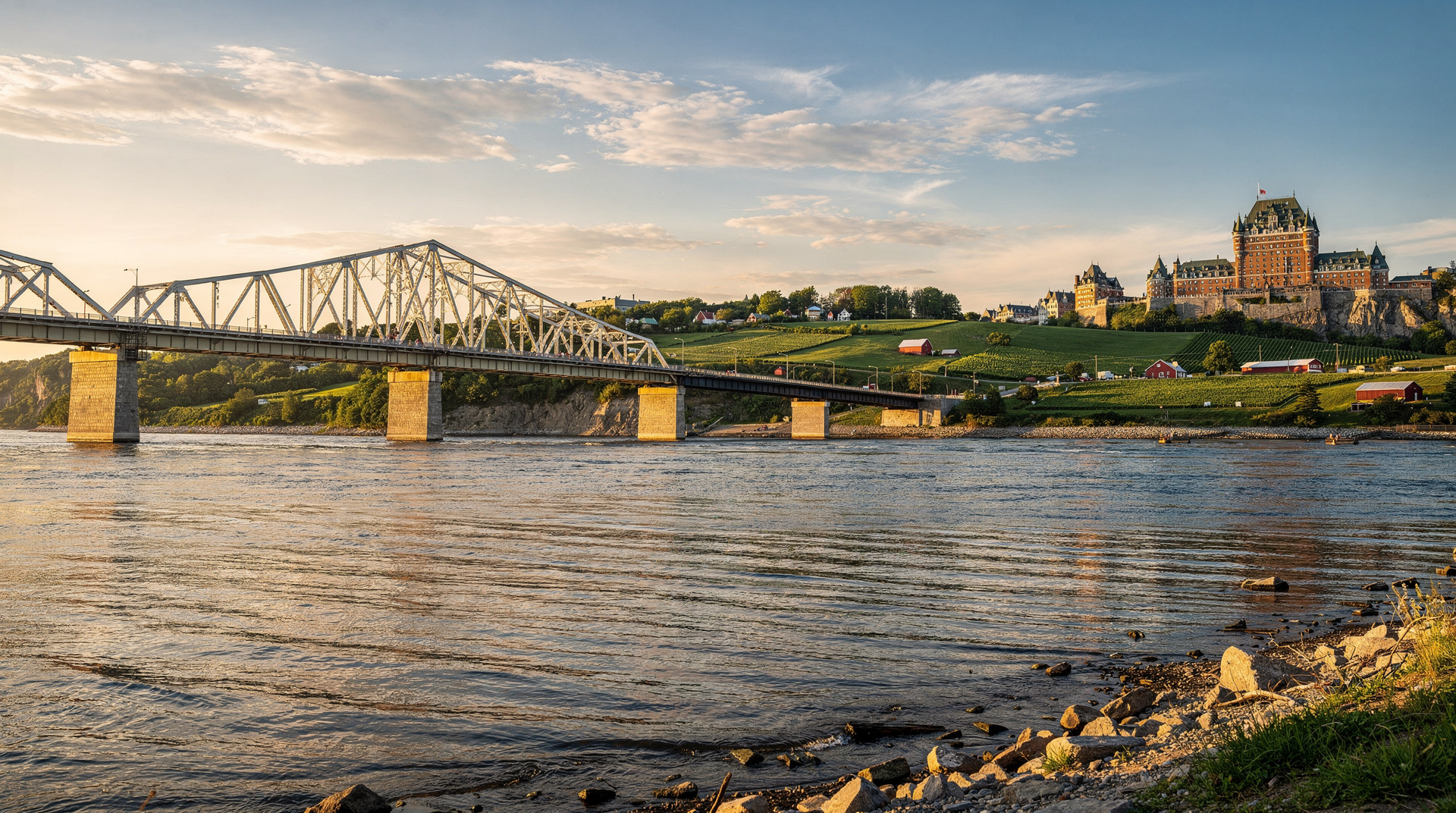
For travellers based in Québec City, the sea kayaking around Île d’Orléans is the obvious first stop. The island sits in the Saint-Laurent 15 km east of the city, and the narrow channels between the island and the north and south shores are sheltered enough to be suitable for beginner sea kayakers, while still giving you the open-water feel of the great river.
The main tour departs from near the bridge on the island’s southern tip and covers 3 hours of paddling, often with views of Montmorency Falls from the water and the cliffs of Charlevoix in the distance on clear days.
Sea Kayaking Tour — Île d’OrléansPrice: approximately 60 CAD per person. Duration: 3 hours. This is a guided group tour; no prior kayaking experience necessary.
This pairs naturally with the Île d’Orléans e-bike and food trails — see our Île d’Orléans guide for a full day itinerary.
Tadoussac: whale watching by kayak (experienced paddlers only)
Let’s be clear from the outset: Tadoussac is not beginner kayaking. The estuary at Tadoussac, where the Saguenay River meets the Saint-Laurent, is one of the most dynamic bodies of water in North America. Tidal currents can exceed 5 knots. Water temperature in July is 12–14°C — cold enough to incapacitate an unprotected swimmer in minutes. The fetch is significant, meaning waves build rapidly in wind.
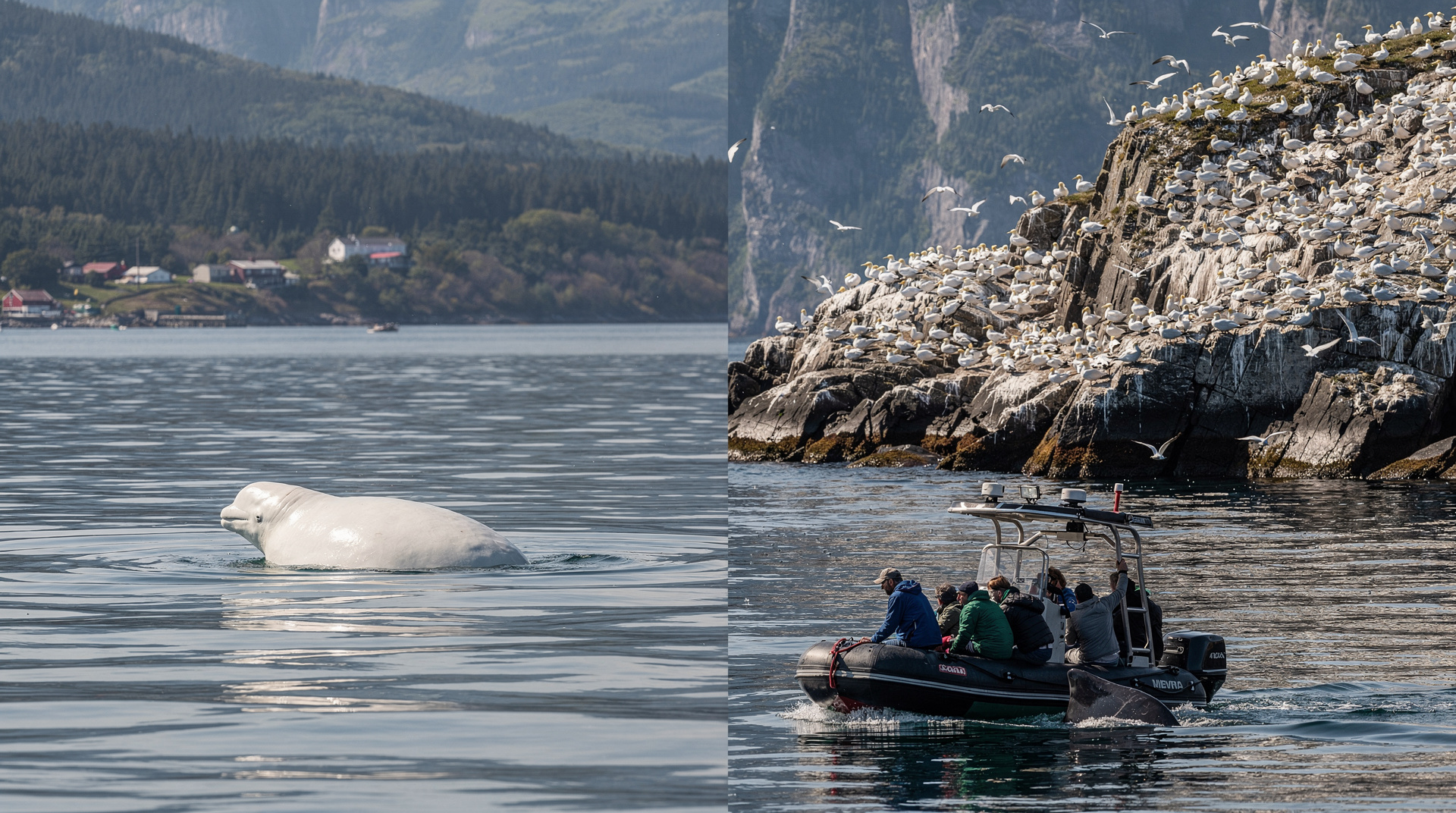
But for experienced sea kayakers, Tadoussac is extraordinary. The same nutrient upwelling that attracts whales — belugas, minkes, fins, and occasionally blues — also creates the most dramatic kayaking environment in Québec. Hearing a beluga surface from a sea kayak, while keeping the 400 m minimum distance the regulations require, is a different experience from watching from a boat deck.
The guided 2-hour session near Tadoussac is specifically designed for the conditions:
15-Minute Guided Sea Kayaking Adventure — TadoussacPrice: approximately 60 CAD. Duration: 2 hours. This is guided, small-group, close to shore — the most accessible introduction to Tadoussac sea kayaking. The “15-minute” in the title refers to a specific element of the experience, not the total duration.
For anyone considering independent sea kayaking at Tadoussac, please paddle only with an ACA or equivalent certified guide, wear a wetsuit or drysuit, and check current conditions before launching. Helicopter rescues from the Saguenay estuary are not an urban legend.
See our whale watching guide for the boat options, which are appropriate for all fitness levels.
Saguenay Fjord: advanced sea kayaking in an extraordinary landscape
The Saguenay Fjord extends 100 km inland from Tadoussac through sheer granite walls rising 300+ metres directly from the water. It is one of the southernmost fjords in the world, carved by glaciers and now filled with a mix of salt and fresh water that creates its own unique ecology.
Kayaking the Saguenay is a multi-day undertaking for properly equipped sea kayakers. The fjord is wide enough (up to 3 km) that crossing it in a sea kayak requires real navigation and weather judgment. The walls mean there is very little beach to land on if conditions deteriorate. Several expedition kayaking operators in Sacré-Coeur and Rivière-Éternité offer guided multi-day trips — the most responsible way to experience this landscape by paddle.
For visitors who want the Saguenay experience without the expedition commitment, the Saguenay Fjord 3-hour cruise is the alternative. The fjord from deck level is already stunning.
The Rouge River: river kayaking near Mont-Tremblant
The Rouge River self-guided kayak and paddleboard option is a gentler alternative to white-water rafting on the same river, using the calmer lower section. It is suitable for paddlers with basic open-water experience.
Self-Guided Kayak/Paddleboard — Rouge RiverPrice: approximately 60 CAD for equipment rental and river access. Duration: 3–4 hours at your own pace. See our Rouge River rafting guide for context on the river.
Kayaking season and water temperatures by region
| Region | Season | July water temp | Difficulty |
|---|---|---|---|
| Vieux-Port Montréal | May–Sept | 20–22°C | Beginner |
| Île d’Orléans | May–Oct | 18–22°C | Beginner |
| Rouge River | May–Oct | 15–18°C | Beginner–Intermediate |
| Tadoussac | June–Oct | 12–15°C | Advanced (guided only) |
| Saguenay Fjord | June–Sept | 10–14°C | Expert |
The cold water temperatures at Tadoussac and Saguenay are not negotiable. Even in July, a capsize without a wetsuit or drysuit in those waters carries a real risk of cold shock and incapacitation. Every guided operator at those locations provides or requires a wetsuit — non-negotiable.
Multi-day kayak touring in Québec
For experienced paddlers looking for route planning resources, Parks Canada manages several paddle routes in Québec that allow multi-day wilderness kayaking:
- La Vérendrye Wildlife Reserve (Outaouais/Laurent): interconnected lake system, portaging required
- Saguenay–Saint-Laurent Marine Park: designated kayak corridors with respect zones around whales
- Mingan Archipelago (Côte-Nord): open-water crossing to monolith islands — expert only, often foggy
These routes require trip planning, camping gear, and navigational competence beyond the scope of this guide. Contact Fédération québécoise du canot et du kayak (FQCK) for route information and safety resources.
Choosing guided versus self-guided
The decision between a guided tour and a self-guided rental is really a decision about which body of water you are on. At Vieux-Port Montréal, Île d’Orléans, and the Rouge River, self-guided rentals are genuinely safe options for confident beginners — the water is sheltered, rescue is close, and the worst-case scenario is getting cold or tired, not swept into open current. At Tadoussac and the Saguenay Fjord, this calculus flips entirely: currents, cold-water shock risk, and the sheer scale of the estuary mean a guide is not a luxury but a safety requirement, and reputable local operators will not rent unguided kayaks to visitors without demonstrated open-water certification for those specific conditions.
A useful rule of thumb: if you can see the far shore clearly and the water looks like a lake, self-guided is probably fine. If the water looks like open ocean — swells, fog banks, visible current lines — treat it as expert terrain and book a guide regardless of your general paddling experience.
What to pack beyond what operators provide
Guided tours supply the kayak, paddle, and PFD, and often the wetsuit for cold-water locations, but a few items are worth bringing yourself regardless of location: a dry bag for phone and camera (even calm-water paddling involves splash), polarized sunglasses with a retention strap (glare off the Saint-Laurent is intense at midday), reef-safe sunscreen, and a spare set of dry clothes left in the car or with your guide’s support vehicle for after a cold-water session. For Tadoussac and Saguenay specifically, base layers that retain warmth when wet (merino wool, not cotton) make a genuine difference to comfort even inside a provided wetsuit.
Building kayaking into a wider Québec trip
Kayaking rarely justifies a trip on its own, so the practical question is where it fits. The calm-water options slot into city stays: a morning on the water in the inner harbour before an afternoon exploring Montréal, or a half-day paddle from Québec City before dinner in the old town. Because the Île d’Orléans tour is guided and self-contained, it works well as a single block in a three-day Québec City itinerary without any extra logistics.
The northern options need more planning because getting there is part of the day. If you are heading toward the estuary, read the Québec City to Tadoussac day trip guide and the notes on the Tadoussac ferry crossing so you know how the route works before you commit to a paddling slot. The five-day whale and fjord itinerary shows how to string the estuary, the fjord and the boat tours together at a sensible pace, which is far better than rushing a kayak session between two long drives.
Seeing the same water from different angles
One of the best arguments for staying a couple of nights around Tadoussac is that the water offers several ways in, and you do not have to choose only one. A guided kayak gives you the low, quiet, close-to-the-surface view. A boat gives you range and comfort. Walking the headlands gives you the long view. Combining two of the three tends to be more satisfying than doing the same thing twice.
If the kayak session is the highlight, a boat outing makes a good counterpoint, and the Zodiac versus large cruise comparison helps you pick between them. For travellers who like the water but prefer to stay on land, the guide to whale watching without a boat at Bergeronnes and Les Escoumins covers shore-based viewing, which is a calm way to build your sense of the estuary before you ever get in a kayak. To know what you are looking at when something surfaces, the whale species guide is a useful read, and the best time for whale watching in Québec explains how the season shapes what you are likely to see.
On the fjord side, the Saguenay destination page and the hiking guide for the Saguenay fjord are good companions for anyone who wants to experience the granite walls from a trail as well as from a cruise or a boat. Seeing the cliffs from above first makes it easier to judge the scale of the water below, and it quietly reinforces why the guide-only rule matters there.
Calm lakes and more relaxed alternatives
Not every paddling day needs to be a statement. If your group includes children, nervous swimmers or people who simply want to drift, a lake is the right answer. Lac Memphrémagog in summer is the natural place to look in the Eastern Townships, and the Mont-Tremblant destination page covers the lake and river options in the Laurentides. If you enjoy standing on the water more than sitting in it, the paddleboarding guide covers the lakes where that works well.
The advantage of lakes is flexibility. You can stop when the wind picks up, turn back when someone is tired, and rent by the hour without committing to a full schedule. Treat them as the place to build skills and confidence, then step up to the sea-kayaking sites only when your technique and your fitness match the conditions described above.
Safety and insurance before you paddle
Everything in this guide comes back to the same idea: match the water to your ability and be honest about both. Before any paddling day, tell someone where you are going and when you expect to be back, check the weather and wind on the morning itself, and listen to the briefing your guide gives, even if you have paddled before. Operators brief every group because conditions change from one hour to the next, and the briefing is where you learn about the day’s specific hazards.
For general advice on staying safe while travelling in the province, see the Québec safety tips. If you are planning several outdoor activities, it is also worth reading about travel insurance for Québec and checking that your policy actually covers adventure sports on open water, since some policies treat paddling differently from ordinary sightseeing.
Practical planning
- All guided tours listed above provide equipment: kayak, paddle, PFD, wetsuit where relevant
- Self-guided rentals typically include kayak, paddle, and PFD; wetsuits may be extra
- Booking: Île d’Orléans and Rouge River tours run throughout the season; Tadoussac guided kayak fills quickly in July–August, book ahead
- What to wear: quick-dry synthetic clothing underneath any wetsuit; no cotton; water shoes or sandals that stay on your feet
Related guides
- Whale watching in Tadoussac
- Rafting the Rouge River
- Paddleboarding on Québec lakes
- Île d’Orléans day trip from Québec City
- Day trips from Québec City
Frequently asked questions about Kayaking the Saint-Laurent: from Vieux-Port to Saguenay Fjord
Do you need experience to kayak in Québec?
It depends on the location. Vieux-Port de Montréal and Île d'Orléans are calm-water introductions suitable for beginners with no prior experience. Tadoussac is not beginner territory — the Saint-Laurent there has strong tidal currents and cold water; go only with an experienced guide. The Saguenay Fjord is also expert terrain. The Rouge River self-guided kayak is intermediate.Is it possible to see whales from a kayak in Québec?
Yes, in Tadoussac — but this is only for experienced sea kayakers going with a certified guide. The estuary at Tadoussac is one of the best whale-watching spots on earth, and a well-run guided kayak there can bring you into the same waters as belugas (regulations require staying at least 400 m away). However, the currents are strong and the water is cold; paddling there without proper experience and guidance is genuinely dangerous.What is the kayaking season in Québec?
May to October for most locations. The Saint-Laurent at Tadoussac is theoretically paddleable earlier but water temperatures are near freezing until June. The warmest and safest window is July to September. Île d'Orléans opens in late May; Vieux-Port Montréal offers kayaking from May to September.Can I rent a kayak without a guide in Québec?
Yes at several locations: Vieux-Port de Montréal (calm water), Île d'Orléans for self-guided exploration, and the Rouge River for a self-guided kayak/paddleboard option. At Tadoussac and in the Saguenay Fjord, solo unguided kayaking is strongly inadvisable. Rental shops at Lac Memphrémagog and several Laurentides lakes are the most relaxed option for beginners wanting freedom.How cold is the water for kayaking in Québec?
The Saint-Laurent is cold year-round. At Tadoussac in July, surface water is 12–15°C — cold enough that immersion without a wetsuit is a serious risk. At Île d'Orléans and in calm rivers in July-August, temperatures reach 18–22°C, which is manageable. A wetsuit is strongly recommended for any open-water paddling in Québec, even in summer.What should a beginner choose for their first kayaking trip in Québec?
Île d'Orléans, without much debate. It is guided, requires no prior experience, runs approximately 3 hours for around 60 CAD, and still gives you real Saint-Laurent open-water scenery with views toward Montmorency Falls and Charlevoix. Vieux-Port Montréal is an even gentler option if you want to try a kayak for the first time in a completely sheltered basin before committing to a longer session.
Top experiences
Bookable activities with verified prices and instant confirmation on GetYourGuide.