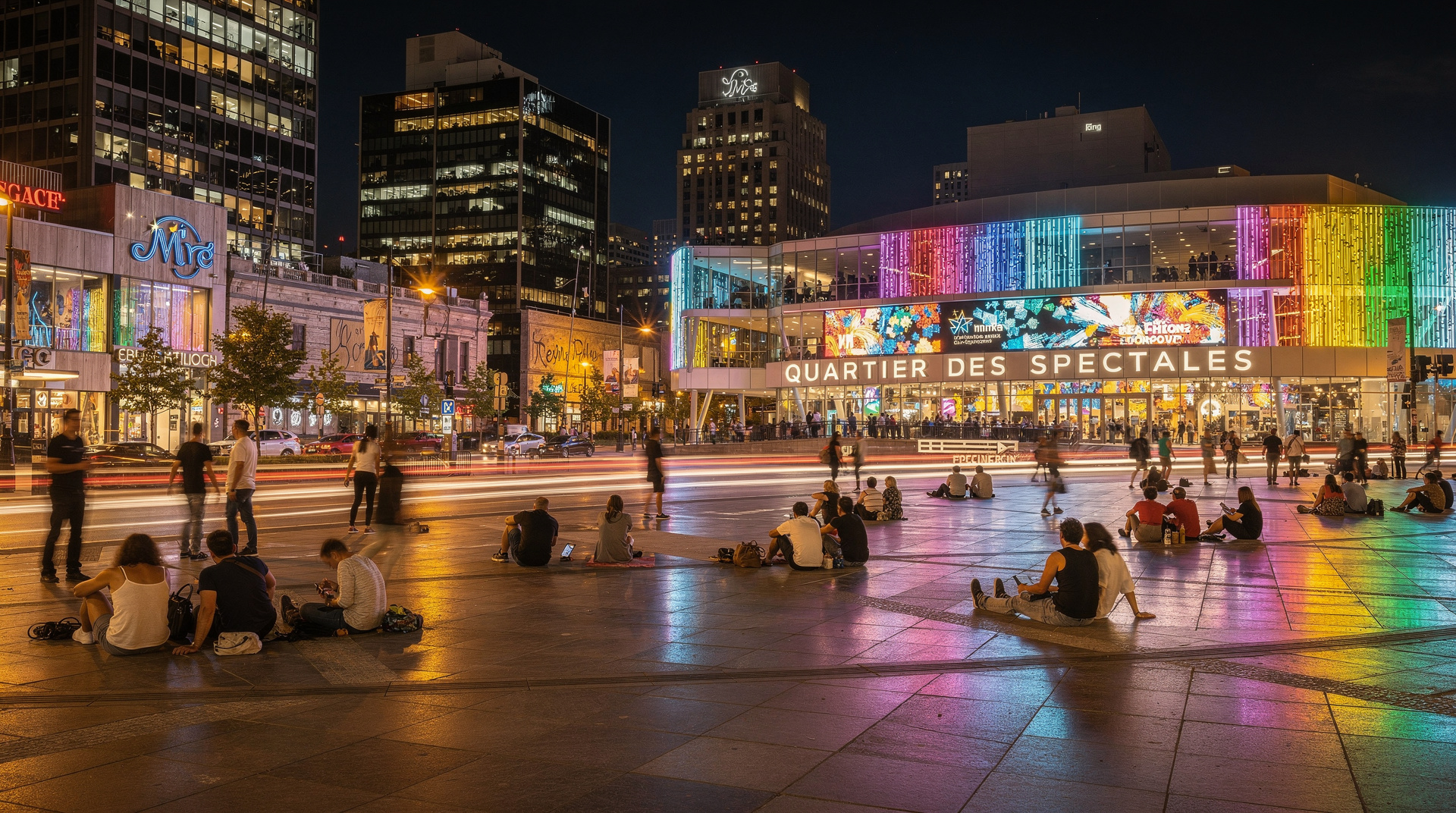
Quartier des Spectacles
Montreal's cultural heart: Place des Arts, world-class festivals (Jazz, Just for Laughs, Igloofest), and the city's densest concentration of venues.
Quick facts
- Location
- Downtown Montreal, between Bleury and Berri, De Maisonneuve and René-Lévesque
- Metro access
- Place-des-Arts (line 2), Saint-Laurent (line 2)
- Key venue
- Place des Arts (5 halls, 3 000 seats)
- Festival peak
- Late June through late July (Jazz + JFL)
| Where | Downtown Montreal, between Bleury and Berri, centred on Place des Arts |
| Cost | Free outdoor festival programming; indoor tickets 15–150 CAD depending on venue and act |
| Time needed | Half a day off-season; a full evening (or several) during festival season |
| Getting there | Metro Place-des-Arts or Saint-Laurent (both Line 2) |
| Best time | Late June–late July for Jazz and Just for Laughs; January–February for Igloofest |
Montreal’s festival epicentre
The Quartier des Spectacles did not exist as a named district twenty years ago. It was a patchwork of parking lots, vacant storefronts, and the occasional theatre on the eastern fringe of downtown Montreal. Then the city committed to one of the most deliberate urban cultural investments in North America: a 14-block zone centred on Place des Arts, purpose-built to concentrate performing arts venues, outdoor performance spaces, and the infrastructure needed to host the world’s largest comedy and jazz festivals in the open air.
Today the Quartier des Spectacles is the highest density of cultural venues in Canada: Place des Arts (five concert halls), the Salle Wilfrid-Pelletier, the Maison Symphonique, TOHU (circus arts), and a network of outdoor stages and plazas that transform into festival grounds from late June through late July, then again in January and February for winter programming.
For visitors, this is where you go when you want to feel the Montreal that travel writers keep describing — the cosmopolitan, Francophone, multilingual cultural confidence that distinguishes this city from its Canadian counterparts. It is also completely free to walk through, and the outdoor programming is mostly free to watch.
Place des Arts
Place des Arts is the architectural and institutional centrepiece of the district. Opened in 1963, it was built as part of the postwar Quiet Revolution modernisation of Quebec — the idea that Francophone culture deserved a world-class permanent home. The main complex includes five halls:
- Salle Wilfrid-Pelletier (2 982 seats): home to the Orchestre symphonique de Montréal (OSM), the Opéra de Montréal, and Les Grands Ballets Canadiens. The OSM season runs September to June; tickets from 30 CAD in the upper tiers to 150 CAD for premium seats.
- Théâtre Maisonneuve (1 460 seats): theatre and dance, with a particular strength in Francophone productions.
- Théâtre Jean-Duceppe: contemporary Francophone theatre, largely inaccessible without French but worth seeing if your French is functional.
- Cinquième Salle and Studio-Théâtre: experimental and small-format productions.
The Musée d’art contemporain de Montréal (MAC) is housed in the Place des Arts complex, with a permanent collection of over 7 000 works focused on art since 1939. Renovations have expanded the space in recent years; current hours and exhibition details at macm.org. Entry around 14-20 CAD; free first Sunday of each month.
The festivals: what actually happens here
The Quartier des Spectacles earns its reputation through its festivals. These are not peripheral events — they are among the largest of their kind in the world, and they happen in the streets and on free outdoor stages where any visitor can participate.
Festival international de jazz de Montréal
The Festival international de jazz de Montréal runs for ten days at the end of June and start of July. It has been held since 1980 and now brings roughly 2 million visitors over its run. The main outdoor stages — on Rue Sainte-Catherine, on the esplanade in front of Place des Arts, and on surrounding streets — host around 350 free outdoor concerts. The indoor paid concerts (at Salle Wilfrid-Pelletier and other venues) feature headline international artists; tickets sell out months in advance for the biggest names.
The genius of the format is that you can attend the Jazz Festival without spending a cent on tickets. The free outdoor stages run from early afternoon to midnight, with genuine quality at every level — international touring acts, local Québécois jazz, and everything in between. The atmosphere on a warm Tuesday evening in early July, with Rue Sainte-Catherine closed to traffic and filled with 30 000 people listening to live music, is one of Montreal’s defining experiences.
Just for Laughs / Juste pour rire
Just for Laughs (English programming) and Juste pour rire (Francophone) run concurrently in mid-July. Founded in 1983, JFL is the world’s largest comedy festival and has launched or advanced more careers in stand-up than any other platform outside Netflix specials. The gala shows (with international headliners) require tickets; the free outdoor programming includes street performers, buskers, and surprise sets in public spaces throughout the district.
The bilingual structure of JFL is a useful proxy for Montreal’s broader culture: the same district, same week, two comedy traditions in two languages that rarely share audiences but somehow coexist without friction.
Igloofest
Igloofest runs for four weekends in January and February on the Old Port waterfront — technically just south of the Quartier des Spectacles proper, but programmatically connected. It is an outdoor electronic music festival held at temperatures that regularly drop below -15°C. The concept is simple and should be ridiculous: dancing outside to techno and house music in a Quebec winter. In practice, the combination of elaborate down jackets, ski goggles, warming tents, and a crowd that has entirely committed to the premise creates an event that has become genuinely famous among winter festival enthusiasts worldwide.
Tickets run 30-45 CAD per night; layering advice is provided on the website and should be taken seriously. See the Quebec in January guide for practical cold-weather clothing notes.
Francofolies and Mutek
Les Francofolies de Montréal (mid-June) is a five-day Francophone music festival covering chanson, rock, hip-hop, and electronic music in French. Most outdoor programming is free; indoor shows 15-50 CAD. It’s less internationally known than Jazz or JFL but arguably more revealing of contemporary Quebec culture.
Mutek (late May or early June) is a festival of electronic music and digital arts with a cult following among producers and sound designers internationally. Venues include both indoor clubs and outdoor installations. Day passes 35-60 CAD; some free programming.
Nuits d’Afrique (mid-July, running concurrently with JFL) is a world music festival focused on African and Caribbean artists that has operated since 1987. Its outdoor stage programming is largely free; indoor concerts require tickets. It is notably well-attended by Montreal’s Francophone African diaspora and gives the Quartier des Spectacles a genuinely different energy for its ten-day run.
Which festival should you actually plan a trip around?
The district hosts several major festivals, and they attract genuinely different crowds and budgets:
| Festival | When | Cost | Vibe |
|---|---|---|---|
| Jazz Festival | Late June–early July, 10 days | Free outdoor stages; 40–150 CAD indoor | Broadest appeal, huge free program, all ages |
| Just for Laughs | Mid-July | Free street performers; 40–100 CAD galas | Comedy-focused, bilingual programming |
| Igloofest | 4 weekends, January–February | 30–45 CAD/night | Winter electronic music, serious cold-weather commitment |
| Francofolies | Mid-June | Mostly free; 15–50 CAD indoor | Francophone music, less touristy |
| Nuits d’Afrique | Mid-July (overlaps JFL) | Mostly free outdoor | African and Caribbean music, distinct energy |
For a first Montreal trip in summer, the Jazz Festival’s free outdoor programming is the easiest and most rewarding entry point — genuine quality at zero cost, no advance planning required beyond showing up.
The Quartier outside festival season
Between festivals, the Quartier des Spectacles is a quieter but still worthwhile destination. The esplanade in front of Place des Arts is a public space with seating, a reflecting pool that becomes a skating rink in winter, and regular art installations. The Promenade des Artistes (a designated pedestrian axis along Jeanne-Mance) has permanent murals and occasional outdoor cinema screenings.
For food and drink within or adjacent to the district: Barroco (312 Rue Saint-Paul) is in Old Montreal but a 15-minute walk; within the district, the neighbourhood is more service-oriented than culinary. Brasserie Molson (historical; the Molson brewery complex on Notre-Dame Est) is a few minutes’ walk east and open for tours. Better restaurants are on nearby Rue Saint-Denis and in the Plateau-Mont-Royal — see the Grand Montréal region overview for the broader context.
Getting there
The Quartier des Spectacles sits between two Line 2 metro stations:
- Place-des-Arts: exits directly onto Rue Sainte-Catherine in the heart of the district.
- Saint-Laurent (not to be confused with the street): at the junction of Boulevard de Maisonneuve and Boulevard Saint-Laurent.
From Old Montreal, walk north on Rue Saint-Urbain or Saint-Denis for 15-20 minutes, or take the metro one stop from Square-Victoria-OACI.
From the Quartier Latin, the Quartier des Spectacles is a 5-minute walk west along Rue Sainte-Catherine.
During festivals, the area is best accessed by metro or on foot — streets are closed to vehicles and parking is effectively impossible in the immediate vicinity.
Practical notes
- Tickets: for paid shows at Place des Arts, book through the Place des Arts website (placedesarts.com) well in advance, especially for OSM and Opera. Festival tickets for Jazz and JFL through their respective websites.
- Free programming: outdoor festival stages are genuinely free. No ticket, no reservation. Arrive 30-40 minutes early for a good position for headline acts on the main esplanade stage.
- Weather: summer festivals operate rain or shine. Bring a light rain jacket for July evenings — Montreal thunderstorms can be sudden. Igloofest requires serious winter clothing.
- Language: all official programming is bilingual, though individual shows may be French-only. The street atmosphere is mixed. See the language and French guide for practical notes.
- Connectivity to the rest of the itinerary: the Quartier des Spectacles pairs naturally with the Plateau Mont-Royal for a full Montreal cultural day, and with the Quartier Latin for an evening that starts with dinner on Rue Saint-Denis and ends at a festival stage.
For the fuller nightlife and music-festival picture beyond this specific district, see the nightlife in Montreal guide and the Québec music festivals guide, which places the Jazz Festival and JFL alongside festivals elsewhere in the province.
Frequently asked questions about Quartier des Spectacles
Do I need tickets for the Jazz Festival or Just for Laughs?
Not for the outdoor programming — both festivals run extensive free stages in the street and on public plazas throughout the district, and this is where most of the atmosphere happens. Tickets are only required for indoor headline shows and gala performances, which sell out for the biggest names months in advance.
Is Igloofest actually worth attending in the cold?
Yes, if you come prepared — serious winter layers, warm boots, and the mindset that this is meant to be an outdoor winter experience rather than a normal club night. The warming tents help, but temperatures regularly sit below -15°C; see the Québec in January guide for clothing specifics before you commit to a ticket.