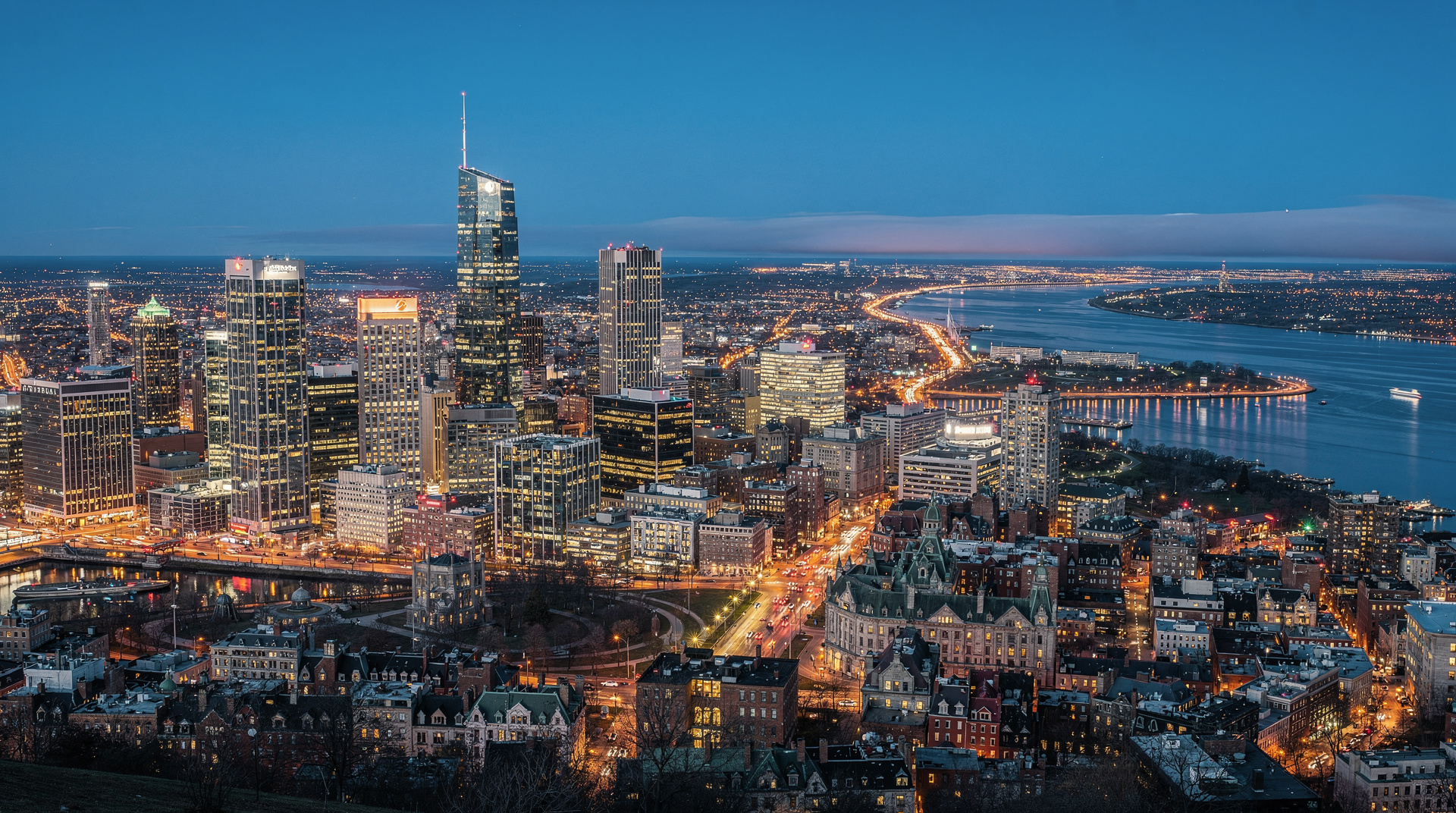
Grand Montréal region overview
Metropolitan Montreal and its surroundings: Old Montreal, Plateau, Mile End, Mount Royal, the Old Port, Quartier Latin, Quartier des Spectacles, and Laval.
Hop-On Hop-Off Double-Decker Bus Tour
Duration: 1.5 hours
Quick facts
- Population
- ~4.3 million (metro area), Canada's 2nd largest city
- Official language
- French (de facto bilingual in most tourist areas)
- Airport
- Montréal-Trudeau (YUL), 20 km west of downtown
- Distance from Quebec City
- 250 km southwest, ~3h by car or Via Rail
- Key summer festival
- Festival international de jazz de Montréal (late June-early July)
What’s in this region
Grand Montréal is the most urbanised region in Quebec, centred on Canada’s second-largest city and extending to the Island of Laval to the north, the South Shore municipalities (Longueuil, Brossard), and the expanding suburbs in all directions. For visitors, the action is concentrated on the Island of Montréal itself, which can be navigated almost entirely by metro and on foot.
What distinguishes Montreal from other North American cities is a combination of factors that rarely coexist: a genuinely Francophone urban culture (70% French-speaking, with English widely used), one of the world’s best festival calendars, a food scene that punches well above its population weight, and a density of distinct neighbourhoods — each with its own character — accessible on a metro system that costs 3.75 CAD per ride.
A first visit of 4-5 days gives you a solid overview. A second visit can explore neighbourhoods — Rosemont, Verdun, Saint-Henri — that the first visit doesn’t reach.
| Where | Island of Montréal plus Laval and the South Shore, southwestern Quebec |
| Cost | Metro 3.75 CAD/ride; Bixi day pass ~20 CAD; museums 15–25 CAD |
| Time needed | 4–5 days for a solid first overview |
| Getting there | Fly into YUL, or Via Rail from Quebec City (~3h) or Ottawa (~2h) |
| Best time | Year-round; summer for festivals, October for foliage, January for Igloofest |
For an easy first-day orientation, a hop-on hop-off bus tour covers the major districts below in a single loop — a practical way to get your bearings before choosing which neighbourhoods to explore on foot.
Montreal hop-on hop-off double-decker bus tour
GYG ↗Neighbourhood comparison at a glance
| Neighbourhood | Character | Best for |
|---|---|---|
| Old Montreal | 19th-century stone streets, historic churches | First-time visitors, photography, waterfront dining |
| Plateau Mont-Royal | Victorian duplexes, terrasses, murals | ”Real Montreal” atmosphere, café culture |
| Mile End | Bagel bakeries, boutique galleries | Foodies, a quieter creative-district feel |
| Quartier des Spectacles | Concert halls, festival plazas | Evening culture, free outdoor festival programming |
| Quartier Latin / Village | Student bistros, LGBTQ+ nightlife | Nightlife, Pride season, independent bookshops |
Top destinations in the Grand Montréal region
Montreal (the city itself)
Montreal is the overview page covering the full city: neighbourhoods, logistics, orientation, when to visit, and how the different districts fit together. Start here before reading the sub-area pages.
Old Montreal (Vieux-Montréal)
Old Montreal is the historic district: Place d’Armes, the Notre-Dame Basilica, Rue Saint-Paul (the oldest commercial street in the city), Marché Bonsecours, and the cobblestone streets around Place Jacques-Cartier. The architecture is predominantly 19th-century commercial — grey stone warehouses and bank buildings that have been converted to restaurants, galleries, and hotels. It is beautiful, genuinely historic, and at peak season genuinely crowded. Plan 1-2 days.
Old Port of Montreal
The Old Port of Montreal occupies the riverfront south of Old Montreal: electric boat rentals, jet boating on the Lachine Rapids, the Science Centre, the AURA light show at Notre-Dame Basilica, and 2.5 km of promenade along the St. Lawrence. Best in summer (May-October) but open year-round.
Plateau Mont-Royal and Mile End
Plateau Mont-Royal and Mile End is the neighbourhood that travel writers most often identify as the “real Montreal” — a claim that has some truth and some tourism-industry inflation behind it. The Plateau is dense with cafés, terrasse restaurants, Victorian duplexes with external staircases, street murals, and a 24-hour energy that comes from a mixed population of students, artists, families, and tech workers. Rue Saint-Denis and Rue Mont-Royal are the main axes; Mile End (roughly north of Fairmount Ave) has the legendary bagel bakeries (St-Viateur, Fairmount) and the boutique gallery scene. Half-day to full day.
Mount Royal and Outremont
Mount Royal is the 234-metre hill that sits above the city and gives it its name. The Parc du Mont-Royal was designed by Frederick Law Olmsted (who also designed Central Park); the Kondiaronk Belvedere lookout at the chalet has the best panoramic view of the Montreal skyline. Accessible by foot from Plateau Mont-Royal (30 min uphill) or by electric fat-tire bike. The western slope descends into Outremont, a predominantly Francophone and historically upper-middle-class neighbourhood with exceptional patisseries and quiet streets.
Quartier Latin and Gay Village
The Quartier Latin is Montreal’s student and arts district: Carré Saint-Louis, Rue Saint-Denis bistros, independent bookshops, and the Grande Bibliothèque. Immediately east, the Gay Village (same page) extends along Rue Sainte-Catherine Est, with the famous pedestrianised summer installation, year-round nightlife, and the annual Fierté Montréal Pride festival in August.
Quartier des Spectacles
The Quartier des Spectacles is Montreal’s designated cultural district — Place des Arts, the Maison Symphonique, and the outdoor stages and plazas that host the Festival international de jazz de Montréal, Just for Laughs, the Francofolies, Igloofest, and Mutek. Much of the outdoor festival programming is free to attend. This is the area for evening cultural experiences year-round.
Suggested itineraries for the region
3 days (essential Montreal)
- Day 1: Old Montreal (Notre-Dame Basilica, Place Jacques-Cartier, Rue Saint-Paul), Old Port afternoon (electric boat or promenade), dinner near the port
- Day 2: Plateau Mont-Royal (Rue Mont-Royal market, Saint-Denis cafés, Carré Saint-Louis), Mount Royal viewpoint by late afternoon
- Day 3: Mile End (bagels at St-Viateur before 8h, Jean-Talon Market, murals on Rue Duluth), Quartier des Spectacles evening if there’s a festival
4-5 days (deeper coverage)
- Days 1-3 as above
- Day 4: Montreal Museum of Fine Arts (MMFA, free permanent collection Wednesday evenings), Westmount neighbourhood, bike ride along Canal Lachine to Atwater Market
- Day 5: Quartier Latin exploration, Notre-Dame-de-Grâce (NDG) neighbourhood, or a half-day trip to Laval for the Cosmodome
When to visit Montreal
Summer (June-August): the city comes fully alive. The Festival international de jazz (late June-early July), Just for Laughs (mid-July), and Nuits d’Afrique (mid-July) stack on top of each other, filling the Quartier des Spectacles with free outdoor performances. Terrasses open citywide. July is genuinely hot (25-30°C); humidity is manageable compared to Toronto. Book accommodation early in June/July — the city fills during festival weeks.
Autumn (September-October): underrated and often the best time. Temperatures fall to 10-20°C, crowds thin after Labour Day, and the trees on Mount Royal and in the Plateau turn gold and red through October. The Formula E race (when it returns) and fall film festival programming add energy without summer-level crowds.
Winter (November-March): Montreal’s winters are serious (-15 to -25°C at peak, January-February). The underground city (RÉSO) connects 33 km of underground pedestrian tunnels connecting the metro to major buildings — genuinely useful infrastructure, not a tourist attraction in itself. Igloofest (outdoor electronic music festival, Old Port) runs four weekends in January-February, demonstrating that Montréalers take winter seriously in a positive direction. Accommodation rates drop significantly from October through April.
Spring (April-May): the mud season between winter and terrasse culture. Less compelling unless you are timing it for sugar shack season (March-April; see the sugar shack guide).
Getting to and around Montreal
By air: YUL (Montréal-Trudeau) receives direct flights from most major European, US, and Canadian cities. The 747 bus (7.50 CAD) runs express from the airport to Berri-UQAM metro; a taxi costs 45-60 CAD fixed rate to downtown. No rail connection from YUL to downtown.
By train: Via Rail connects Montreal (Gare Centrale) to Quebec City (~3h, multiple daily), Toronto (~5h30), and Ottawa (~2h). Gare Centrale is downtown and connected directly to the metro.
By car: Autoroute 20 from the east (Quebec City, Eastern Townships), Autoroute 40 from the west (Ottawa, Toronto), Autoroute 15 from the south (Vermont, New York). Downtown Montreal has expensive and scarce parking; a car is not useful for central tourist activities and adds cost. Rent a car only when you are leaving the city for regional destinations.
Metro: four lines, frequent service (5-minute intervals peak), 3.75 CAD single ride. The STM app shows real-time arrivals. The metro reaches most tourist destinations: Old Montreal (Square-Victoria-OACI or Champ-de-Mars), Plateau (Mont-Royal), Mile End (Laurier), Olympic Stadium (Pie-IX). Note: the metro does not go to the Old Port directly; it requires a 10-15 minute walk south from the nearest stations.
Bixi (bike-sharing): 750 stations citywide. Day pass (20 CAD) or single rides (3.50 CAD). One of the best urban cycling networks in North America; the Canal Lachine and the Route Verte paths in the city are excellent.
Laval and the suburbs
Laval (just north of the Island of Montréal, connected by bridge) is the third-largest city in Quebec and predominantly residential. For visitors, two attractions are worth noting: the Cosmodome (space science museum, Laval; entry ~20 CAD, good for families) and the Centropolis shopping-entertainment complex. Neither justifies a dedicated trip from the city if you’re on a limited schedule.
The South Shore (Longueuil, Brossard, Saint-Lambert) has the Samuel-De Champlain Bridge as its most scenic feature; the bike path across it connects the south shore cycling network to Montreal. The South Shore suburbs are largely residential and commuter-oriented.
Food in Montreal: an overview
Montreal’s reputation for food is not tourism marketing — it holds up. The two rival bagel bakeries, St-Viateur and Fairmount, both in Mile End, produce a wood-fired bagel that is genuinely different from a New York bagel (smaller, sweeter, denser); the debate over which is better is a permanent local sport. Smoked meat at Schwartz’s on Boulevard Saint-Laurent remains the reference despite decades of competitors trying to unseat it.
Poutine, in its countless variations, ranges from gas-station quality to genuinely elevated versions at sit-down restaurants. For a structured approach rather than wandering, see the where to eat in Montreal guide, the smoked meat guide, and the bagel blind taste test for the St-Viateur-versus-Fairmount debate specifically.
If a guided introduction appeals more than self-navigating, a food walking tour covers several of these stops with a local guide in a few hours.
Best-of-Montreal food walking tour
GYG ↗Connecting with other regions
Montreal is the natural starting point for most Quebec itineraries:
- Northeast to Quebec City: 250 km, ~3h by car or Via Rail
- North to the Laurentides: Mont-Tremblant 130 km, ~1h30. Laurentides overview.
- East to the Eastern Townships: Magog 130 km, ~1h30. Eastern Townships overview.
- South to Montérégie: Saint-Jean-sur-Richelieu 45 km, ~45 min.
For multi-region itineraries, see the 5-day Montreal + Quebec City itinerary and the 7-day Quebec loop with Tremblant.