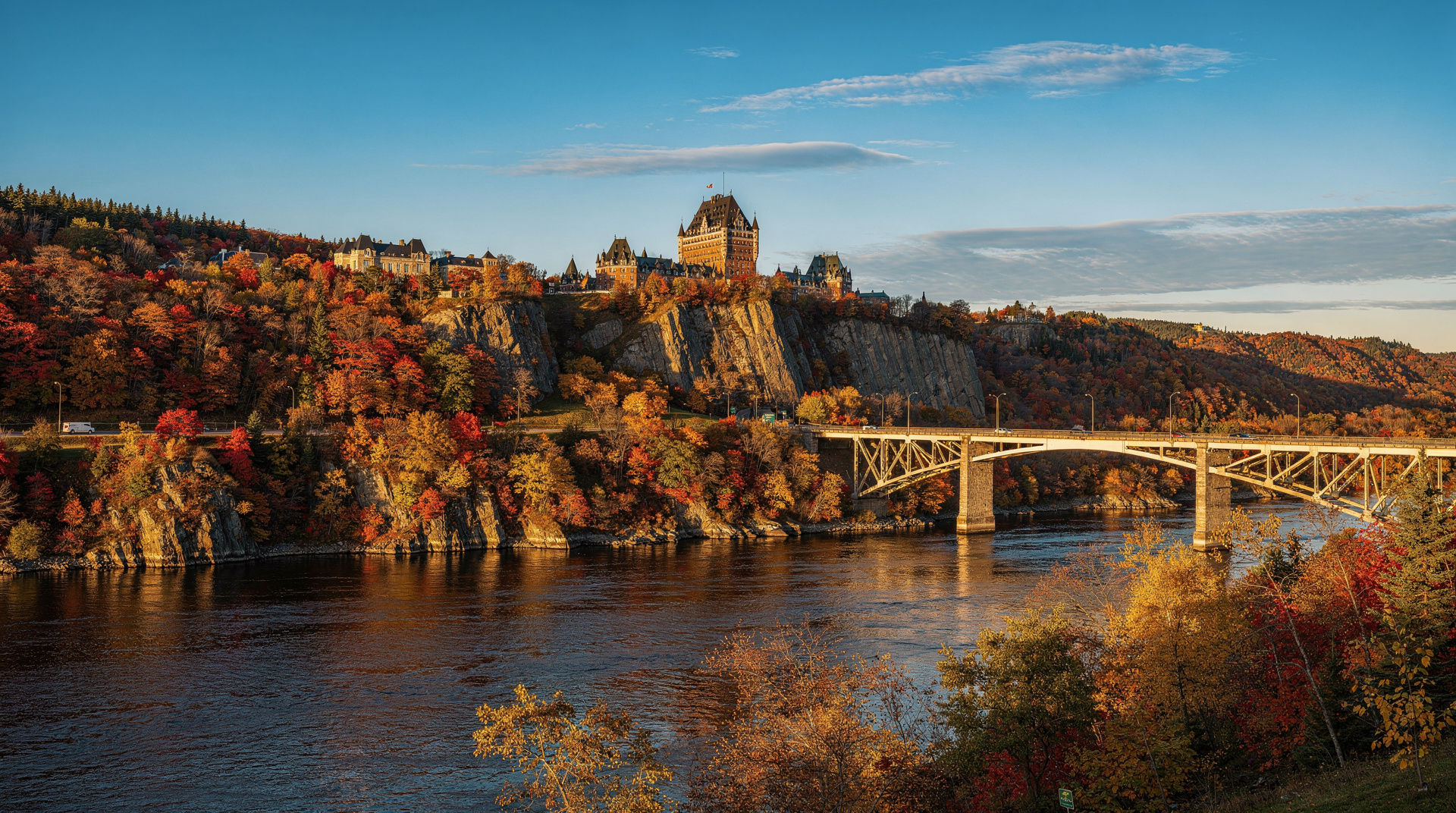
Capitale-Nationale region overview
Quebec's historic capital region: Quebec City, Île d'Orléans, Côte-de-Beaupré, Montmorency Falls, Wendake, and the Portneuf countryside.
Old Quebec City: Grand Walking Tour
Duration: 2 hours
Quick facts
- Regional capital
- Quebec City (population ~800 000 metro)
- Distance from Montreal
- 250 km northeast, ~3h by car or Via Rail
- UNESCO site
- Old Quebec (Vieux-Québec), designated 1985
- Key winter event
- Carnaval de Québec (late January-mid February)
- Key summer event
- Festival d'été de Québec (mid-July, 11 days)
What’s in this region
The Capitale-Nationale is one of Quebec’s most geographically compact yet historically dense regions. Within a 60-km radius of Quebec City, you have: a UNESCO World Heritage city with the only fortified city walls in North America north of Mexico; an island in the St. Lawrence River whose farms have fed the city for 400 years; one of the most dramatic waterfalls in eastern Canada; a First Nations community with a long-established cultural tourism programme; and a royal road (the Chemin du Roy) along the north shore that predates Confederation.
| Where | Around Quebec City, within a ~60 km radius |
| Time needed | 3 days minimum, 5+ days for full coverage |
| Getting there | Via Rail or car from Montreal (~3h); rental car for the outlying sites |
| Cost | Most sites 10–35 CAD; region overall mid-range |
| Best time | Year-round — winter for Carnaval, summer for Île d’Orléans, fall for foliage |
This is not a region you rush through. It rewards time. Five days gives you depth; three days is the minimum for anything beyond Quebec City itself.
Top destinations in the Capitale-Nationale
Quebec City
The centrepiece and the reason most visitors come to this region. Quebec City is the only walled city in North America north of Mexico, with a Lower Town (Basse-Ville) and Upper Town (Haute-Ville) separated by a cliff and connected by funicular. The Old City (Vieux-Québec) is the UNESCO-listed core; surrounding it are neighbourhoods like Saint-Roch, Limoilou, and Montcalm that contain the real day-to-day life of the city. Plan a minimum of 3-4 days for Quebec City alone.
Old Quebec (Vieux-Québec)
Old Quebec is the UNESCO-designated historic district — the walled city, the Plains of Abraham, the Château Frontenac, the Citadelle, and the narrow streets of Petit-Champlain. It is one of the most intensively visited historic districts in Canada and simultaneously one of the most genuinely atmospheric. The challenge is managing the tourist infrastructure (which is real and unavoidable in summer) while still accessing the history underneath it. Our guide gives a candid assessment. A guided walking tour is the fastest way to make sense of the layout on a first visit.
Old Quebec grand walking tour, 2 hoursGYG ↗Petit-Champlain and Lower Town
Petit-Champlain is the oldest commercial district in North America, at the base of the cliff below the Château Frontenac. The funicular connects the two levels; Rue du Petit-Champlain is narrow, photogenic, and dense with craft shops and restaurants — some genuinely excellent, some tourist-priced. The adjacent Place Royale is where Champlain founded New France in 1608.
Île d’Orléans
Île d’Orléans sits in the St. Lawrence 15 km east of Quebec City, connected by bridge. Jacques Cartier called it l’Île de Bacchus when he arrived in 1535 — the wild grapes he found gave way to the orchards, strawberry fields, and artisan producers that still define the island today. A 67-km circuit road circles the island; cycling it (with e-bike rental from Saint-Pierre) is one of the better half-day options in the region. Best visited June through October.
Côte-de-Beaupré and Montmorency Falls
The Côte-de-Beaupré corridor runs 40 km northeast of Quebec City along the north shore of the St. Lawrence, culminating at Sainte-Anne-de-Beaupré (a major pilgrimage basilica). The first stop is Montmorency Falls — a waterfall 30 metres higher than Niagara Falls (83 m), 11 km from Quebec City, with cable car access, ziplines across the face, and a suspension bridge above the crest. Day trips from Quebec City cost 25-35 CAD with cable car; the site is open year-round (spectacular frozen waterfall formation in winter).
Upper Town, Citadelle, and Château Frontenac
Quebec City’s Upper Town holds the most recognisable landmarks: the Château Frontenac (opened 1893, still a working Fairmont hotel), the Citadelle de Québec (an active military fort with a changing of the guard from late June to early September), and the Terrasse Dufferin promenade with its panoramic view over the river. The Observatoire de la Capitale (in the Marie-Guyart Building, 31st floor) offers a free-to-minimal-cost alternative to helicopter tours for views.
Wendake (Huron-Wendat Nation)
Wendake is the reserve territory of the Huron-Wendat Nation, 15 km northwest of Quebec City. It has the most developed Indigenous cultural tourism programme in the Capitale-Nationale region: guided e-bike tours, a traditional longhouse, a hotel (Hôtel-Musée Premières Nations, 200-350 CAD/night), and cultural interpreters who explain Huron-Wendat history and contemporary life. It is a short and easy detour from Quebec City that most visitors miss.
Wendake Huron-Wendat guided e-bike tourGYG ↗Choosing between the region’s four “must-do” half-days
If you only have one extra half-day beyond Old Quebec itself, the choice usually comes down to these four options:
| Option | Distance | Best for | Around |
|---|---|---|---|
| Montmorency Falls + cable car | 11 km | Dramatic scenery, easy access | 25–35 CAD |
| Île d’Orléans e-bike circuit | 15 km | Food, farms, slower pace | 60–90 CAD |
| Wendake cultural tour | 15 km | Indigenous history, low crowds | 50–70 CAD |
| Canyon Sainte-Anne + Côte-de-Beaupré | 45 km | Hiking, suspension bridges | 20–30 CAD entry |
Families with young children usually do best at Montmorency (short, visually dramatic, minimal walking required). Travellers who want a slower, food-focused afternoon should pick Île d’Orléans. Those who have already done Montmorency on a previous trip should prioritise Wendake or Canyon Sainte-Anne, both of which see far fewer visitors.
Suggested itineraries for the region
3 days (Quebec City focused)
- Day 1: Old Quebec walking tour (Lower Town, Place Royale, Petit-Champlain, funicular to Upper Town)
- Day 2: Château Frontenac area (Citadelle, Terrasse Dufferin, Plains of Abraham), Saint-Roch neighbourhood for dinner
- Day 3: Montmorency Falls half-day (cable car + suspension bridge), afternoon in Saint-Jean quarter
5 days (region coverage)
- Day 1-3: Quebec City as above
- Day 4: Île d’Orléans full day (e-bike circuit, farm stands, cider producers)
- Day 5: Wendake morning (Huron-Wendat cultural tour), Côte-de-Beaupré afternoon (Sainte-Anne-de-Beaupré Basilica, Canyon Sainte-Anne)
7 days (extended with day trips)
- Days 1-5 as above
- Day 6: Day trip east toward Charlevoix — Baie-Saint-Paul (~1h30 from Quebec City) for galleries and the Gouffre River
- Day 7: Portneuf region (Deschambault-Grondines village, Route du Fleuve cycling)
When to visit
Winter (January-February): the Capitale-Nationale is at its most cinematically itself in winter. Snow, the walled city, the Carnaval de Québec (10 days, late January-mid February), and the Hôtel de Glace (January-March at Valcartier, 20 km north of Quebec City). The Carnaval is genuinely fun for families and couples; the ice sculptures, night parades, and outdoor events are unique. Book accommodation 6-8 weeks ahead for Carnaval weekends.
Spring (April-May): transition season, quieter, lower prices. The Saint Lawrence ice moves out in April; the river views from the Terrasse Dufferin in early May, with the last ice floes passing, are among the most striking in the region.
Summer (June-August): peak tourist season. The Festival d’été de Québec (mid-July, 11 days) draws 3 million visits to shows across the city, with major international headliners. Île d’Orléans strawberry season runs late June through July. Streets in Old Quebec can be crowded; arrive early for popular sites.
Autumn (September-mid October): arguably the best time for the region. Cooler temperatures, thinning crowds after Labour Day, Île d’Orléans harvest season (apples, squash, cider), and foliage in the Portneuf hills west of Quebec City peaking around the first week of October.
How to get around
Quebec City’s Old City is walkable for most of its key sites. However, reaching Île d’Orléans, Wendake, Montmorency Falls, or the Côte-de-Beaupré requires either a car or an organised tour. No dedicated transit serves these areas from the city.
Rental car: essential for more than 3 days in the region. Quebec City airport (YQB) and downtown agencies available.
Tours from Quebec City: various operators run half-day and full-day tours to Montmorency + Île d’Orléans (around 60-80 CAD). Practical if you don’t want to drive. See the Quebec City day trips guide for options.
Via Rail: Montréal to Quebec City (Quebec Central station, 250 km, ~3h, multiple daily departures, from 55 CAD booked in advance). No rail service to outlying parts of the region.
How the Capitale-Nationale connects to other regions
Quebec City is the natural pivot between two itinerary patterns:
- West to Montréal: the Autoroute 20 or 40 corridor (~3h), stopping optionally in Centre-du-Québec at Drummondville.
- East toward Charlevoix and Tadoussac: Charlevoix begins 100 km east of Quebec City at Baie-Saint-Paul, reachable in ~1h30. The whale-watching hub of Tadoussac is another 90 minutes beyond.
The Quebec City to Charlevoix day trip guide and Quebec City to Tadoussac guide cover these connections in detail.
For the multi-region Quebec itinerary, see the 7-day Quebec loop and 10-day grand tour.
Frequently asked questions about Capitale-Nationale region overview
Is 3 days enough for the Capitale-Nationale?
Three days is enough for Old Quebec itself — the walled city, Petit-Champlain, the Citadelle — but it means skipping Île d’Orléans, Wendake, and Côte-de-Beaupré entirely. If any of those interest you, plan for 5 days so you have at least one full day for the outlying sites without rushing Quebec City.
Do I need a car for this region?
Not for Quebec City’s Old City, which is entirely walkable. You do need a car (or an organised tour) to reach Île d’Orléans, Montmorency Falls, Wendake, or the Côte-de-Beaupré — none of these are served by regular transit from downtown.